| |
| Thursday, 07 May 2026 |
| The Arts Society Wokingham spreads its love of learning |
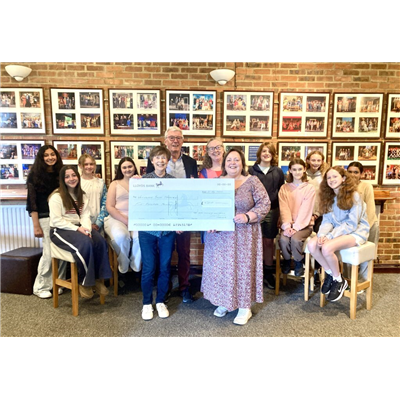 |
A Wokingham group that loves learning has shown its support for young people’s education by donating a gift to Wokingham Youth Theatre. David Canning and Anne Haycocks from The Arts Society Wokingham met Wokingham Youth Theatre director Diane Hogg and Wokingham Theatre chair Claire Lawrence in the theatre foyer. And because they arrived on a Thursday evening, they were able to meet some of the young people about to start their Wokingham Youth Theatre Intermediate class. The society gifted a cheque for £500, will be used to support less advantaged youngsters who would otherwise be unable to access youth theatre sessions. David Canning said: “At our meetings adults are able to enjoy learning through the lectures we provide.But we also like to contribute to the community at large, and especially look for ways to support children in education. So it’s a great pleasure to be able to support Wokingham Youth Theatre which provides learning opportunities for young people.” Anne Haycocks is passionate about children’s arts education, and is keenly involved with WASMA, which gives youngsters an opportunity to perform annually at The Hexagon Theatre. She said: “We’ve contributed money this year to four local primary schools and two secondary schools already, to support a variety of dance, drama, theatre and photography projects across the arts. So when we were thinking about another local youth group to support, I remembered how I myself had once benefited from being a member of a youth theatre group in Bristol. Donating to Wokingham Youth Theatre seemed to be an inspired choice.” Diane Hogg said: “We’re very grateful to The Arts Society Wokingham. “With this gift we will be able to support youngsters with a desire to learn, who might not otherwise have that opportunity to benefit from our drama classes.” Wokingham Youth Theatre classes enable young people to practice improvisational decision-making, and to come up with creative ideas and stories.And through the fun (and challenges) of drama, they learn to trust each and to recognise that everyone’s contribution has value. Weekly classes during term times lead to showcase performances at Christmas and in the summer, and a major production for senior students in February half term – all on the theatre’s main stage. The Arts Society Wokingham meets monthly to hear from knowledgeable and entertaining experts about all aspects of the arts, including; painting, sculpture, literature, theatre and the art and culture of ancient civilisations. Its members meet on the third Monday of every month (except August and December) at King’s Academy, Binfield. For information, visit: wokinghamtheatre.org.uk and theartssocietywokingham.org.uk Emma Merchant |
|
| Tuesday, 03 February 2026 |
| The Arts Society Wokingham Gives Back |
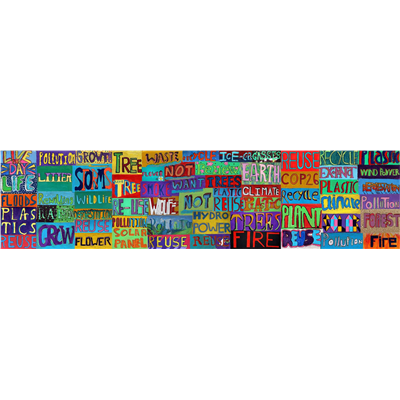 |
Since its inception we have been involved in community arts projects which make a difference to young lives. Past projects include supporting pupils from Bulmershe School to go to Edinburgh to premier their play, ‘The Emperor’s Fool’ at the Fringe. We also funded High Close pupils to work with a local potter to create a tree mural to adorn their school wall. More recently we have formed partnerships with Foundry College, St Crispin’s and Maiden Erlegh schools. At these schools our funding has been spent on a mosaic wall memorial, performing arts, pottery and photographic equipment as well as supporting individual pupils with music lessons. This year we are continuing to work with St Crispin’s and Maiden Erlegh secondary schools but also widening our support to include local primary schools. The schools were all contacted and invited to bid for funding for this year. We received seven applications which have been shortlisted down to four. Each of these has been awarded £500, to fund the following projects: At Floreat Montague Park, an African drumming workshop will celebrate Black History Month. Farley Hill is able to provide additional art resources for an after-school club and/or pay for a visit from a local artist. We will support music tuition for 64 pupils at Hawthorns Primary, and we will also help Earley St Peter’s School to develop an outdoor music area accessible to all children. |
|
| Wednesday, 06 November 2024 |
| Vincent van Gogh and Leonardo da Vinci raise money for local charity |
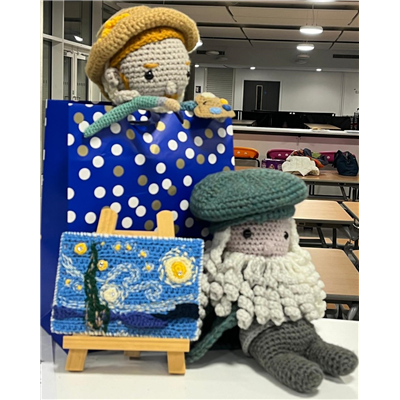 |
Several months ago the Arts Society Wokingham approached Gaynor White, the leader of Barkham Hookers, to ask whether her group could create a post box topper to celebrate their 10th Anniversary. Gaynor and her group set to work and crocheted a beautiful topper which adorned the double post box outside the old Wokingham post office this summer. It featured Vincent van Gogh and his Starry Night painting and also Leonardo da Vinci resplendent with a long curly grey beard Gaynor kindly donated the figures for the Society to raffle at their October lecture in aid of her chosen charity, First Days. £200 was raised and has been donated to the First Days Christmas Appeal This appeal will ensure that children do not miss out on special festive activities and can experience the joy of Christmas by visiting their magical Christmas Grotto. Here they can talk to Santa and take part in Christmas crafts while their families chose from a large range of gifts that their children can open on Christmas morning. |
|
| Monday, 22 July 2024 |
| The Arts Society Wokingham Celebrates its 10th Anniversary |
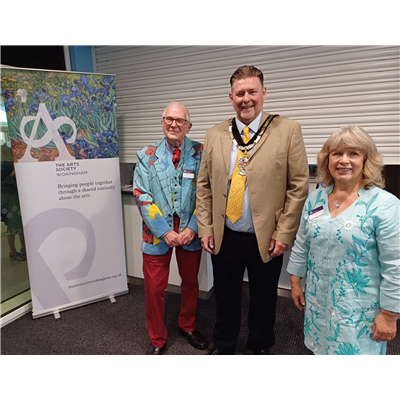 |
The Arts Society Wokingham celebrates its 10th Anniversary in Roman style More than 50 guests joined members at King's Academy to socialise and enjoy drinks and nibbles before Councillor Adrian Mather, the Mayor of Wokingham Borough, cut the ceremonial cake. He congratulated the Society on enriching the cultural life of the Borough over the past 10yrs. As the rain battered the windows, he recalled a quote made by the Roman general, Agricola, who described the British climate as 'wretched, with its frequent rains and mists'. The audience was then treated to a fascinating illustrated talk entitled 'The Golden Age of Roman Art' by Dr Paul Robert, the Head of Antiquities at the Ashmolean. Paul traced the chequered history of the 'eternal city'. Despite the civil unrest during the reigns of the Roman Emperors, art flourished. Eventually the Empire fell apart. The Visigoths sacked Rome in the fourth century AD damaging and destroying many imperial buildings, statues and mosaics. Mussolini’s attempts at redesigning Rome in the 1930s caused further destruction. Even so, much of Rome’s former glory can still be seen today. As one member commented, ‘An extremely informative and interesting talk which brought back memories of our visit to Rome last year. We realise we need to go back.’ Paul’s informative and humorous talk rounded off a memorable evening: a fitting conclusion to 10 years of enjoying the arts. |
|
| Thursday, 23 May 2024 |
| The Arts Society Wokingham achieves charitable status |
 |
The Arts Society Wokingham achieves charitable status Registered Charity No. 1207877 We are delighted to have achieved charitable status recently, thanks to the diligence of our Treasurer, David Canning, who led the application. Becoming a charity was a key part of our plan to improve our financial sustainability as a Society and reinforces the charitable work we have been doing for many years with young people and local schools. In accordance with the resolution at our EGM in April 2023 we have had to make some minor changes to our Constitution where required by the Charity Commissioners. The revised Constitution is now available on our website (click this link). Our membership fees for the next season will now be able to attract gift aid funding and members will be able to claim Gift Aid on the full membership fee. |
|
| Thursday, 16 May 2024 |
| Review of April lecture - 'Cinema from the Rubble: the post-war politics of Ealing Studios' |
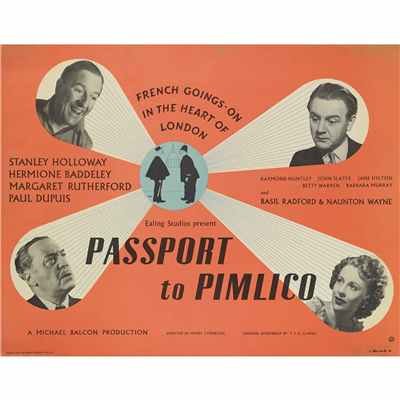 |
Despite frustrating train delays, an unruffled Benedict Morrison eventually breezed into King’s Academy and led members and guests of the Arts Society Wokingham on a thoroughly enjoyable romp through British post-war cinema. His lively illustrated talk, entitled ‘Cinema from the Rubble: the post-war politics of Ealing Studios’, was not just a cosy look at the actors and stories of these nostalgic films. Benedict put forward the challenging but well researched theory that these comedies encapsulated the energy of the post-war period whilst also being subversive and mildly anarchistic. While Italian filmmakers, like Rossellini, were producing dark neorealist films focusing on the tragedy of war such as ‘Germania Anno Zero’, Ealing Studios tapped into the British people’s optimism and sense of fun and improvisation in the face of post-war austerity. Benedict treated his audience to a short clip from the start of ‘Passport to Pimlico’ when a meeting of the local Planning committee, who are rejecting the residents’ plan for the redevelopment of a nearby bomb site, is interrupted by an undiscovered bomb exploding in the middle of the site. The resulting discovery of evidence that Pimlico was actually a part of Burgundy and therefore except from rationing is a fine example of the residents’ collaboration and improvisation heavily laced with a degree of transgressive joy. Benedict ended with a clip from the ‘Lavender Hill Mob’: which he described as the ultimate Ealing comedy. This featured the famous scene towards the end of the film when the two protagonists, Alec Guinness and Stanley Holloway, race down the Eifel Tower to try and retrieve the real gold miniatures bought by the party of school girls. This was an exhilarating end to a most entertaining and thought provoking evening. All the Arts Society Wokingham lecturers are accredited and entertaining speakers and Benedict was certainly no exception. As one member said, ‘What an extremely entertaining man. So knowledgeable, confident and amusing. This was a lecture with a difference’. The Society’s next illustrated talk, entitled ‘The Rise of Modern British Sculpture’ will be held on 20th May at 7.30pm at King’s Academy, Binfield. Guests are always most welcome so why not come along and find out how and why 20th century British sculptors played a pioneering role which affected sculpture throughout the world. Please email memsectheartssocietywham@gmail.com to register your interest.
The talk will also be live streamed and available to watch from home on the Society’s own YouTube channel.
For further details please visit the Society’s website www.TheArtsSocietyWokingham.org.uk Sue Bryant |
|
| Saturday, 06 April 2024 |
| The Arts Society Wokingham funds Foundry College Exhibition |
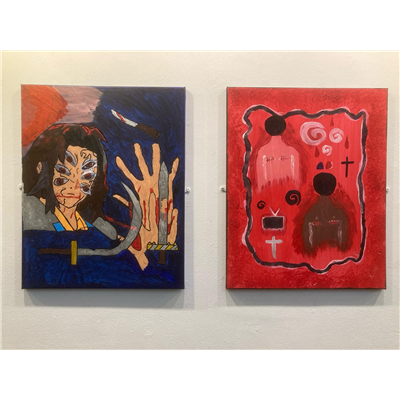 |
Funding from The Arts Society Wokingham has helped students at Foundry College put on an end of year exhibition of art work at South Hill Park. Desiree Collison, Art and Craft Teacher, said, ‘Not only do your kind donations support the student’s art and craft, but it also gives them other valuable life opportunities; team working, improving their communication skills, and building their confidence.’ This year’s exhibition was based on three themes, Foundry Face Off, Lollapalooza Landscapes and The Blast Sessions. The flexibility and freedom of these themes enabled the young people to explore them in any way that they wished (as long as it was appropriate!) with some artists chosen by pupils such as Andy Warhol, Clarissa Rose, Gideon Rubin and Polina Bright. Students experimented with different materials and tools whilst on their individual and sometimes very personal journeys. The end result is some very diverse and thought-provoking pieces of art and craft. Funding for this project came from the Society’s own funds and also a grant from The Arts Society national fund. The Arts Society Wokingham supports its partner schools, Foundry College, Maiden Erlegh School and St Crispin’s School as part of its Young Arts initiative. The Society believes in helping and encouraging young people to expand their horizons and realise their personal potential through involvement in creative arts activities. |
|
| Thursday, 14 March 2024 |
| Clifton Ingram announce principal sponsorship of the Arts Society Wokingham in its anniversary year - press release |
 |
Clifton Ingram Solicitors are pleased to announce that they will be continuing their long running support of the Wokingham Arts Society, as principal sponsors in their 10th anniversary year. Clifton Ingram Partner and Joint Head of Wills and Inheritance, Peter McGeown said that the firm are, “honoured to be the principal sponsors for the Arts Society Wokingham.” He continued by acknowledging the important work of the society saying that it, “provides a high calibre of events and opportunities for the local community to engage with the arts, which as we all know is so important and enriching. I’d like to congratulate the society on an exceptional 10 years, and here’s to many more to come!”. The Arts Society Wokingham is an arts appreciation group and UK-based charity. The local Arts Society branch was set up in 2014 by an enthusiastic committee and now attracts over 200 members. The Arts Society continues to advance art education and appreciation and embraces all aspects of the arts, alongside promoting the preservation of artistic heritage. Vice Chairman Michael Shirley says that he is, “delighted to have once again secured the support of a key firm in the Wokingham community.” He reiterated that “Clifton Ingram have been friends of the society for many years” and that the committee were, “thrilled to work with a team that really understand and appreciate the benefit of the arts to the community of Wokingham.” Clifton Ingram is a full-service law firm serving business and individual clients throughout the South East, from offices centred in Wokingham, Reading and Farnham. With approximately 100 partners and lawyers across the firm, and Wokingham being their largest office, they have local experts to help you when you need it. You can contact them by calling their Wokingham branch on 0118 978 0099, or emailing info@cliftoningram.co.uk. The firm are committed to being active members of the community of Wokingham, with more support for local organisations and charities to be announced through the year, including headline sponsorship of the Wokingham Lions activities across their 50th anniversary year, starting with the May Fayre. |
|
| Friday, 01 March 2024 |
| Review of February 2024 lecture - 'A Yorkshire Textile Renaissance' |
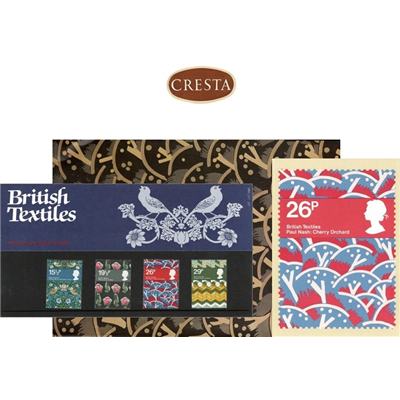 |
Ashley Gray took members and guests of the Arts Society Wokingham from Yorkshire to London via Cornwall and Welwyn Garden City, tracing the development of the modern textile industry. His illustrated talk featured Alec Walker a painter from a Yorkshire family of textile manufacturers and Tom Heron, an entrepreneurial business man from Leeds. In 1912, Alec’s father gave him a derelict old silk mill to quell his desire to travel abroad to develop his artistic talents. Alec transformed the mill and set up Vigil Silk, producing fashionable spot and striped silk based on his own designs. After the First World War he met and married Kay Earle, a Newlyn artist, and moved to Cornwall. Here they set up Cryséde; a small cottage based craft-led industry. They dyed and hand blocked-printed the modern designs created by Alec onto Vigil Silk. Kay designed dress patterns which local girls then hand sewed to create beautiful avant-garde dresses. From such small beginnings Cryséde fashionable garments and lengths of silk became highly sort after. .Alec invited Tom to move to Cornwall to manage the expanding business. A chain of shops and a booming innovative mail-order business sold readymade, made-to-order garments and silk lengths all over the world. But Tom’s ambitions outgrew the Cornish business and in 1929 he and his family moved to Welwyn Garden City where he set up his own business, Cresta Silks. He commissioned the up and coming architect, Wells Coates, to create stylish modern shop front designs incorporating the company’s logo designed by Edward McKnight Kauffer. He commissioned Paul Nash and Graham Sutherland to create textile designs to be hand-block printed onto the fabrics in vibrant colours. These became the hallmark of this very successful business. At the start of the Second World War the government commandeered Cresta silk to make parachutes. However Tom’s business acumen was well-known and he was appointed as Advisor to the Board of Trade where he initiated the Utility Clothing scheme, resulting in the mass production of high-street fashion designed by such well-known names as Hardy Amies and William Hartnell. This was a fascinating tale of two Yorkshire men who transformed the world of fashion and design for all time. The Arts Society organises monthly lectures on all aspects of the arts. The next illustrated talk, entitled ‘Turner vs Constable: the great British paint-off’, will be held on 18th March at 7.30pm at King’s Academy, Binfield. Guests are always most welcome so why not come along and find out who will ultimately be crowned star painter? Please email memsectheartssocietywham@gmail.com to register your interest.
The talk will also be live streamed and available to watch from home on the Society’s own YouTube channel.
For further details please visit the Society’s website www.TheArtsSocietyWokingham.org.uk Sue Bryant |
|
| Wednesday, 20 December 2023 |
| Chair's New Year Letter to members |
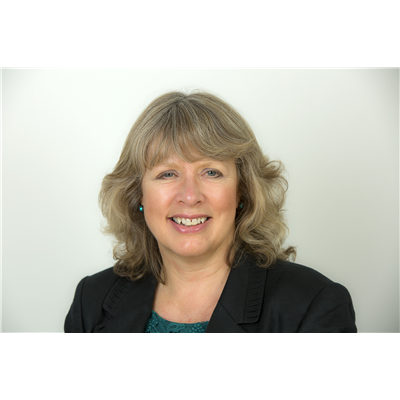 |
Dear Member, I hope you had a peaceful and joyful Christmas with those you love. Our Society has had an excellent programme in 2023 with some fascinating lectures and visits. We now have about 100 members and guests in the hall at Kings Academy and around 50 people watching on line. There is no doubt though that the experience “in the room” is still a great one, with the ability to meet up with friends and share the experience. We are keen to keep our lectures both online and in person, where we can. Thanks to Robin Cops for choosing some great speakers and to Quentin Clark for our technical support. Your views on each lecture are studied carefully by your committee and we have had a consistently high level of scores over the last year. Let’s hope next year’s lectures are even better. We now have 200 members in our society and are keen to recruit more so please do bring along your friends to enjoy our lectures. We have an amazing Committee working behind the scenes to ensure our Society runs smoothly and we are all indebted to them for their support. If you would like to join us, please let me know, chairtheartssocietywham@gmail.com Our wider programme of events has seen some excellent visits to Dulwich Picture Gallery, Royal Holloway College, Marble Hill House, Coal Drops Yard at Kings Cross and Cumberland Lodge in Windsor Great Park. It was a privilege to have a peek behind the scenes in these places, which is not normally possible. Our thanks go to Margaret Campbell-White for arranging a great programme. We are very much looking forward to the Westminster Abbey visit in February. Elaine Hayes arranged some excellent special interest days this year: The Forensic Eye, Australian Art, The Culture of the Huguenots and the fascinating Trees in Art. Elaine is well underway with planning for another special interest day in April 2024. Our Young Arts team of Kete Ellison-Bourne and Tim Lloyd, have been busy supporting projects at St Crispin’s School (theatre trips, art gallery visits, sheet music, Digital Theatre + subscription, singing lessons and instrument lessons) and Maiden Erlegh School (to re-develop an unloved pond area as a space to sit outside making it a colourful environment). 2024 is a milestone year for our Society as it is our 10 Year Anniversary. We hope to make the lecture on 15th July a particularly special and enjoyable one with a celebration and also have other commemorative events leading up to that date. We are very much looking forward to our first lecture at 7.45pm on Monday 15 January 2024 at Kings Academy School Binfield, where we will enjoy 'The Classical Re-invented - the brilliant legacy of Sir Christopher Wren' by Ian Swankie. I look forward to seeing you there either in person or on line. Finally, I would like to wish you a very Happy New Year for 2024, With very best wishes, Alison Sanders - Chair, The Arts Society Wokingham |
|
| Wednesday, 20 December 2023 |
| Memories of Judy Tomlin - First Chair of the Arts Society Wokingham |
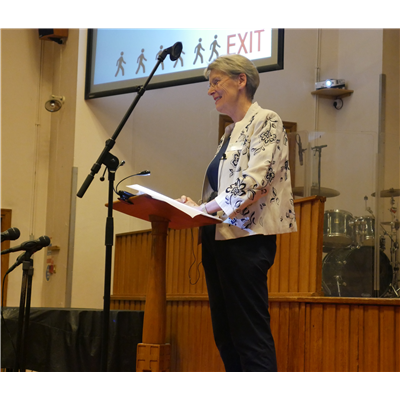 |
We are very sad to have to tell you that Judy has recently died after a period of illness. Many of you will know Judy as the driving force behind the establishment of The Arts Society Wokingham and its first Chair. We wanted to share a few thoughts and recollections about this special woman. Michael Shirley 'By 2013 Wokingham was an obvious location to set up a new Society. Permission was given by my New Societies Committee Chairman to start the process of finding a Founder Chairman and forming a Steering Committee. With great good fortune I was contacted by a Henley Society member who recommended Judy as she had recently stepped down from Magistrate duties and had the time and expertise to become our Founder Chairman Judy was very well connected with several people who had a deep interest in the Arts and were prepared to serve on the Steering Committee, they included Robin Cops, Martin Haslem and Tim Burton. There is much to do before a new society opens including finding 150 members but Judy decided that we should aim to open in the spring of 2014 and all requirements were met by the target date. Judy had all the skills to motivate members and committee members. She had a generous personality which was put to good use in establishing our society which makes a full contribution to the Arts in Wokingham. She will be sadly missed by everyone in TAS Wokingham who knew her.' Tim Burton 'There is no doubt that Judy was the instigator, and responsible for the initial success in setting up the society. Her experience as a no-nonsense magistrate must have equipped her well for the firm role she took to marshal the committee. The committee meetings were a model of best practice. No wasted chat; no prevarication; polite debate with final decision made; humour and enthusiasm. We all benefitted from the experience. It’s such a pity that she won’t be celebrating the Society’s 10th anniversary with us, but her Arts Society will live long in her name.' Barbara Stoker 'She was an excellent chair and steered the first committee towards the establishment of a very successful Arts Society.' Jennifer Barnes 'I know how much Judy did in setting up the Society and how much hard work it was; getting people to do things they perhaps didn’t really want to do or things they didn’t know they were able to do! She was the Deputy Manager of the Wokingham Citizens Advice Bureau for many years and the trainer of new volunteers. That is where I met her and worked with her for about 10 years. I think that was why she got in touch with me to help (in a very small way) with setting up the Society.' |
|
| Thursday, 16 November 2023 |
| Article in wokingham.today November 15th 2023 |
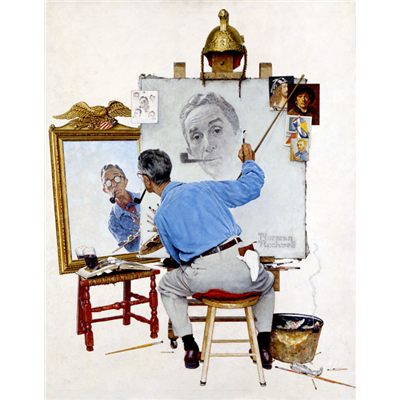 |
From New Mexico, before heading to New York Last month members and guests of the Arts Society Wokingham enjoyed an illustrated talk on the life and art of the prominent American artist Georgia O’Keeffe. A Modernist painter, O’Keeffe is possibly best known for her paintings of beautiful outsized flowers but Lydia Baumann chose to base her lecture more on the painter’s interpretation of the New Mexican landscape.. Lydia took her audience on a journey in the footsteps of the painter, further and further into the desert from Santa Fe to Taos and finally to Abiquiu where she settled. O’Keefe was influenced by the current surrealist interest in skulls. Sun blanched carcasses of cows were often found in the desert and she chose to paint many images of the stark and angular cow’s skulls which she saw as a symbol of the pioneers of the Wild West. The landscape in Abiquiu inspired her to flatten her style of painting leading to a concentration on the line, colour and shape of the mountains, rocks and cliffs in what she called her ’back yard’. She often painted these landscapes from inside her car which explains why the images had to be quite small compared with her large flower paintings which she painted in her studio. In contrast, the Society is moving to urban New York for its next lecture. Norman Rockwell was a prolific painter and illustrator living in New York. He was most famous for his cover illustrations of everyday life which he created for The Saturday Evening Post magazine for over fifty years. They are folksy images of Middle America and have been dismissed for decades by art critics as over-sentimental. But his reputation has soared in recent years as a new generation comes to appreciate his humanity and inventiveness and he is revered by film directors George Lucas and Steven Spielberg for his brilliant storytelling. This illustrated talk by Rupert Dickens will take place at 7.45pm on Monday 20th November at King’s Academy, Binfield. Guests are always welcome but do email memsectheartssocietywham@gmail.com to register beforehand. The talk will also be live streamed and available to watch from home on the society’s own YouTube channel. For further details please visit the Society’s website www.The ArtsSocietyWokingham.org.uk Sue Bryant |
|
| Wednesday, 14 June 2023 |
| Review of May 2023 lecture - 'Arts in 19th Century Venice - poets, painters and private lives' |
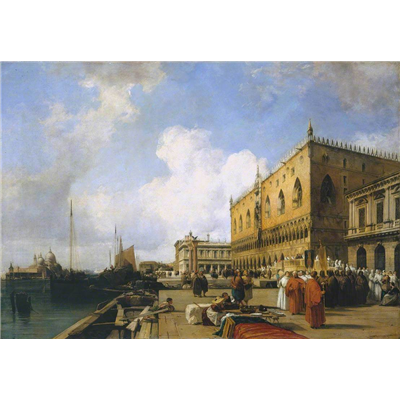 |
A romp through 19th century Venice Douglas Skeggs took members and guests of The Arts Society Wokingham on a whistle- stop tour of 19th century Venice. The Venetian Republic had fallen to Austria and 19th century Venice was bankrupt, no longer an important trading hub between the east and the west. The ending of the Napoleonic Wars meant that travel across Europe could be resumed. The city’s reputation for decadence and promiscuity attracted many artists, poets and writers from Europe. In 1816 Lord Bryon arrived and set up residence in a palace on the Grand Canal where he continued to live a life of debauchery. J. M. W. Turner made several trips to Venice. Whistler, John Singer Sargent and eventually several French Impressionists including Renoir and Monet were all unable to resist the romantic charm of the city and were inspired by its colour and beauty to produce many fine paintings. Douglas also introduced his audience to the work of some lesser-known painters such as Bonington and Clarkson Stanfield. Stanfield’s painting of the ‘Ducal Palace with a Religious Procession’ can be seen above. The artist and writer, Ruskin, was an even more frequent visitor. Inspired by the city’s beauty and fragility he undertook a detailed study of the city’s history, art and particularly its architecture. ‘The Stones of Venice’ was published between 1851 and 1853, running to three volumes. Henry James loved Venice and returned there to stay many times. The city is at the heart of his literary work and is the setting for ‘The Aspen Papers’ and ‘The Wings of a Dove’. These artists and writers created a romantic, idealised vision of Venice and this image remains to this day. Douglas is a superb lecturer who knows his subject well. He talked for an hour without notes, keeping his audience entertained and engaged throughout. As one member of the audience said, ‘An incredible lecturer, so much knowledge delivered in quick fire to keep us on our toes. Extremely interesting with the right degree of sauciness and humour. The time just whizzed by. Another real hit by The Arts Society Wokingham’. The Arts Society Wokingham ‘s next lecture is on Monday 19th June at 7.30pm at King’s Academy, Binfield, when Tyler Butterworth will reveal the pains and pleasures of a career in the theatre, drawing on his personal experiences. Guests are always welcome but do email memsectheartssocietywham@gmail.com to register beforehand. The talk will also be live streamed and available to watch from home on the society’s own YouTube channel. For further details please visit the Society’s website www.The ArtsSocietyWokingham.org.uk Sue Bryant |
|
| Saturday, 29 April 2023 |
| Review of The Cultural Heritage of The Huguenots - Study Day on 26th April 2023 |
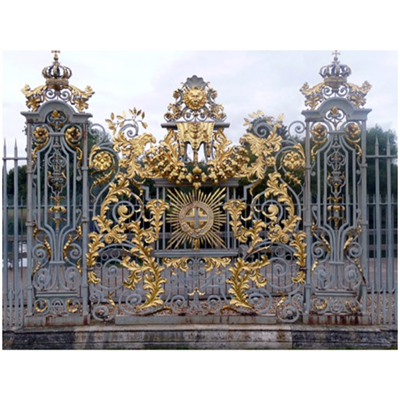 |
The recent study day on the Cultural Heritage of the Huguenots offered wide appreciation of the skills brought to England by Huguenots escaping religious persecution in France, including those of silk weavers, silversmiths, clock makers, opticians, bankers, gilders, ironworkers and horticulturists. Sue Jackson, a Fellow of the Huguenot Society, began by explaining the rags to riches life of the silk weavers who moved to London and settled in Spitalfields. Their fortunes followed those of the court as yards of beautiful silks were woven with floral designs in the latest fashion and made up into the highly impractical mantua style dresses that were in vogue at the time. Moving on, we learnt about other fashions, this time in beverages, and the skilled workmen such as Samuel Courtauld who fashioned beautiful coffee, chocolate and tea pots in which to serve these hugely expensive luxuries. Lunch in the theatre foyer gave members a chance to chat with friends before the last lecture exploring the decline of Spitalfields and its more recent recovery which has restored buildings to their Georgian prime such as the Dennis Severs house in Folgate Street which gives an insight into what life would have been like for a family of Huguenot silk weavers. For those who would like to learn more about this fascinating subject, “Huguenot Heritage - The history and contribution of the Huguenots in Britain” by Robin Gwynn, published by Sussex Academic Press, has been recommended for further reading. Our next study day is Describing a Continent - 50,000 years of Australian Art by Georgina Bexon on Friday 30th June 2023 also at the Wokingham Theatre and booking opens on 2nd May 2023. Elaine Hayes |
|
| Saturday, 01 April 2023 |
| Review of March 20th 2023 lecture - 'Sorolla - Painter of Light' |
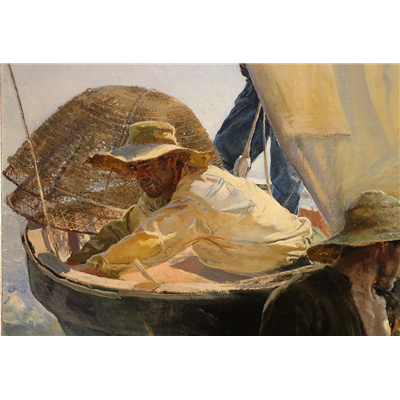 |
Arts Society Wokingham learns about Sorolla, Painter of Light 'An informative and entertaining evening by a lecturer totally in command of her subject. I had never heard of Sorolla before last night and I was enthralled.’ This was one of the many enthusiastic comments made by members and guests of the Arts Society Wokingham who attended the Society’s March lecture. Jacqueline Cockburn, a specialist in Spanish art, gave a beautifully illustrated talk on Joaquin Sorolla, one of Spain’s most extraordinary artists, who lived from 1863 to 1923. He was a prolific painter. By the age of 22 he had created a portfolio of more than 140 paintings. He moved to Paris where he exhibited his work which was popular with visiting American buyers. In 1909 he held an exhibition of 350 works in New York and sold almost half of them. He idolised Velasquez and developed the 17th century master’s use of pigment to great effect. The Impressionists also influenced him. Like them he enjoyed painting outside, especially seascapes. Many of his most famous paintings featured the sunny coastline of Valencia as you can see in this detail from ‘The Return from Fishing’. Here you can see his use of thick brush strokes creating a feeling of sun light, texture and warmth. He painted his subjects unposed, going about their normal lives. Many of the audience were unaware of Sorolla’s work but by the end of the evening they understood why there has been a resurgence of interest in this amazing painter of light and colour in the past 15 years. In contrast, the Society’s April lecture will examine Picasso’s famous painting ‘Guernica’. Paul Chapman, the well-known art historian and National Gallery guide, will explain why it is much more than a depiction of the Spanish Civil War. This illustrated talk is on Monday 17th April at King’s Academy, Binfield. The school has excellent facilities including a well-lit car park and plenty of space to mingle while enjoying tea or coffee and biscuits before the talk starts at 7.45pm. Guests are always welcome but do email memsectheartssocietywham@gmail.com to register beforehand. The talk will also be live streamed and available to watch from home on the society’s own YouTube channel. For further details please visit the Society’s website www.The ArtsSocietyWokingham.org.uk Sue Bryant |
|
| Tuesday, 28 February 2023 |
| Review of February 20th 2023 lecture - 'The Lions of Trafalgar Square' |
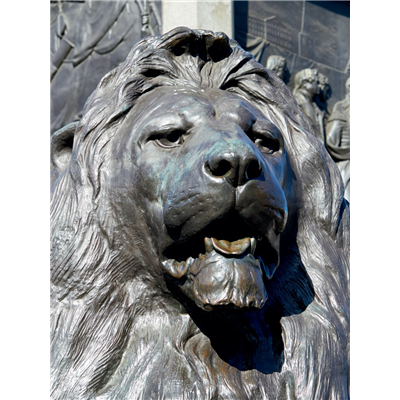 |
Karin Fernald gave members of the Arts Society Wokingham a fascinating insight into the life and times of the creator of the lions in Trafalgar Square, Sir Edwin Landseer. The four bronze lions are some of the world’s most famous sculptures, but they were created by Sir Edwin Landseer who was much better known as a painter, albeit a painter of animals. He was not the first person to be offered the commission but he willingly accepted it and set to work. He applied the same painstaking approach to anatomical detail as he had when painting dogs and stags. He studied the lions in Regent’s Park Zoo and even had the body of one that died in the Zoo delivered to his home where he dissected it. It was a decade before the four lions were eventually completed and unveiled on 31st June 1867. When Landseer died, six years later, he was given a public funeral and buried in St Paul’s Cathedral. Crowds lined the streets and black wreaths were wrapped around the necks of his lions in Trafalgar Square. Karin is a theatre and TV actor and she used her acting skills to great advantage, keeping her audience entertained and informed. As one member said, ‘Her memory of details and non-stop faultless delivery were indeed outstanding. She made the artist come alive.’ Karin’s dry sense of humour gave her audience a fascinating insight into life in 19th century society. She described how, in 1820, John Russell, 6th Duke of Bedford, commissioned the young Landseer to paint his young wife’s portrait. Soon Landseer became a frequent visitor and their favourite house guest. At dinner parties he loved to entertain the guests with ghost stories. Karin hinted that his relationship with the Duchess was more than simply friendship. He is reputed to have fathered one, if not two, of the Duchess’s many children. After the Duke’s death Landseer proposed to the Duchess but she turned him down, causing him to suffer a nervous breakdown. His last years were marred by mental instability. In contrast, the Society’s March lecture is a celebration of the arrival of spring. Why not come along and discover the glorious paintings of Joaquin Sorolla? Jacqueline Cockburn will be sharing her love of his paintings and explaining how he achieved this extraordinary feeling of light and colour. The talk is on Monday 20th March at King’s Academy, Binfield - the Society’s new home. The school has excellent facilities including a well-lit car park and plenty of space to mingle while enjoying tea or coffee and biscuits before the talk, which starts at 7.45pm. Guests are always welcome but do email memsectheartssocietywham@gmail.com to register beforehand. The talk will also be live streamed and available to watch from home on the society’s own YouTube channel. For further details please visit the Society’s website www.The ArtsSocietyWokingham.org.uk Sue Bryant |
|
| Monday, 12 December 2022 |
| The Arts Society Wokingham are moving to King’s Academy, Binfield |
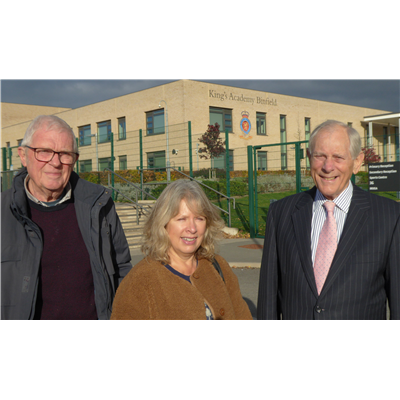 |
The Arts Society Wokingham are moving to King’s Academy, Binfield It’s a New Year and a new venue for the Arts Society Wokingham! The first lecture on Monday 16th January 2023 - Palmyra. Bride of the Desert – the ancient city in Syria – its rise and fall, delivered by Lecturer Dr Paul Roberts will be held in the hall at King’s Academy, Binfield. King’s is a new academy school which offers excellent theatre facilities to be enjoyed by all members. The car park is spacious, well-lit and is located very close to the lecture hall which makes easy access for everyone - with no parking charges. We had to move from Newbold Church due to their introduction of different digital technology and, after an extensive search of venues, we found King’s Academy. King’s is located very close to the Newbold College site. The Hall has seating for 200 so we are able to welcome and accommodate new members and friends. The projection facilities are excellent and we will use our own sound support to have a good audio experience. As usual we will live stream our lectures to all those members who cannot make it there in person. Tea and coffee will be offered free to all on arrival before monthly lectures with café seating available adjacent to the Lecture Hall. This is an ideal opportunity for members to encourage friends to come to the lecture which, as ever, will be interesting and entertaining. Our lecturer, Dr Paul Roberts, Head of Antiquities at the Ashmolean Museum, Oxford, has a profound knowledge of Palmyra and its influence on the ancient Middle East Society Chair, Alison Sanders says ‘King’s Academy will provide a perfect location to attend the 2023 monthly lecture programme and meet old friends and make new acquaintances’. If you would like to attend or view on line as a guest or join as a member, please contact memsectheartssocietywham@gmail.com who will give you more information. Lectures start at 7.45pm, with refreshments from 7pm, and finish around 9pm. The full address of the new venue is King’s Academy, Wood Lane, Binfield, RG42 4PS and a map is available on our website www.theartssocietywokingham.org.uk. |
|
| Tuesday, 29 November 2022 |
| The Arts Society Wokingham and Foundry College Partnership
A Mosaic in Memory of an Inspirational Head Teacher |
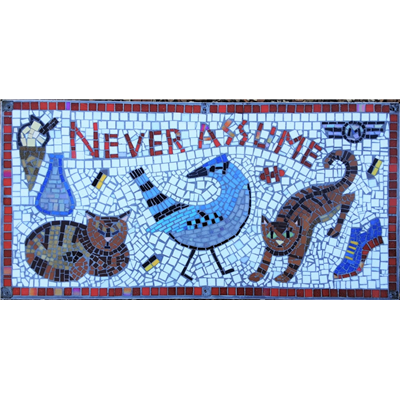 |
A wonderful mosaic wall was commissioned by Foundry College to remember their inspirational Head Teacher, Jay Blundell, who died in January 2021. Jay was described as ‘truly amazing’ and inspired students at Foundry to find their path. Thanks to The Arts Society Wokingham, a talented community artist, Joanna Dewfall was commissioned to work with students and staff to create a mosaic that captured Jay’s spirit and ethos. Entitled ‘Never Assume,’ the mosaic illustrates her belief in the students to achieve their goals within the supportive environment she led. The students and staff suggested the motifs that most represented Jay such as the jay bird at the centre and the two cats representing her love of nature and her cats’ Sebastian and Montgomery. Her sense of humour and fun is remembered in the 99 ice-cream which she loved. Joanna enabled both students and staff to contribute in a hands-on manner helping to create the mosaic, so they felt fully involved in the project and she completed the panel in her workshop before it was placed into the wall space at the entrance to Foundry College. The Arts Society Wokingham has worked in partnership with Foundry College for a number of years and is delighted to have supported the project. The Chair Alison Sanders said ‘This is a beautiful mosaic and a fitting tribute to a much loved head teacher.’ |
|
| Tuesday, 15 November 2022 |
| October activities for the Arts Society Wokingham |
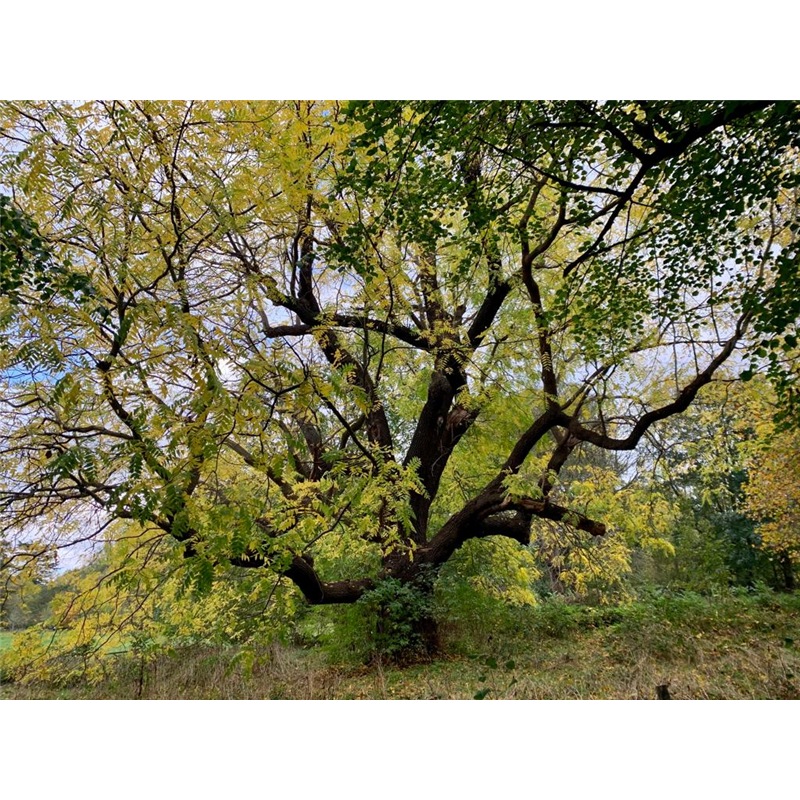 |
Members of the Arts Society Wokingham had a busy October. On a warm sunny day, a group travelled to Marble Hill House to enjoy guided tours of this elegant Georgian house and its extensive grounds which stretch down to the Thames. This image shows the 300 year old Black Walnut tree in all its autumn glory. Marble Hill House was built in the 1720s for Henrietta Howard, mistress of King George II when he was Prince of Wales, as a retreat from court life. The villa is an important and relatively rare example of a house built for and by a woman in Georgian England. The Arts Society’s October lecture was also about women who made names for themselves, but in an earlier era. In Renaissance Italy aristocratic women were expected to lead a modest life based at home - not even being able to walk out on their own. They were however educated and had to be capable of running their households and even ruling their husbands’ lands while the men went off to war. Nicole Mezey introduced members to three women who overcame social constraints and restricted means to become patrons of the arts: Lucrezia Borgia, Alfonsina Orsini de’Medici and Isabella d’Este. Alfonsina Orsini de’Medici commissioned architects to build palaces such as the Palazzo Lente in the heart of Rome. She also commissioned Raphael to paint a portrait of Pope Leo X as a present for her son to mark his marriage Isabella d’Este grew up in a cultured family in the city-state of Ferrara and became a renowned patron of the arts. She had a reputation for haggling and built up an extensive collection of antiques. She also commissioned paintings by well-known artists such as Bellini and Leonardo da Vinci. Lucrezia Borgia, Alfonsina and Isabella d’Este were all related and shared a circle of friends. They frequently wrote to each other exchanging information about paintings and artefacts that were for sale. The Society’s November talk also concerns cultural artefacts and haggling. Ever wondered what the life of an auctioneer is really like? If so, then come along to the Society’ s lecture on 21st November to hear Marc Allum’s incredible stories of the great discoveries and emotive situations that he has experienced during his 30 years as an auctioneer. The talk will be held at Moor Close, Newbold College. Guests are always welcome but do email memsectheartssocietywham@gmail.com to register beforehand. The talk will be live streamed and made available to watch on the society’s own YouTube channel. For further details please visit the Society’s website www.The ArtsSocietyWokingham.org.uk Sue Bryant |
|
| Thursday, 13 October 2022 |
| Review of 'The Ghent Altarpiece' Monday 19th September 2022 |
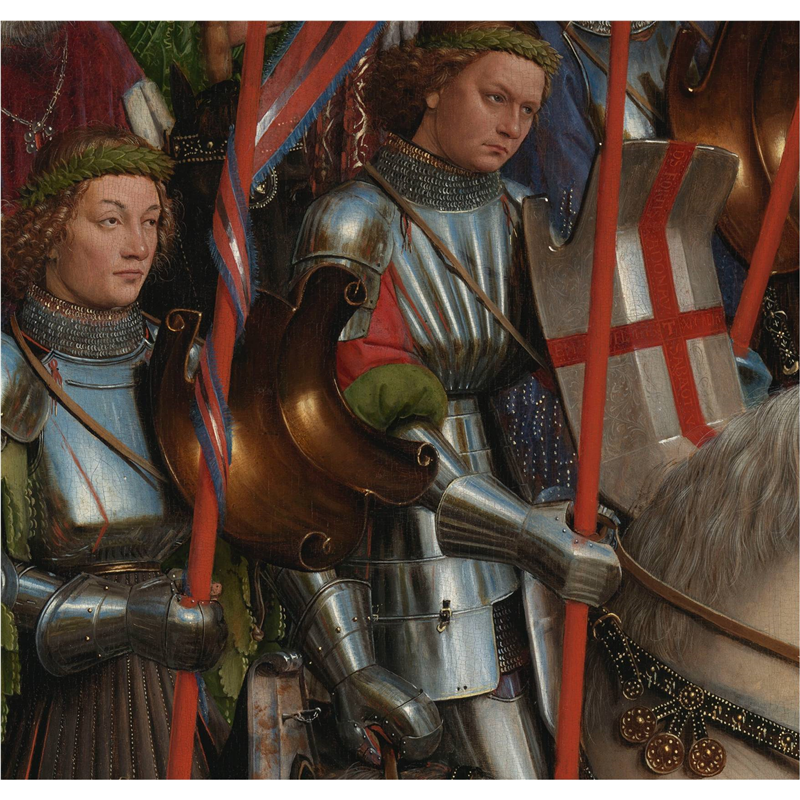 |
Discovering the Ghent Altarpiece In September, Paula Nuttall gave members of the Arts Society Wokingham a fascinating detailed account of the 15th century Ghent Altarpiece. As well as explaining its importance she revealed the meaning of its complex imagery, its later history and its recent restoration. Completed in 1432, this large altarpiece represents a milestone in the history of art. It marks the beginning of the northern Renaissance. Its dazzlingly realistic depiction of people, plants and objects is in sharp contrast to previous medieval flat, unrealistic and mainly religious images. It was commissioned by Jodocus Vijd, a wealthy Flemish wool merchant and constructed and painted by the brothers Hubert and Jan Van Eyck. Hubert died in 1426 and Paula explained that Jan Van Eyck is thought to be responsible for the majority of the painting. He developed the oil medium, blending and layering colours to produce a depth of colour and create innovative effects such as the sheen on the armour of St George, as shown in the picture. Van Eyck’s attention to detail can also be seen in the expression on the faces of the knights. The complex altarpiece consists of 12 wooden panels. It is hinged so eight of the panels are painted on both sides. The theme of the inner central panel is the Adoration of the Lamb with panels either side depicting the secular judges and knights as well as the pilgrims and hermits all converging on the Lamb. When closed, the outer panels show images of Jodocus Vijd and his wife as well as images of the Annunciation, again a mixture of the secular and the religious. Paula explained that this work of art has had a turbulent history. During the Reformation it had to be winched up into the belfry to save it from desecration. Napoleon’s troops stole the central panels. They were returned in 1816 but minus some of the original frames. The outer wings were sold to the Germans and dispatched to Berlin but returned to Belgium at the end of the First World War. In 1942 the Nazis took the altarpiece to the Salt Mines near Saltsburg where it was discovered by the Monuments Men in 1945 and repatriated. Despite all this it has remained largely intact. It was restored in 1950 and then again in from 2012 to 2016. This second and more thorough project discovered and removed a coating of yellow varnish which had been applied in 1950 revealing the original paint colours. Paula swept the audience along with her enthusiasm and knowledge. As one member said ‘After listening to the lecture, I just want to visit Ghent’. The Society’s next talk explores how women such as Lucrezia Borgia and Alfonsina Orsini overcame social constraints to become patrons of the arts in Renaissance Italy. It will be held on 17th October at Moor Close, Newbold College. Guests are always welcome but do email memsectheartssocietywham@gmail.com to register beforehand. The talk will also be available to watch on the society’s own YouTube channel. For further details please visit the Society’s website www.The ArtsSocietyWokingham.org.uk Sue Bryant |
|
| Monday, 29 August 2022 |
| Summer Socialising with the Arts Society Wokingham |
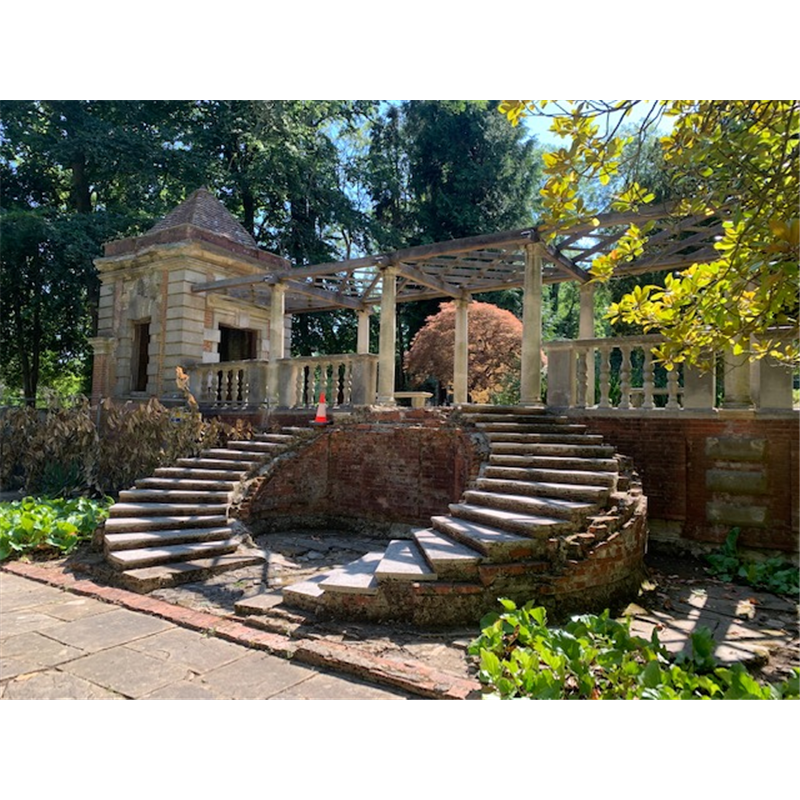 |
There was a real buzz as members and guests of the Arts Society Wokingham gathered at Moor Close, Newbold College on a hot and sunny August afternoon. Some opted to start with refreshments including a wide selection of delicious homemade cakes (baked by ladies of the Committee). Another group set off on a tour of the grounds led by Elena. She explained that the gardens were designed by Oliver Hill in 1910 before the site was purchased by the College in 1945. They are currently in need of some renovation but as the group walked around they could see that Hill’s original concept included magnificent terraces, circular brickwork steps, pergolas, staircases, balustrades and lily ponds. Hopefully the College will secure the necessary funding for the renovation that these gardens so richly deserve. Members and guests were reluctant to leave at the end of the afternoon but they all agreed that the Society should make this an annual event. A few days later the Society held another successful event: a study day featuring Andy McConnell talking about the history of glass making. Andy, a presenter on the ‘Antiques Roadshow’ was originally due to talk to members in 2020 but due to the pandemic the Study Day had been postponed. Despite the delay, he did not disappoint. He had the audience in laughter at his many anecdotes before settling down to the serious stuff of how glass is made. He made his audience stop and consider what becomes possible with glass, everything from having natural light in our homes, being able to see properly by wearing glasses through to the wonders of fibre optics. He then took them through the history of decorative glass explaining the various techniques for shaping and decorating glass and the effect that social etiquette and fashion had on their design. As much as the Society’s study days are about learning about a topic in more depth, they are also about the social breaks in between. The Wokingham Theatre foyer provided a great space where members were able to chat over morning coffee and the delicious sandwich lunch. In the afternoon, Andy talked about each of the pieces of glass brought along by members. The most interesting were those with a background story like the iridescent glass vase called carnival glass as it was often a prize at American fairgrounds, the celery vase named as a utility item to avoid tax and the glass bottle with a marble in the neck invented by Codds of Camberwell for carbonated drinks. The day was perfectly summed up when Andy was thanked for giving members the best Wednesday we had all had in ages … which surprisingly left him briefly speechless! Next season, the Society has a varied programmes of monthly talks, visits and study days planned. Why not come and learn about putting on a play from an actor’s perspective, hear Marc Alum’s fascinating tales of his life as an auctioneer, appreciate Sorolla’s paintings (full of life and colour), study the detail of Picasso's 'Guernica' and enjoy the beauty of ancient Palmyra: the ‘Bride of the Desert'? The first lecture on 19th September at 7.45pm not only unravels the meaning of the fifteenth century Ghent Altarpiece but explores its later history, including its finding by the Monument Men in 1945. For further details please visit the Society’s website www.The ArtsSocietyWokingham.org.uk Sue Bryant |
|
| Tuesday, 26 July 2022 |
| Thank you letter from Arts4Wokingham for donation |
 |
25th July 2022 Dear Alison, On behalf of the Arts4Wokingham Committee I am writing to sincerely thank everyone at The Arts Society Wokingham for your generous donation to help fund The Arc in Wokingham. Without sponsors such as yourself it would not be possible to bring about this momentous project, which will not only bring to fruition a landmark piece of art to Wokingham but also enable all of the community to access free high quality art that is accessible for all in our community. Already the monies that you have donated are going into the work to build this artwork by Nicola Anthony RSS. Nicola has been extremely busy out and about in our borough and hopefully you may have already attended or seen advertised one of the workshops that she is running. She is capturing individual’s life stories from the community so that these can feed into the writing, sound and braille within the final artwork and if your members want to contribute they can via our website. As a founder donor to this project, you already know that we will be permanently acknowledging the generous donation by The Arts Society Wokingham in the public arena, hopefully in close proximity to the final artwork depending on planning requirements. Once again, thank you all for your support for The Arc in Wokingham and we look forward to inviting you to its grand unveiling. With all best wishes, Charlotte Charlotte Haitham Taylor
Chair: Arts4Wokingham |
|
| Tuesday, 07 June 2022 |
| Review of 'The Two Faces of Russia: Moscow and St. Petersburg' on Monday 16th May 2022 |
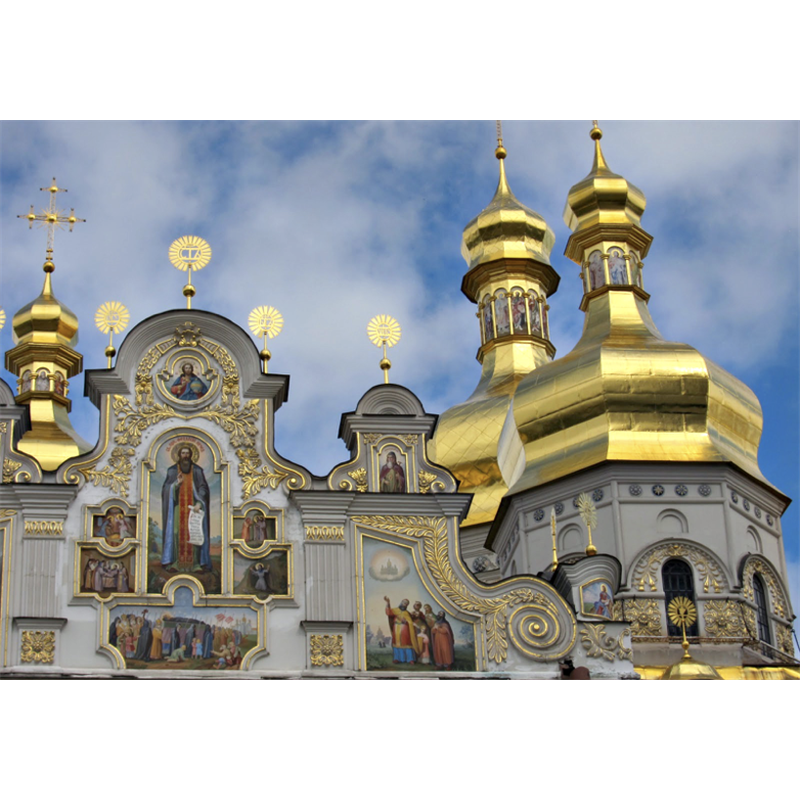 |
The Two Faces of Russia: Moscow and St. Petersburg In May, members of The Arts Society Wokingham were treated to a fascinating talk about Russian history and art by Rosamund Bartlett. Rosamund used the architecture of the two cities, Moscow and St. Petersburg, to illustrate how Russia through the centuries has been influenced by both the east and the west. Before the invasion of Russia by the Mongols in the 13th century Kyiv had been the capital of Russia. At the end of the 15th century when the Mongols were eventually forced out, Moscow emerged as its capital. Although drawn to the Byzantine Empire and its Orthodox Christianity, Tsar Ivan III commissioned two Italian Renaissance architects to build the Kremlin. Within this ‘fortress in a city’ they created three cathedrals, all with golden domes. The iconic St Basil’s Cathedral built 50 years later just outside the Kremlin has a more oriental feel but originally had the gold ‘onion domes’ that we associate with Russian Orthodox churches. Two centuries later the young Tsar, Peter the Great, was greatly influenced by his European travels especially to Amsterdam and Paris and undertook to create a new capital city; St Petersburg. He employed Jean-Baptiste Le Blond as chief architect. The Frenchman also designed the magnificent classical summer palace and gardens, Peterhof. Russia had turned its head to the west. Successive Romanov Empresses were also drawn to western culture. Elizabeth loved European music and introduced concerts, ballet and opera into St Petersburg society. She was also inspired by the Baroque style of architecture and commissioned the building of the Winter Palace (The Hermitage). Catherine the Great was influenced by The Enlightenment movement in Europe and built up her art collection in the Hermitage, buying the Walpole collection of more than 200 works in 1779. But in the 19th century, the reactionary Tsars Nicholas I and Alexander III turned away from Europe and became more insular and nationalistic. Before he moved back to Moscow, Alexander commissioned the Russian architect, Alfred Parland, to build the Church of the Saviour on Spilled Blood in St Petersburg with its characteristic Russian domes. Rosamund had a wealth of knowledge to impart during this fast paced talk and gave members a fascinating insight into Russian history and art which provided a context to the current conflict in Ukraine. At the end of the evening there was an opportunity for members to donate to the Disaster Emergency Committee's Appeal for Ukraine. In contrast, the Society’s June lecture is entitled ‘The Art of the Cartoonist’. Harry Venning, who was awarded the UK Strip Cartoonist of The Year for his Guardian strip ‘Clare In The Community’ will be drawing live at Newbold Church. Guests in person or online are most welcome. Please contact memsectheartssocietywham@gmail.com for more details. Details of future talks are available at www.TheArtsSocietyWokingham.org.uk Sue Bryant |
|
| Friday, 01 April 2022 |
| Review of 'Denys Lasdun and the National Theatre: architectural masterpiece or was Prince Charles right after all?' on Monday 21st March 2022 |
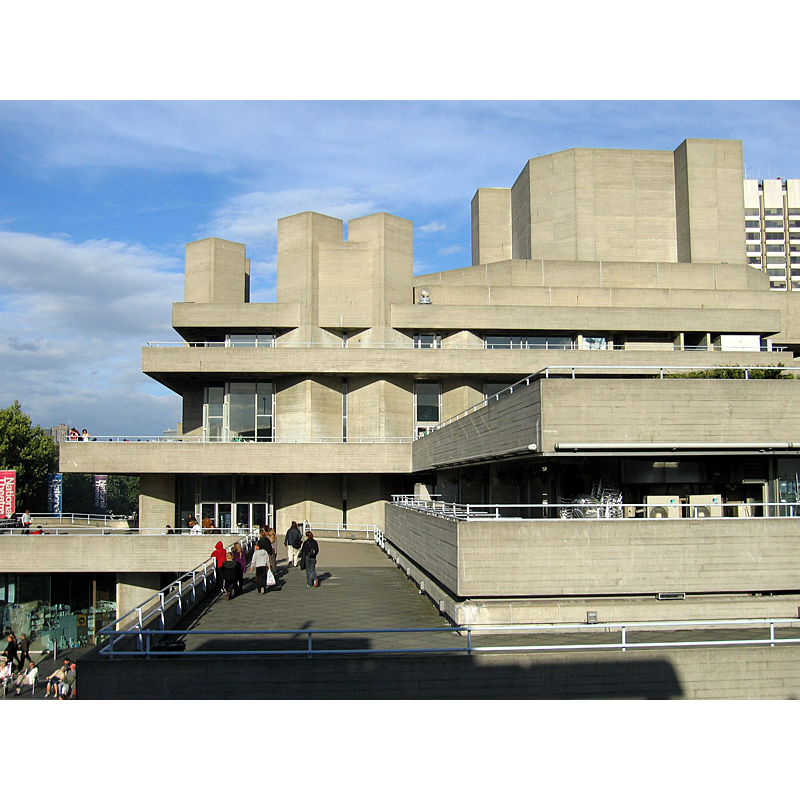 |
How I learnt to love the National Theatre There are few buildings in the United Kingdom which divide public opinion as much as The Royal National Theatre on the South Bank of the Thames in London, opened in 1976. The Theatre features prominently in surveys of both most liked and disliked buildings and has even drawn the opprobrium of the Prince of Wales who compared it to a “nuclear power station”. On the other hand John Betjeman found it to be “a lovely work and so good from many angles…..it has that inevitable and finished look that great work does”. Alan Read in his lecture to The Arts Society Wokingham on March 21st on “Denys Lasdun and the National Theatre” proposed that the main reason for the controversy lies in the fact that the Theatre is built in concrete, a material used for centuries in its basic form. However, the advent of reinforced concrete at the beginning of the 20th century unleashed potential for design, resulting in outstanding buildings such as Notre Dame de Raincy, designed by Auguste and Gustave Perret in 1922, and the modernist house “Falling Water” designed by Frank Lloyd Wright in 1936. The use of reinforced concrete grew apace and was largely used to build social housing and institutional buildings such as universities and was associated with the polarising term “brutalism” which critics inferred coldness and soullessness. As early as 1907 there had been calls by theatre directors such as Harley Granville Barker, to build a National Theatre and a site in Bloomsbury had been offered in 1913 as well as a site off the Cromwell Road with a design by Sir Edwin Lutyens in 1942. It was not until nearly 20 years later that the architect Denys Lasdun was commissioned to design the National Theatre on a site provided by the GLC on the South Bank of the Thames. Lasdun was much influenced by Le Corbusier but also had an appreciation of the more classical work of Hawksmoor. This is demonstrated by his breakthrough work in 1960-1964 for the Royal College of Physicians building in Regent’s Park, now listed as Grade I , using modern reinforced concrete technology and highly expressive structural methods, together with several other commissions including the Grade II* listed Hallfield Primary School in Paddington. The lecture presented evidence that Lasdun’s design for the National Theatre reflects his mature style in its use of textured bare concrete and angularity, as well as its more human scale and this, argues Read, is the key to the success of the building. Audiences flow into the theatres on to the terraces and to intimate spaces as the outside is reflected by the inside and the “ fly towers”, now illuminated at night, have added a new dimension to the London Skyline and the South Bank vibe. Its three theatres provide a variety of experiences from the traditional theatre environment of the Lyttelton to the fan shape auditorium of the Olivier where actors have a 130 degree viewpoint and performances are enhanced by a unique “Drum Revolve” facilitating spectacular scene changes. In short, Read believes that the Theatre works as a theatre with the public in mind and confounds its critics. In a considered and well presented lecture, Alan Read may very well have convinced me to join with John Betjeman and to love the National Theatre. Toby Faber will be giving the Society’s next talk is on 25th April at 7.45pm. It is entitled ‘The Imperial Easter Eggs of Carl Fabergé - before the Revolution’. Between 1885 and 1916, Carl Fabergé made fifty jewelled eggs – Easter presents from Russia’s last two emperors to their wives. They have become the most famous surviving symbols of the Romanov Empire: both supreme examples of the jeweller’s art and the vulgar playthings of a decadent court. Guests (in person at Newbold Church or online in the comfort of their own home) are most welcome. Please contact memsectheartssocietywham@gmail.com for more details. Details of all future talks are available at www.TheArtsSocietyWokingham.org.uk Dudley Cooper |
|
| Thursday, 10 March 2022 |
| Review of 'A Carpet Ride to Khiva' on Monday 21st February 2022 |
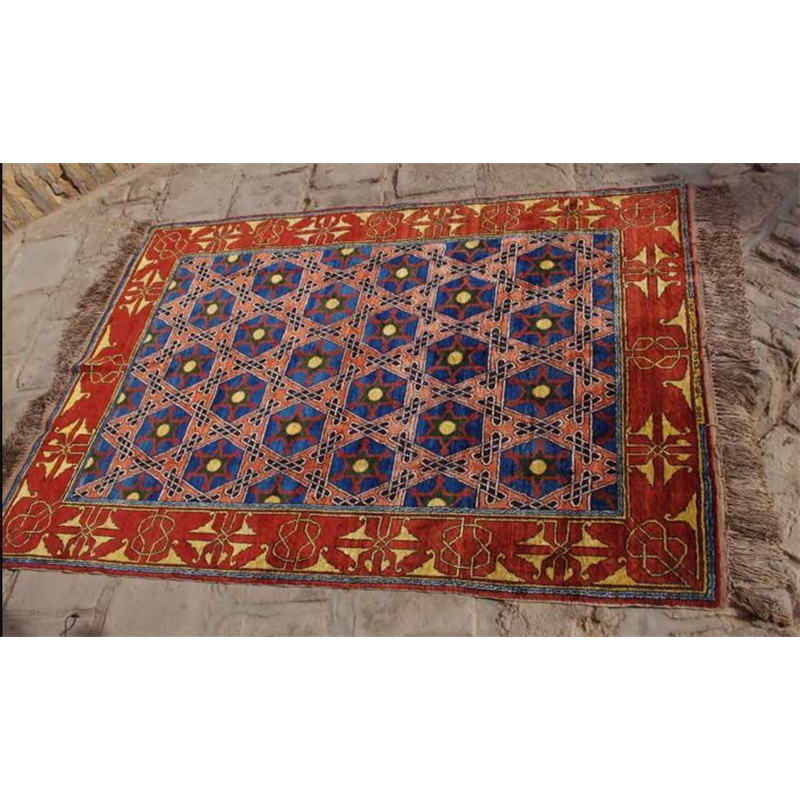 |
Uzbekistan and the Rose Street Connection Any similarity between Wokingham and Khiva in Uzbekistan seems improbable but both were important centres for silk weaving in the 16th Century. Whilst silk weaving in Wokingham ended in 1832, the craft survived in Khiva until the Soviet occupation of Uzbekistan in 1921 when traditional crafts were discouraged. However, almost 100 years later, silk carpet weaving in Khiva was revived through the extraordinary efforts of British Aid volunteer, Chris Aslan Alexander, whose lecture to The Arts Society Wokingham on February 21st described the traditional Timurid silk carpet craft. Funded by a teaching and travel scholarship, Chris went to Uzbekistan as a volunteer and was asked by the local mayor to produce a guidebook for tourists to this walled city with classical Islamic architecture. The high unemployment rate in Khiva prompted him to search for crafts that the local people could develop to sell as souvenirs and he initially encouraged some wood carvers, who mainly carved wood pillars for mosques, to diversify into making coffee tables to sell in the markets of Tashkent. The success of this venture led him to consider other crafts and despite the misgivings of his sponsors and with no knowledge of weaving, he proposed that the skills used by the local silk portrait carpet weavers could be employed in reviving the 15th Century Timurid carpet weaving industry. The Timurid, a Sunni Muslim dynasty goes back to Genghis Khan but unfortunately early carpet designs had not survived and Chris had to undertake considerable research to unearth designs of this period. Often they could only be found in paintings and in illustrations in books including those from the Tudor Period in England. Eventually, with the support of UNESCO, he was able to organise a conversion to a workshop of a 19th Century madrassah in the heart of the tourist trail in Khiva. In due course they ran out of space and had to open a second workshop which concentrated on Suzani (small rugs), handbags and cushion covers as well as Kilims using ceramic tiling designs, many with a pomegranate signature unlike very early designs which were never signed. It would be nice to report that everything continued to go well but with a change in the political climate and a high level of corruption, Chris was denied entry into Uzbekistan and the factories requisitioned though he was able to return as a visitor some time later. After writing a book entitled ‘A Carpet Ride to Khiva ‘about his experience, Chris now leads tours to Uzbekistan and advises that visitors to Khiva which include a visit to a silk carpet factory need “heavy wallets and big suitcases”. The society’s next talk, on 21st March, is entitled ‘Denys Lasdun and the National Theatre: architectural masterpiece or was Prince Charles right after all?’. Alan Read aims to convince his audience that this austere building deserves their appreciation. Guests (in person at Newbold Church or in the comfort of their own home) are most welcome. Please contact memsectheartssocitywham@gmail.com for more details. Details of all future talks are available at www.TheArtsSocietyWokingham.org.uk Dudley Cooper |
|
| Thursday, 03 February 2022 |
| Review of ‘A Picture a Day’: Peggy Guggenheim and the birth of mid-century Modernism on Monday 17th January 2022 |
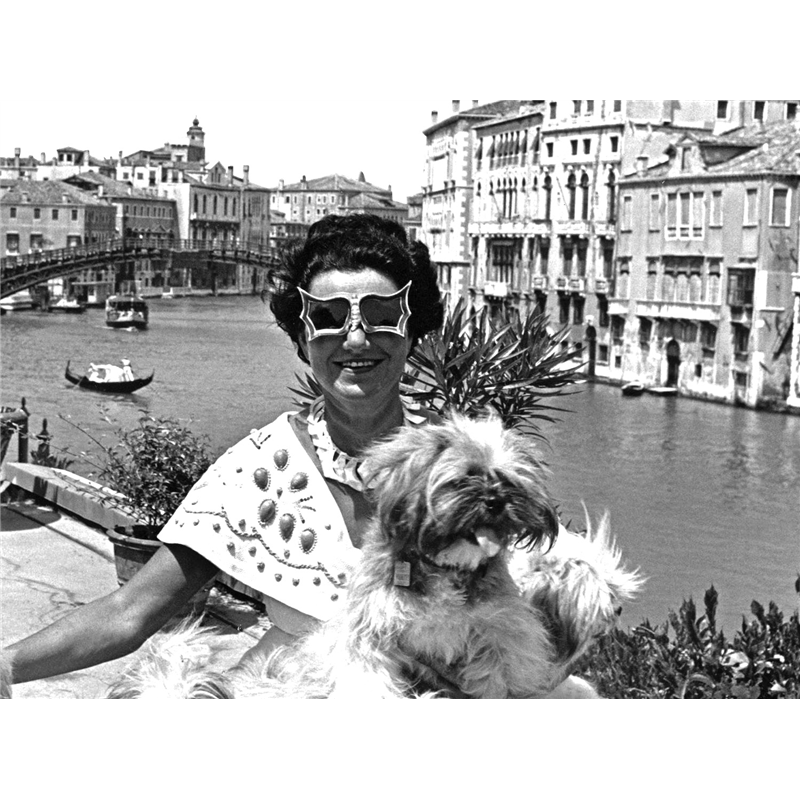 |
‘A Picture a Day’ Peggy Guggenheim’s life was full of glamour, money, art, sex and tragedy. Jacky Klein, the well-known art historian, shared her enthusiasm and knowledge of this iconic 20th century art collector with members of The Arts Society Wokingham at their January lecture. Jacky painted a vivid picture of Peggy as a wealthy New York society heiress. In 1930 after the breakdown of her tumultuous marriage to Laurence Vail and the tragic death of her sister, she decided to use her inheritance to build up a collection of modern art works. Within just a few years she had amassed a large collection which included drawings by Jean Cocteau, Surrealist sculptures by Marcel Duchamp and abstract paintings by Kandinsky. She exhibited them in London’s first museum of modern art, the Guggenheim Jeune, in 1938. Jacky explained that Peggy continued to expand her collection to include American art works after she moved herself and her collection to New York in 1941. Her home became a home for displaced European artists such as Max Ernst whom she married. The work of these artists in turn influenced young American artists such as Jackson Pollock and Mark Rothko. Her amazing unconventional gallery, Art of the Century, was designed by the avant-garde architect, Frederick Kiesler, to show-case both European and American modern art. In 1947 Peggy moved on again, this time to Venice where she spent the last 30 years of her life. She found a permanent home for her ‘children’, as she called her collection, in the18th century Palazzo on the Grand Canal where much of it remains to this day. Jacky brought the life and times of Peggy Guggenheim to life. She convinced her audience that Peggy changed the course of modern art. Peggy did take advice from mentors such as Herbert Read and other friends but she also had the knack of being in the right place, at the right time. She had the ability to recognise and encourage the talent of young emerging artists. She was much more than a ‘bourgeois housewife with a shopping list’ buying a picture a day as Picasso once described her. With the continuing support of Newbold Church’s technical team The Arts Society will be offering hybrid lectures to its members and guests for the rest of the season. The next lecture, on 21st February at 7.45pm, is entitled ‘A Carpet Ride to Khiva’. Chris Aslan, inspired by 15th century Persian illustrations which were the only surviving record of Timurid carpet designs, set up his own workshop in Khiva, a desert oasis in Uzbekistan. Here he is recreating these ancient carpet and embroidery designs and has become the largest non-government employer in town. Guests (in person at Newbold Church or online in the comfort of their own home) are most welcome. Please contact memsectheartssocietywham@gmail.com for more details. Details of all future talks are available at www.TheArtsSocietyWokingham.org.uk Sue Bryant |
|
| Wednesday, 08 December 2021 |
| Another Christmas Gift for First Days from the Arts Society Wokingham |
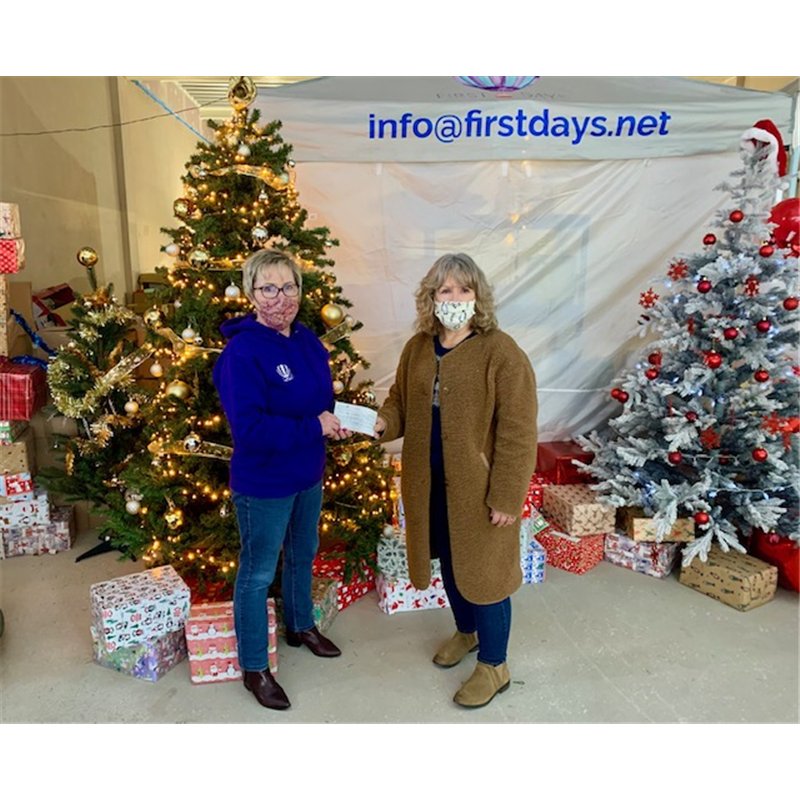 |
Another Christmas Gift for First Days from the Arts Society Wokingham Members of The Arts Society Wokingham continue to support the First Days charity. Last Christmas they donated to their Christmas Appeal and they also supported their Back to School project in July. Early in December, Alison Sanders, Chair of the Society, visited the Christmas Presence community shop in Elms Field to present a cheque for £500 to Jenny Westmoreland, First Days Head of Fundraising, in support of this year’s Christmas Appeal. Alison said, "Once again the very generous members of The Arts Society Wokingham have supported the excellent work of First Days in helping local families. The Arts Society members are very keen to benefit their local community at this special time of year." In response, Jenny, thanked the Society for their generous donation and went on to explain that the charity’s focus this Christmas is on giving low-income families the dignity and power of choosing gifts for their children. They are invited to book an appointment and come into the shop and chose from the amazing selection of toys on offer. As Jenny said, “Choice is so important, especially at Christmas. Many of us are lucky enough to be able to choose presents for our children that we know they will love. You may have experienced that magical feeling of seeing your child’s face light up on Christmas morning, opening a present that you have thoughtfully chosen for them. This donation will enable us to extend that gift of choice. “ To find out more about First Days and their Christmas appeal, please visit www.firstdays.net/christmas Members of The Arts Society Wokingham continue to meet monthly to listen to talks covering all aspects of the arts including painting, theatre, music, architecture and photography. Currently these talks are available live at Newbold Church or through a live stream to their YouTube channel. New members and guests are always welcome. To find out more please visit, www.theartssocietywokingham.org.uk. Sue Bryant |
|
| Monday, 22 November 2021 |
| Review of 'Origins of our English Christmas' on 15th November 2021 |
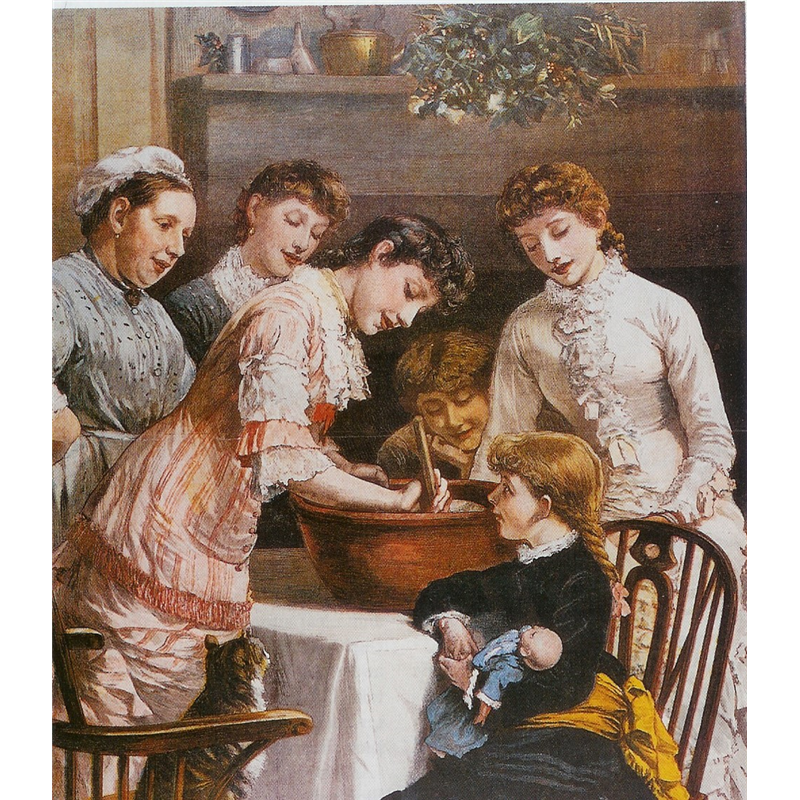 |
Christmas is Coming to the Arts Society Wokingham Members of the Arts Society Wokingham marked the start of the festive season with a talk by Roger Askew on ‘The Origins of our English Christmas’. Roger took his audience on a journey through time showing how many of our modern Christmas celebrations date back from pagan festivals which marked the death of the old year and the birth of the new. In mid December the Romans held the festival of Saturnalia. There was much feasting and singing in honour of Saturn, the god of agriculture. Meanwhile in northern Europe Yuletide was celebrated with much eating, drinking, singing and the burning of Yule logs. Food continues to play an important part in our modern celebrations and much of what we are planning to eat on Christmas Day can be traced back to times gone by. Henry VIII introduced the tradition of eating turkey although his daughter Elizabeth I preferred goose. George I introduced the plum pudding which earned him the nickname of ‘The Pudding King’. These days we prefer to eat our (chocolate) Yule logs rather than burn them. Our modern trappings of Christmas such as decorated trees, crackers, cards and Santa Claus date back to Victorian times when Christmas traditions became more established across society. However, we can thank a Coca-Cola advertising campaign for changing the colour of Santa’s cloak from green to red in 1931. Roger’s talk was peppered with fascinating details such as the fact that the puritans tried (and failed) to ban Christmas games and carol singing in 1647, the robin which features on many Christmas’ cards signifies a postman and in 1880 the public were urged to ‘Post early for Christmas’ due to the popularity of sending cards which threatened to overwhelm ‘the kindly robin’. Singing has always played an important part in Christmas celebrations and Roger interspersed his talk with recordings of carols starting with two lesser known medieval ones, ‘Wolcum Yole’ and the ‘Boar’s Head Carol’. ‘The Holly and the Ivy’ and ‘While Shepherds Watched’ date back to the 18th and early 19th centuries. Roger brought his audience into the 20th century by inviting them to join in with Slade’s ‘Merry Christmas Everybody’ as a rousing finale to his fascinating talk. With the continuing support of Newbold Church’s technical team the Society will be offering hybrid lectures to its members and guests for the rest of the season. Now is an excellent time to join us. Membership for the rest of the season is reduced to £40. Future illustrated talks cover a wide range of topics such as Peggy Guggenheim and the birth of mid-century Modernism, the revival of 15th century Timurid carpet designs, the Imperial Easter Eggs of Carl Fabergé, and the sculptures of Antony Gormley. Guests (in person or online) are most welcome. Please contact memsectheartssocietywham@gmail.com for more details. For full details of our programme, please visit www.TheArtsSocietyWokingham.org.uk Sue Bryant |
|
| Thursday, 30 September 2021 |
| Review of 'Two Gustavs, Mahler and Klimt' on 20th September 2021 |
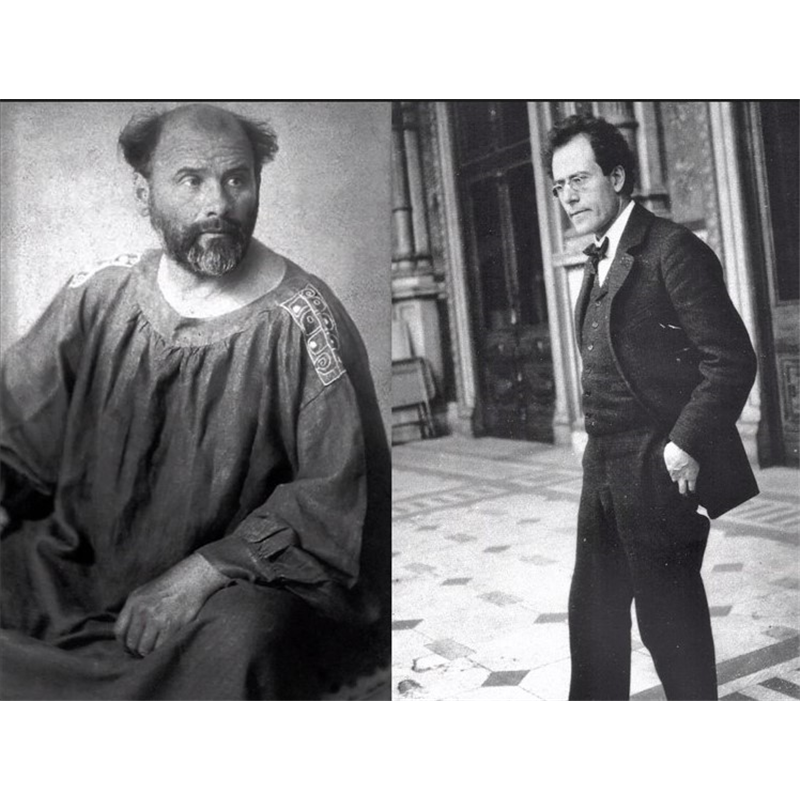 |
The art of freedom What a start to the new season! Gavin Plumley the well-known broadcaster gave an outstanding talk on Klimt and Mahler to more than 100 members of The Arts Society Wokingham last Monday. He set the scene. Vienna at the end of the 19th century was the centre of the Hapsburg Empire. The conservative Emperor Franz Joseph was at the height of his power and commissioned the construction of the great Ringstrasse with its collection of neo-classical buildings. This display of traditional opulence provoked a reaction from a group of young architects, painters and designers led by Gustav Klimt. Funded by a wealthy industrialist, Karl Wittgenstein, these Secessionists built an Art Nouveau exhibition centre, in the heart of the city, where they could display their own work. “To every age its art, to every art its freedom" was carved above the door. Meanwhile Gustav Mahler was appointed musical director of the Vienna Court Opera. Gavin played his audience the opening of Mahler’s 1st Symphony to illustrate the composer’s modern style of composition. The majority of the audience at its Viennese premier were appalled and a fight ensued between these traditionalists and a group of more avant-garde students. Both Klimt and Mahler sought respite from the stifling atmosphere of Vienna on the shores of Lake Attersee. Here Mahler shut himself off to write his 2nd and 3rd symphonies in a small hut specially built for him on the lakeside. Klimt in contrast was inspired by the natural beauty of the area and began painting landscapes after the style of the French post-Impressionists such as Seurat. Despite their different personalities and approaches to life the two Gustavs were brought together by their admiration for Beethoven. Inspired by Beethoven’s 9th Symphony, Klimt painted a frieze for the Secession’s Beethoven Exhibition in 1902. The Exhibition opened to the strains of an arrangement by Mahler of a theme from the closing chorus of Beethoven’s 9th Symphony. Gavin’s knowledge and enthusiasm for his subject coupled with his lovely turn of phrase made this an evening to remember. Good news, the Society will be returning to live lectures at Newbold Church on 18th October. Guests are most welcome. Julian Richards will explore why and how Stonehenge has been an inspiration to painters, potters and poets throughout the ages. Please contact memsectheartssocietywham@gmail.com for more details. Better still, why not become a member and have access to these monthly illustrated lectures. Future talks cover a wide range of topics such as Peggy Guggenheim and the birth of mid-century Modernism, the revival of 15th century Timurid carpet designs, the Imperial Easter Eggs of Carl Fabergé, and the sculptures of Antony Gormley. For full details of this season’s programme, please visit www.TheArtsSocietyWokingham.org.uk Sue Bryant |
|
| Thursday, 09 September 2021 |
| Review of 'Taken by Surprise': a Revolution in the Art of the Poster on 16th August 2021 |
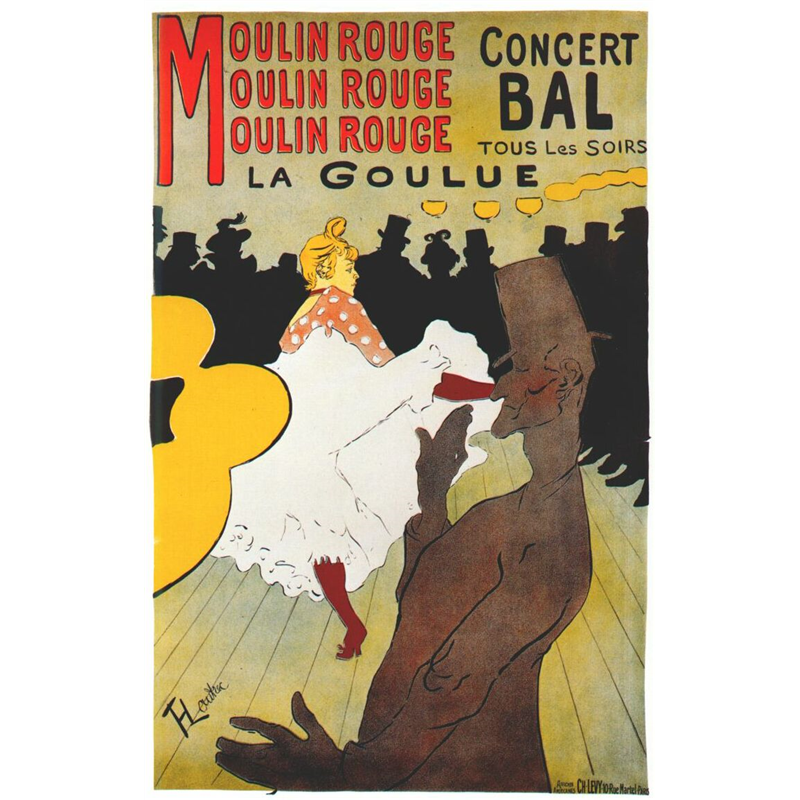 |
The Amazing Art of the Poster Revealed In August, members of the Arts Society Wokingham were treated to a bonus on-line lecture by Charles Harris entitled ‘Taken by Surprise ': a Revolution in the Art of the Poster. Charles, who has enjoyed a life-long career in advertising, took his audience back to the birth of commercial art during the Belle Époque in Paris. It was Jules Chéret the French illustrator and graphic designer who first used the emerging technique of lithography to create eye-catching posters in the latter half of the 19th century. Toulouse-Lautrec, Mucha, Steinlen and Cappiello followed in his footsteps and created some iconic Art Nouveau posters, blurring the line between high art and advertising. These artists understood how to use line and colour to maximum impact as illustrated in the Toulouse-Lautrec’s poster for the Moulin-Rouge above. Charles pointed out that our eyes are immediately drawn to the colour yellow which was frequently used for dramatic effect. Nowadays we take brand mascots such as the Michelin man (with associations of strength and durability) and the energetic pink Duracell bunny, for granted, but it was Leonardo Cappiello who first used them to great effect at the beginning of the 20th century - his Maurin Absinthe green demon and the Cinzano red zebra being the most famous examples. Charles explained that the juxtaposition of a red zebra and a bottle of Cinzano creates the element of surprise which is essential when designing a good poster. By his choice of illustrations and insights into the techniques, artistry and psychology behind poster art Charles convinced his audience that a revolution did take place in Paris during the Belle Époque. This lecture was the last in the season for the Arts Society Wokingham but we have an exciting new season starting at 7.45pm on 20th September. Gavin Plumley, the well known writer and broadcaster, will be talking about ‘Two Gustavs: Mahler and Klimt’ He will be comparing these two great fin de siècle talents, and asking what fundamentally links and, indeed, divides them. Future lectures cover topics such as Peggy Guggenheim and the birth of mid-century Modernism, the revival of 15th century Timurid carpet designs, the Imperial Easter Eggs of Carl Fabergé, and the sculptures of Antony Gormley. Why not join the Society and enjoy these monthly talks by accredited and knowledgeable experts? For full details of the new season’s programme, please visit www.TheArtsSocietyWokingham.org.uk Sue Bryant |
|
| Friday, 16 July 2021 |
| Review of 'The Making of Landscape Photographs' 21st June 2021 |
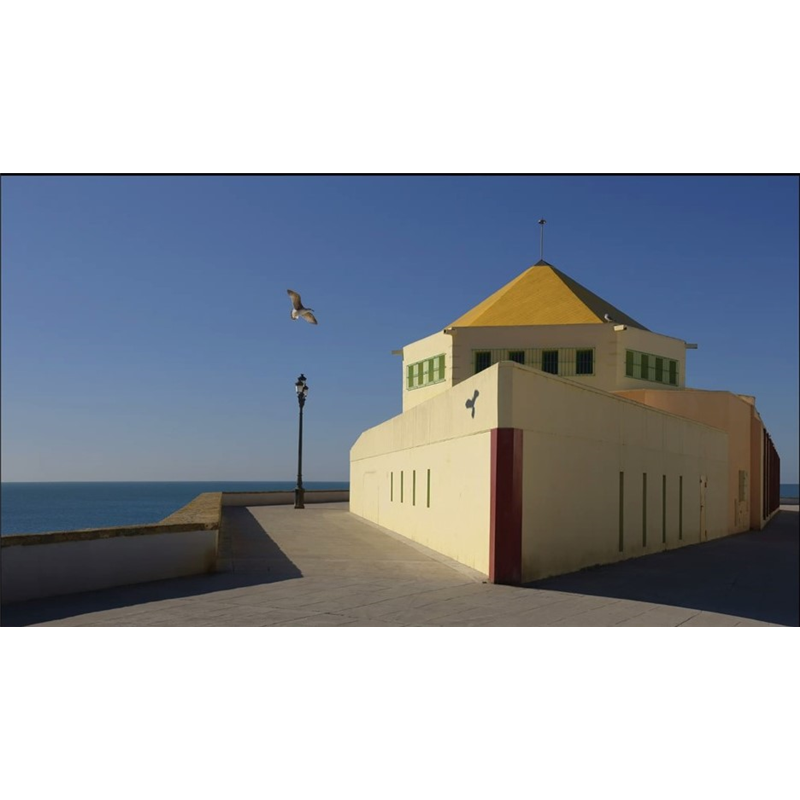 |
The Making of Landscape Photographs Is photography really ‘art’? Members of the Arts Society Wokingham were left in no after doubt after attending Charlie Waite’s illustrated on-line talk entitled ‘The Making of Landscape Photography’. Charlie is justifiably hailed as one of the world's leading landscape photographers. Some of his early photographs may have been the result of being in the right place at the right time - such as an early black and white image of four girls with their bikes queuing for a ferry in Vietnam. But it is Charlie’s artistic vision and attention to detail that has made him so successful. The audience were treated to a stunning set of his photographs taken all over the world. Strongly influenced by the French photographer, Henri Cartier-Bresson, Charlie stressed that the landscape photographer’s emotional connection to nature is vital. To quote Cartier-Bresson the most evocative images are achieved by ‘putting one's head one’s eye and one's heart on the same axis’. A good photograph can create many sensations - wonder, joy, serenity. The Neurological Department at St George’s Hospital, London, have recognised the power of Charlie’s photographs and commissioned him to produce a large back-lit image to display in their Reception area. This image of light streaming through a wood one early spring morning is bringing pleasure and a sense of calm and serenity to both patients and staff. More recently Charlie has become interested in the way that shapes work together - their colour, pure lines and their geometric patterns. His photograph of a boat-shaped building in Cadiz, illustrated here, shows that he still retains his attention to detail. Imagine how long he had to wait to capture the moment when a bird flew just above the lamppost and cast its shadow on the side of the building. It is rare privilege for the society to have the pleasure of hearing a living artist talk about their work. Our next on-line talk examines the eccentric and visionary world of one of the most creative and imaginative British painters of the 20th century, Stanley Spencer. Why not join us at 7.45pm on July 19th? Val Woodgate is our speaker. She is a well-known lecturer and guide at Tate Britain and Tate Modern. This talk is free and will be broadcast via our unlisted YouTube channel. Just email memsectheartssocietywham@gmail.com in advance and you will be sent the link the day before the lecture. For more details go to www.theArtsSocietyWokingham.org.uk Sue Bryant |
|
| Thursday, 10 June 2021 |
| Review of 'Underground Cathedrals' 17th May 2021 |
 |
Underground Cathedrals – The World Class Art, Architecture and Design of the London Underground The Arts Society Wokingham’s May lecture was ‘one of the best lectures I have attended either live or via zoom’ according to one of its members. High praise indeed, but well deserved. Ian Swankie’s enthusiasm for and knowledge of the London Underground kept his audience enthralled as he took them from the early days of railway construction through to the building of the Jubilee line extension and Crossrail. He drew the audience’s attention to the small details: the reason why Jacob Epstein’s sculpture of ‘Day and Night ‘which adorns the exterior of original headquarters of the Underground Electric Railways Company was so controversial, the construction of beautiful blue glass ceiling which greets you as you travel up the escalators at the new Southwark station. It was Frank Pick, in the 1930’s, who recognised that a transport system could be aesthetically pleasing as well as functional. He engaged the architect, Charles Holden, to design a series of new Art Deco stations. He also commissioned Edward Johnston, an artist and calligrapher, to design the distinctive lettering still in use on signage. Harry Beck, an electrical draughtsman, created the format of the current grid map. The recognition of the importance of incorporating art into the planning and design of the ever growing London Underground system continues to this day. Architects were commissioned to design the 11 new stations on the Jubilee Line Extension and the 10 stations on the Elizabeth Line (Crossrail). Norman Foster designed the Canary Wharf tube and Crossrail stations. Public art has been a theme throughout the life of the Underground. Eduardo Paolozzi created the stunning mosaic murals at Tottenham Court Road station and Yayoi Kusama has recently been commissioned to create an installation outside the new Crossrail station at Liverpool Street. Similarly, London Underground also has a long tradition of commissioning memorable advertising posters. These include WW1 propaganda, safety advice (Mind the Gap), suggestions for day trips by rail and adverts for events and exhibitions. Before the lecture many of the audience thought they knew the Underground but as one member summed it up perfectly, 'Having travelled, both as a child and all my adult working life, on the underground system and been fascinated by it, I was amazed at how much I didn't know! I was like a visitor in a new country.' Guests, especially amateur photographers, are invited to watch our next lecture by the world famous photographer, Charlie Waite. The talk, entitled ‘The Making of Landscape Photographs’, will be streamed live to the society's unlisted YouTube channel at 7.45pm on Monday 21st June. Non-members should email memsectheartssocietywham@gmail.com in advance so that they can be sent the link. There is a guest fee of £5. More information about the society is available on our website www.TheArtsSocietyWokingham.org.uk Sue Bryant |
|
| Wednesday, 12 May 2021 |
| Review of 'Power, Propaganda and Men In Tights: English Art Under The Tudors' 19 April 2021 |
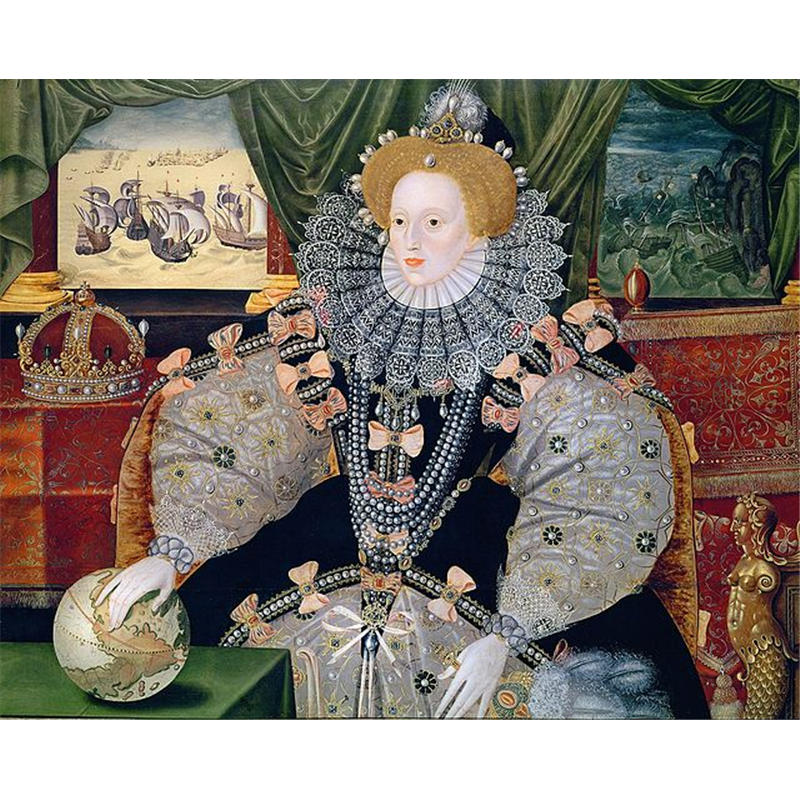 |
Power, Propaganda and Men In Tights: English Art Under The Tudors The Arts Society Wokingham’s April lecture had an intriguing title, ‘Power, Propaganda and Men in Tights’. Members soon realised that they were in for a real treat as Linda Smith took them on a visual journey exploring the symbolic details of portraiture in Tudor times. Many of the audience were familiar with the portraits of the Tudor monarchs but had not realised their original significance and purpose. First Henry VIII and then Elizabeth I embraced the idea that portraiture could be used as a means of communication and propaganda. Realism was not as important as symbolism. Throughout her long reign Elizabeth commissioned a series of portraits by different artists to mark occasions or emphasise aspects of her personality. Her Coronation portrait was rather formal but the Phoenix portrait of 1575 shows her dressed in an opulent gown encrusted with pearls (the symbol of chastity) and gold thread. She is wearing a large phoenix jewel round her neck which was a symbol of rebirth. In her hand is a rose which was a symbol of virginity. The Armada portrait is perhaps the most symbolic and features many different images celebrating the defeat of the Spanish fleet. Elizabeth is in the centre with her hand firmly placed on a globe - emphasising her role as’ the Warrior Queen’. It was not only royalty who commissioned portraits. Aristocrats commissioned family portraits to illustrate their dynastic power. There are also examples of portraits of pregnant ladies commissioned by their husbands, maybe as a memento in case the wife should die during child birth. Linda is an entertaining and knowledgeable speaker. She wove together the historical background of the paintings, all beautifully illustrated, and their symbolic details in such a way that it kept her audience enthralled. As one member summed up the lecture, ‘Brilliant speaker! I could listen to her for hours’. The society’s next on-line lecture is entitled, ‘Underground Cathedrals – The World Class Art, Architecture and Design of the London Underground’. Ian Swankie will reveal the unique architecture, ingenious design, powerful advertising posters and iconic calligraphy of the world’s first underground railway. He will also take a peek at a few of the new Crossrail stations, designed by some of the world’s top architects. The talk will be streamed live to the society's YouTube channel at 7.45pm on 17th May. To find out how to become a member of the society and have access to these varied monthly lectures please visit our website www.TheArtsSocietyWokingham.org.uk Sue Bryant |
|
| Thursday, 08 April 2021 |
| Review of 'Art and Illusion' 15th March 2021 |
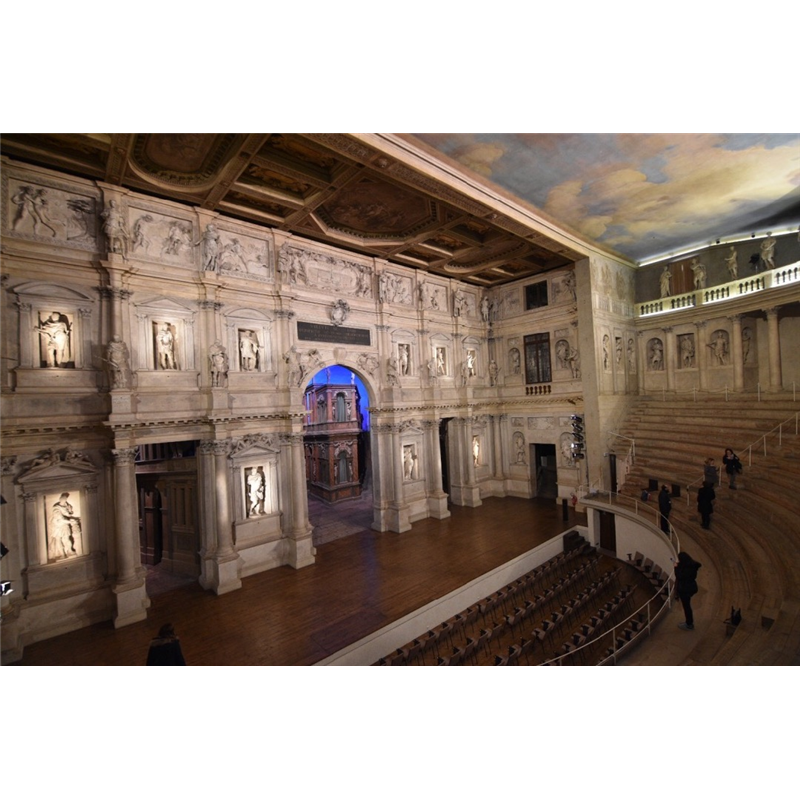 |
Art and Illusion Drawing on his wealth of knowledge and personal experience, Ian Gledhill, gave the members of The Arts Society Wokingham an informative and amusing talk on the origins, and development of stage scenery including the practicalities to be considered when designing stage sets. The origins of theatre date back to ancient Greece. Many of the words currently in use today are derived from Greek, including ‘theatron’ meaning ’a watching space’. Greek and Roman amphitheatres were often built of stone and set into a hill side - the view beyond the stage providing the only scenery. The origins of stage scenery in England date back to medieval times when simple painted wooden sets were mounted on wagons in front of which troops of travelling players performed mystery plays. By the sixteenth century purpose built theatres were being built in London by entrepreneurs such as Richard Burbage. These wooden theatres offered scope for permanent and more complex stage designs. Around the same time in Italy, the Teatro Olimpico was built with stage scenery, made of wood and canvas painted to create the optical illusion of streets stretching off into the distance. Ian reminded the audience that lighting played an important part in the evolution of stage scenery. In the Middle Ages and right up to the start of the nineteenth century stages were lit by candle light. Chandeliers hung from the ceilings of theatres giving off rather dim light which meant that the actors need to stand in front of the stage so they could be seen. The invention of gas lighting changed all that. More elaborate and deeper sets could be designed including real doorways and, balconies and even bridges. By 1881 gas lights had been superseded by electricity. For the first time the auditorium lights could be dimmed during performances. Nowadays stage scenery can range from the minimalistic through to the elaborate sets of West End musicals. Technology has opened up many more opportunities. Ian explained how he used CAD and Photoshop software to create the backdrop for the Spider Man show at Thorpe Park in a very short time frame. His designs were printed onto vast sheets of plastic by specialist printers and hung on scaffolding towers. Ian’s depth of knowledge and entertaining style left the audience wanting to hear more about his own theatrical experiences. Maybe the subject of a future lecture? The society’s next lecture will be on a completely different topic: ‘Power, Propaganda and Men In Tights: English Art Under The Tudors’. It was portraiture that dominated this period and Linda Smith will be considering the impact and function of some of the portrayals of the great monarchs and personalities of the Tudor age. The talk will be streamed live to the society's YouTube channel at 7.45pm on 19th April. To find out how to become a member of the society and have access to these varied monthly lectures please visit our website www.TheArtsSocietyWokingham.org.uk Sue Bryant |
|
| Thursday, 04 March 2021 |
| Review of 'Eric Ravilious – Networks of Arts and Design'
15th February 2021 |
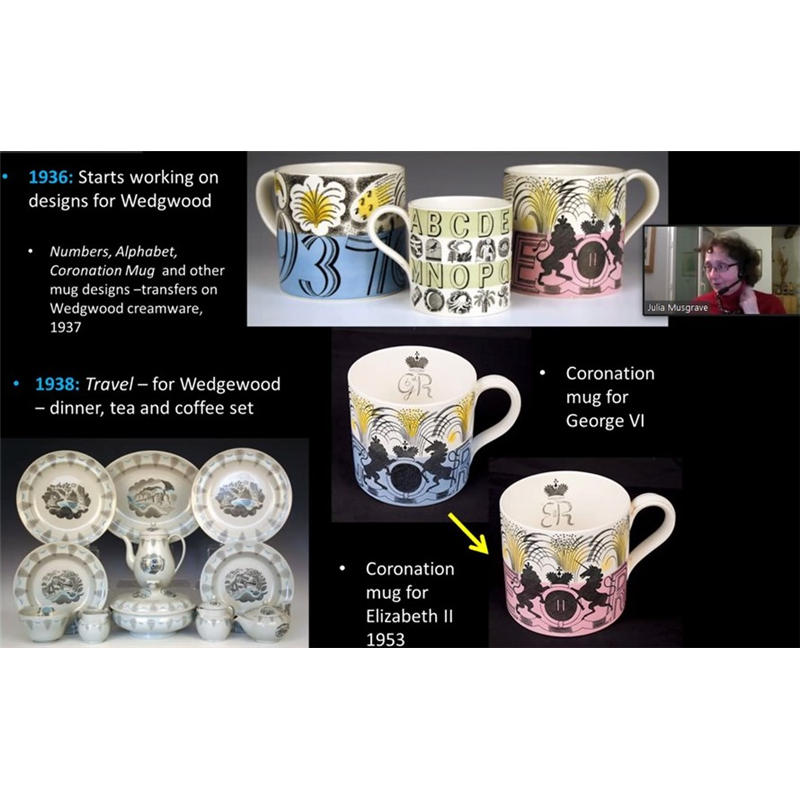 |
Eric Ravilious – Networks of Arts and Design Live from the south of France, Julia Musgrave shared her knowledge and enthusiasm for the art and design work of Eric Ravilious with members of The Arts Society Wokingham during their February on-line lecture. Julia took her audience through Ravilious’s short career from 1922 when, aged only 19, he won a scholarship to study at the Design School at the Royal College of Art through to his untimely death in 1942, aged only 39. At the Royal College of Art he was nicknamed ‘the boy’ by his contemporaries such as Cecilia Dunbar Kilburn and Douglas Percy Bliss. It was here that he met and became life-long friends with Edward Bawden and Peggy Angus. Under the tutelage of Paul Nash he developed his technique of wood-engraving and so impressed Nash that he helped Ravilious get commissions for his bold wood-cut designs. Ravilious also studied in the Department of Mural and Decorative Painting at the RCA which led to him and Bawden to undertake an important commission to design and paint the walls of the Refreshment Room of Morley College. They chose Shakespearean plays as their theme and when completed in 1928 these vast and detailed murals were highly acclaimed and made them both famous. Unfortunately the building was hit by a bomb during the Blitz and the murals were destroyed. Ravilious had become well known as a designer and in 1936 Wedgewood hired him as their leading pattern designer. He designed bowls, dinner services and mugs, including one to celebrate the coronation of George VI. These days, Ravilious is perhaps best remembered as a watercolourist. He not only took inspiration from his beloved South Downs, but also served as a war artist and painted many striking images of planes and ships including one of HMS Ark Royal in action in 1940. The aim of Julia‘s lecture was to explore whether the art of Eric Ravilious could have existed without the friendships and social networks which inspired and employed him: this she did. The society's next lecture is entitled ‘Art and Illusion’ by Ian Gledhill. This talk will illustrate the way in which theatre has developed over the past two and a half thousand years; in particular how stage scenery design has evolved and advanced in that time. It will be streamed live to the society's YouTube channel at 7.45pm on 15th March. To find out how to become a member of the society and have access to these virtual lectures, please visit our website www.TheArtsSocietyWokingham.org.uk Sue Bryant |
|
| Thursday, 04 February 2021 |
| Review of 'Gaudi and Catalan Modernista Architecture' 18th January 2021
|
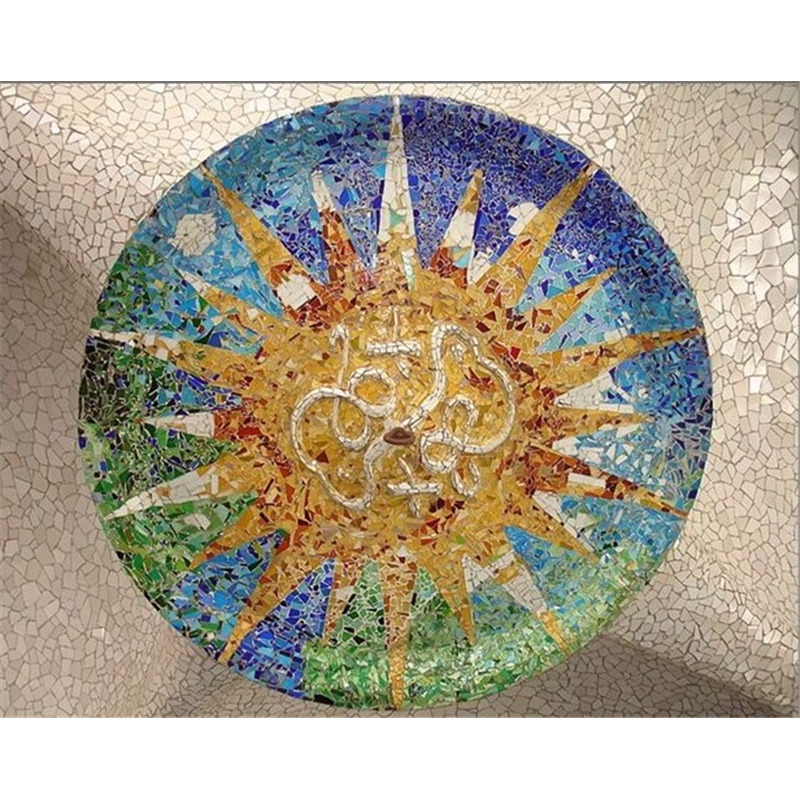 |
Gaudi and Catalan Modernista Architecture On a cold and dark January evening, members of the Arts Society Wokingham were transported to sunny Barcelona to revel in the ravishing extravagance of Gaudi's Catalan Modernista architecture. Live from Andalusia, Dr Jacqueline Cockburn shared her enthusiasm for Gaudi, illustrating her lecture’s theme, 'Fantasy comes from the ghosts', with glorious images, many of which were her own photographs.She explained how Moorish architecture was one of the 'ghosts' that inspired Gaudi. The slender columns and filigree work of the Alhambra and the Islamic 'muquarnas' style ceilings feature in many of his buildings. The influence of Gothic architecture can also be seen in his design of the soaring spires of the Sagrada Familia. Although drawing inspiration from the past, Gaudi used modern materials such as concrete, stone, steel and glass in his buildings. His style was truly innovative while embracing the principles of the Art Nouveau movement, using flowing and asymmetric lines and showing great attention to detail by the use of decorative ironwork and woodwork. In 1882 Eusebi Guell, a wealthy entrepreneur and friend of Gaudi’s, commissioned him to build a palace, Palau Guell. This was the first of several commissions which culminated in the creation of Park Guell. This project gave Gaudi full rein to combine his love of nature and his innovative design capabilities to create a hillside community on the outskirts of Barcelona. It involved collaboration with many other Catalan Art Nouveau craftsmen who specialised in different media. The illustration show’s one of Jujol’s exquisite ceiling mosaics. Jacqueline’s love of her subject and wealth of knowledge inspired her audience to look at Gaudi’s work in greater depth. As one member commented, ‘I immediately had to look up photographs, notes and guide books of previous visits to Catalonia and Andalusia. Reliving the wonderful sites was a joy and the lecture added a further dimension’. The society's next lecture will be on the work of Eric Ravilious, one of the best-known of Britain’s 20th century artists. It will explore whether his art could have existed without the friendships and social networks which inspired and employed him. The talk will be given by Julia Musgrave, a well-known art historian and streamed live to the society's YouTube channel at 7.45pm on 15th February. To find out how to become a member of the society and have access to these virtual lectures, please visit our website www.TheArtsSocietyWokingham.org.uk Sue Bryant |
|
| Wednesday, 30 December 2020 |
| Review of Christmas Extravaganza 18th December 2020 |
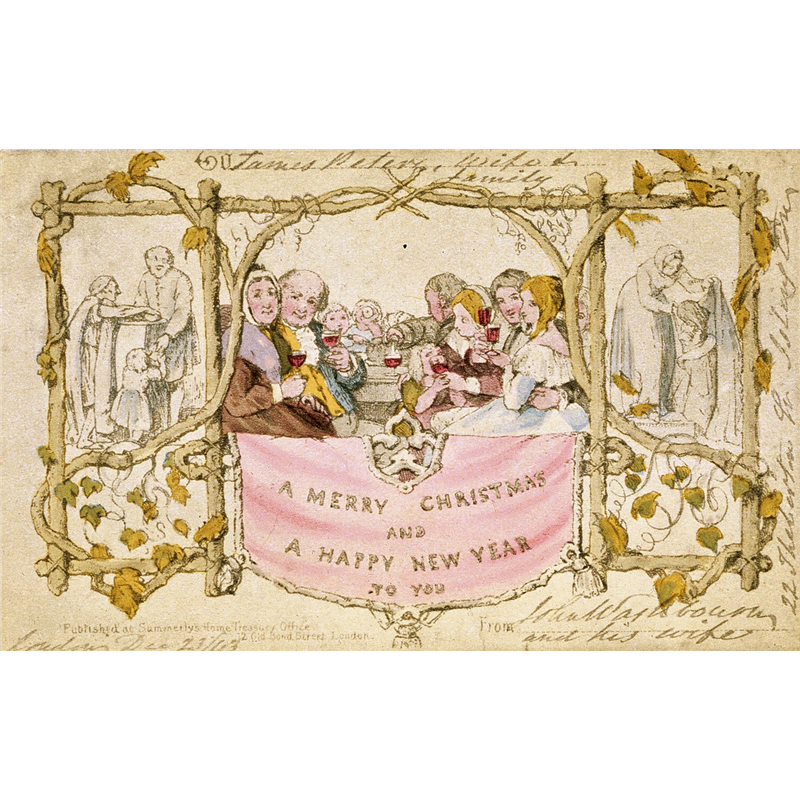 |
The Arts Society Wokingham’s Christmas Extravaganza Members of the Arts Society Wokingham really entered into the spirit of Christmas for their virtual Christmas Extravaganza last week. Dressed in our Christmas sweaters and Santa hats we chatted together on Zoom until Pepe Martinez muted us all and started his interesting exploration of the origins of our Christmas traditions from crackers and trees to Santa Claus and pantomime. We learnt that the tradition of sending cards started in 1843 when Henry Cole sent a beautifully illustrated card, shown above, to his friends. Today over one and a half million cards are sent each year and the sale of charity cards raises £50,000,000. After a short comfort break the afternoon continued with Simon Whitehouse taking us on a journey through Dickens’ London through the pages of “A Christmas Carol”: Scrooge and Marley’s Counting House (now a Fuller’s pub), St Michael’s Cornhill and Camden Town where Bob Cratchit and his family lived and also where Dickens himself grew up. Dickens’ personal championing of social reform was the inspiration behind the story which he hoped would strike a ‘” sledge hammer blow” on behalf of poor and uneducated children. Written in 1842, it also proved to be his most successful and popular novel. He earned more money from his public readings of the story then he did from the sale of printed copies. Within weeks of its publication, it sparked five different stage productions and in more recent years many film adaptations. I’m sure “The Muppet Christmas Carol” (which is my favourite) will be screened again this Christmas. In January, our members are off on a virtual trip to sunny Barcelona to savour Gaudi’s ravishing Catalan architecture. On Monday 18th January at 7.45pm Jacqueline Cockburn will take us on a tour of Gaudi’s Modernista public and private buildings. Membership from January for the rest of the season is only £40. For more details, please visit www.TheArtsSocietyWokingham.org.uk Sue Bryant |
|
| Sunday, 20 December 2020 |
| A Christmas Message from our Chair |
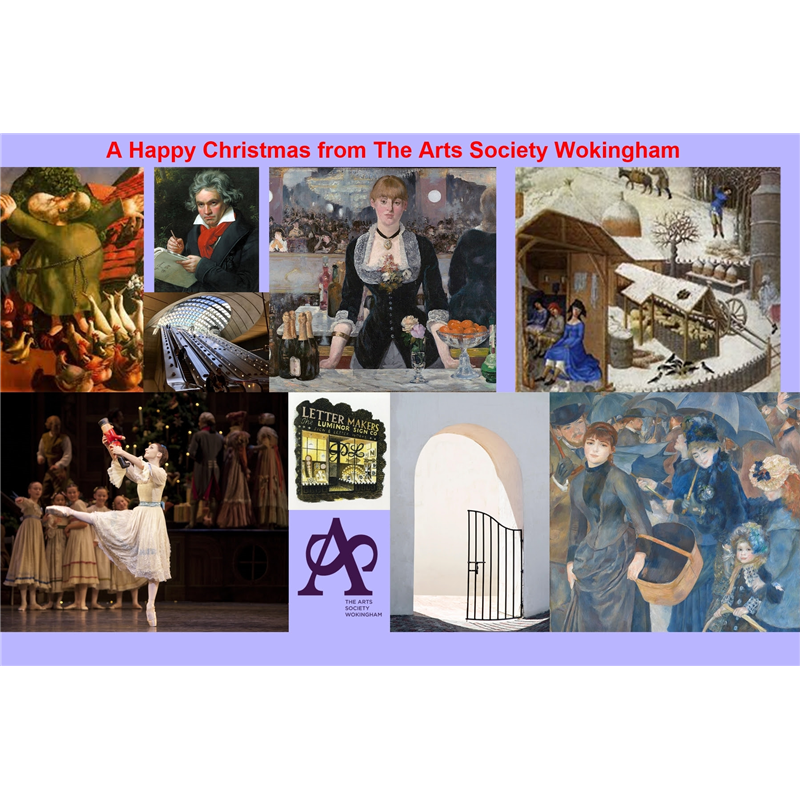 |
A Christmas Message from our Chair This last year has been a difficult one for everyone, to say the least, and looking back I’m so pleased that you have stayed with The Arts Society Wokingham during this period.
Your committee has worked hard to continue the lecture programme even if visits and study days have had to be suspended. By setting up our own YouTube channel and booking a varied programme of on-line speakers, hopefully you’ve had something to look forward to each month.
So, on behalf of your committee, I hope that you are able to make the most of this lock-down Christmas and stay safe and well next year when we can, at some time, resume our normal activities.
Committee member Maggie Holden has put together a reminder of some of the lectures this season (opposite) and from all of us we wish you well.
Robin |
|
| Saturday, 28 November 2020 |
| Review of 'Sing We Yule' lecture on 16th November 2020 |
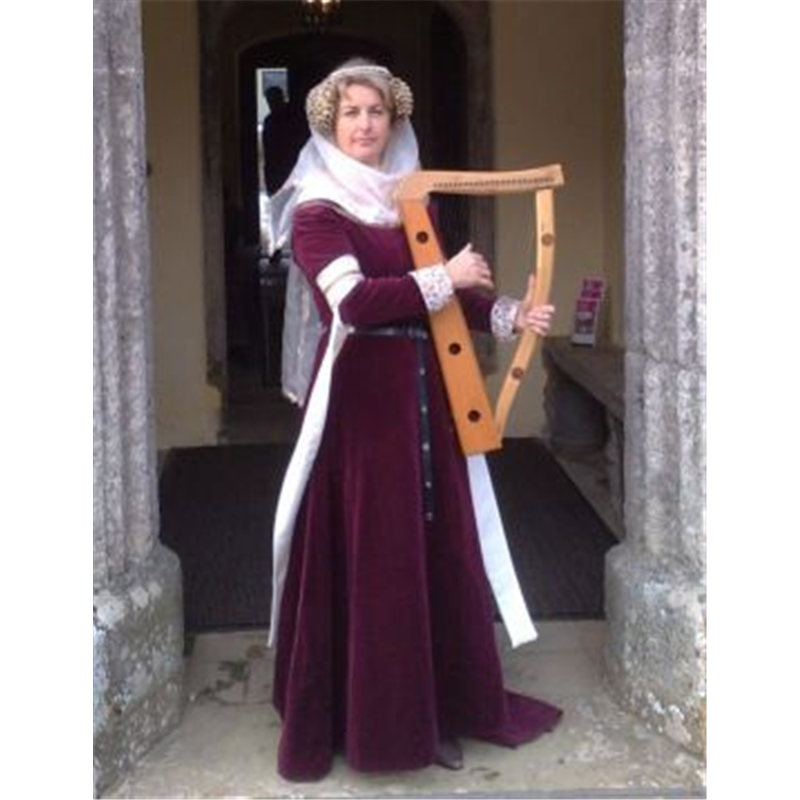 |
Sing We Yule - A Musical Portrait of a Medieval Christmas On 16th November members of The Arts Society Wokingham were invited to ‘Sing We Yule’ along with Sarah Derre-Jones. She set the scene by describing the long cold winters of the Middle Ages. The Little Ice Age’ culminated in England in 1410 when the Thames stayed frozen for more than 12 weeks. By means of illuminated manuscripts and reference to contemporary accounts she showed that despite the cold and harsh conditions Christmas was celebrated in style in a medieval manor house. Carols featured in these festivities, some of them such as the Coventry Carol we still sing today. Drinking songs were also greatly enjoyed by the peasants and Sarah was joined by her husband, Baldrick, (aka Phil) singing and playing a selection of rowdy drinking songs. However, the highlight of this virtual lecture was Sarah’s collection of reproduction medieval instrument s whose names may be known to us but which are rarely seen or heard: the hurdy-gurdy, the plucked psaltery, the hammered dulcimer and the medieval harp among others. Sarah explained in great detail how each of these fascinating instruments worked. Members were particularly interested to see her demonstrate the complexities of the hurdy- gurdy which she nick-named the ‘medieval synthesiser’. Despite a few technical glitches, courtesy of the rather ‘cobbled super highway’ connection from deepest Cornwall, Sarah captured the essence of a medieval Christmas and started the festive season with a flourish. Carrying on the Christmas theme, the Society is offering its members a special bonus event: ‘The Spirit of Christmas - a festive virtual Christmas Extravaganza’. This will be an interactive event hosted by Pepe Martinez and Simon Whitehead who are both Blue Badge guides with theatrical connections. In the first part they will explore the origins of our Christmas traditions. After a short interval the fun really begins with a virtual performance of “A Christmas Carol” with a strong Dickensian theme. This exciting event will take place on Friday 18th December at 3pm so It is not too late to join the Society in time to take part. For more information, please visit our website www.theartssocietywokingham.org.uk Sue Bryant |
|
| Friday, 30 October 2020 |
| Review of 'Beethoven at 250' lecture on 19th October 2020 |
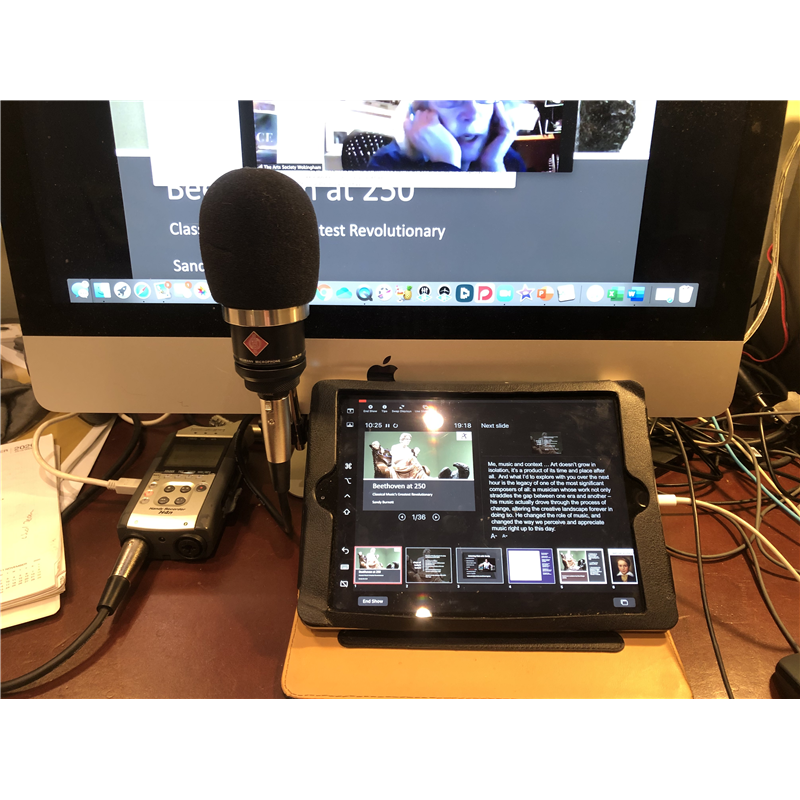 |
Beethoven at 250: Classical Music’s Greatest Romantic The Arts Society Wokingham’s October virtual lecture celebrated the 250th anniversary of Beethoven’s birth. Our lecturer, Sandy Burnett, is one of BBC Radio 3’s core team of presenters; his professionalism is obvious from the image above of his home recording studio. The society’s technical team are really jealous and are demanding an upgrade! In his relaxed style, Sandy took us through the life and times of the great composer. Beethoven came to Vienna in 1792 as’ an unlicked bear cub’ but soon won the support of rich and important sponsors. His increasing deafness which started in his late 20s, stopped him performing as a pianist but did not stop his prolific composing of string quartets, piano sonatas, concertos and symphonies. Sandy‘s choice of musical excerpts perfectly illustrated the different stages in his composing journey. Surprisingly the lecture did not end with the famous choral ‘Ode to Joy’ from the final movement of the 9th symphony but with the lesser-known poignant piano Bagatelle no. 3 opus 126. At the start of the lecture Sandy had posed the question - Beethoven - Romantic or Revolutionary? By the end of this virtual lecture, we were convinced that Beethoven was truly a revolutionary as well as a romantic. By expanding Mozart’s elegant Classical style of music he blazed the trail to Romanticism. He inspired his successors, such as Mahler, Brahms and Schoenberg, to take classical music in previously unimagined directions. Our next lecture will also include some music, but with a seasonal theme. Sarah Deere-Jones will be bringing alive the spirit of a medieval Christmas. Her lecture is entitled ‘Sing We Yule - A Musical Portrait of a Medieval Christmas’ and will include music on reproduction medieval instruments as well as illustrations from illuminated manuscripts, contemporary accounts and haunting songs. The lecture will be available to members on the society's YouTube channel at 7.45pm on 16th November To find out how to join the society and have access to these interesting and varied lectures on all aspects of the arts, please visit our website www.theartssocietywokingham.org.uk |
|
|
| Saturday, 18 July 2020 |
| July 2020 Bulletin - bonus on-line lecture in August |
 |
Hello Everyone
As the lockdown is being carefully lifted in the country your committee have been very keen to understand and implement on-line delivery of lectures until we can resume live lectures at Newbold Church.
We have already booked lecturers for September, October and November 2020 who can give on-line lectures. These will go out at the same planned time and date as the normal lecture (NB the third Monday of the month this season at 7.45pm) and you will be able to see them on any smart device (computer, laptop, iPad, tablet or even mobile phone) via our own YouTube channel, with a secure link that we will email to you the day before.
However, I’m now delighted to announce that we have arranged a special bonus lecture (details below) in August to remind you of what we have all missed over the last few months. The Impressionists and the Painting of Modern Life
by Dr. Lois Oliver This will only be available on Monday August 17th 7.45pm Make sure that you look out for our email on the 16th which will give you the link There is another reason for this full lecture. Your committee is focused on giving you a professional experience but it will be our first on-line lecture and things might not always work as smoothly as we’ve planned. This is where you can help.
We need your feedback on how this preview was for you. So, in the feedback section on our website after the lectures, can you also comment on how the on-line experience worked for you:
was it easy to connect, how did you watch it and in the absence of a live lecture did this work for you? We would really like to get comments from as many people as possible - it’s your society and we need to hear from you. We also want to make sure that some members who don’t always read these bulletins, know about this lecture and understand the link. So perhaps you could just check that any friends who are members, who might fall into that category, are made aware of it. If you really want to make sure that these bulletins and important links do not end up in your junk mail you could put the address in your contacts list: (memsectheartssocietywham@gmail.com).
Let me emphasise that as soon as we can get back to live lectures in the Church, we will. In their absence, we want to deliver something that you will enjoy and hopefully encourage you to stay with us for the next season. FORTHCOMING LECTURES Due to the Covid-19 constraints we are unable to issue bookmarks or a printed booklet with the programme for the coming season. However, full details of all lectures will be posted on the website as normal and we’ll take the opportunity to remind you in these regular bulletins. Below is a list of lectures to be given, up to Christmas.
All lectures will be on-line, starting at 7.45pm for that night only. The on-line, secure link will be E-Mailed to you the day before each lecture.
17th Aug: The Impressionists and the Painting of Modern Life
by Dr. Lois Oliver.
21st Sept: John Singer Sargent - Power of the Portrait
by Alexandra Epps.
19th Oct: Beethoven at 250:Classical Music's Great Romantic
by Sandy Burnett.
16th Nov: Sing We Yule: A Musical Portrait of Medieval Christmas
by Sarah Deere-Jones.
Click here to see more details of these lectures on our website. FOUNDRY COLLEGE STUDENT PRIZE WINNER In January we awarded a prize to one of the students at Foundry College in recognition of her artistic development. She wishes to thank TASW for giving her the confidence and opportunity to follow her artistic pathway. Her teachers say she has gained in confidence over the year and her next steps will be A-Levels then university, leading to a career in Graphic Design. Click here to see the powerful image that she created, which forms part of her GCSE coursework, and read about our other amazing Young Arts projects. AND FINALLY…...…… If you’ve not seen lectures delivered on-line before, they work remarkably well (although no substitute for the real thing).
Your committee is working hard to ensure that connectivity is very simple and basically involves just clicking on one link to our YouTube channel. If you want to check out that connection on your device in advance, we will be sending you a separate link to a test card some time before the actual lecture so that you can reassure yourself that it works. We very much hope that with these lectures, and a 50% discount on membership fees for existing members next season, you will feel able to sign up again when subscriptions become due in August, if only to ensure our survival until we can re-instate our full offering of live lectures, study days and visits. Thank you
Robin
Robin Cops
Chair |
|
| Monday, 01 June 2020 |
| June 2020 Bulletin |
 |
Full Lecture Programme Planned for Next Season Hello Everyone It’s been so disappointing and frustrating that we have not been able to deliver fully this season’s exciting programme that we had planned. These are strange and difficult times for everyone but as we cautiously come out of lockdown in the coming months, your committee is determined that we will be able to deliver a full programme of lectures for you for the next season starting in September.
Obviously there is uncertainty about the availability of our venue and the ability of audiences to get together. So we have taken the decision to deliver our lectures on-line until it is declared safe for everyone to get together again. The steps we have taken so far are: - We have formed a small working group to understand and engage with the technology that will enable us to deliver personalised lectures into your home. By the way, if anyone has specific knowledge of using Zoom and YouTube technology, we would like to hear from you as your experience could be very useful.
- Other Societies are now exploring and introducing similar technology and we are speaking to them to share experiences and develop our own best operating practice.
- In addition, Arts Society House (our co-ordinating body) is putting out specific guidance and help on these technologies for Societies.
- We are contacting our planned lecturers to ensure that they can provide lectures in this format. Over 100 nationally have already indicated that they are now able to offer this capability and most of our planned lecturers are in that group. Where that isn’t possible we’ll need to transfer bookings to other enabled lecturers.
- Of course we will have to make sure that most of you have the right equipment to receive the lectures so we’d like your help on that bit by letting us know what you’ve got. A later bulletin will clarify.
AGM
Another event that is scheduled for September is our AGM and we clearly won’t be able to do that as a live event. So our intention is to post all papers on the website in advance (as always) to enable you to ask any questions on them before the AGM. We can then cover those separately on the website. We are hoping that voting on motions can also be enabled via the website. More news, nearer the time.
VISITS AND STUDY DAYS
With this wonderful and consistent weather that we have had, it’s such a shame that we’ve had to put our Visits program on hold. However, we will reinstate it as soon as it is safe to do so. Similarly with the Study Days, depending on the availability of the planned lecturers.
ARTS FOR FREE I’ve included this section in previous bulletins but in talking to some of you I think you’ve now got the general idea of where to look if you want to see arts output on your TV or devices. So I’ve indicated below some general sites for reference that you can explore yourself. I’m sure that you’ll find something that you like there.
Theatre: - WhatsOnStage at Home is a useful guide that comes out several times a week and contains a lot of free material in their site https://www.whatsonstage.com/london-theatre/news/stage-shows-musicals-opera-free-stream-online_51198.html
- Culture Fix:
This is a great general-purpose site with content from all around the world – it even includes The Arts Society Connected talks!
https://culturefix.digital/ - The Arts Society
I hope that you’ve kept an eye on the TAS website as they have been putting out some excellent material in their blogs, “Become an Instant Expert” column and the Connected platform mentioned above. My favourite so far is the excellent YouTube video of Nicola Moorby talking about the twenty-pound note and the art of J.M.W Turner. So much information in such a short talk – don’t miss it. www.connected.theartssociety.org
AND FINALLY…...……
On-line delivery involves a big learning curve for the committee but it’s a challenge that we are looking forward to, to make sure that we do not lose our Society which we have worked so hard to build up over the last 5 years. With your help, support and understanding, I’m sure we’ll get there.
Robin
Robin Cops
Chair |
|
| Sunday, 03 May 2020 |
| May 2020 Bulletin and links to free on-line cultural activities |
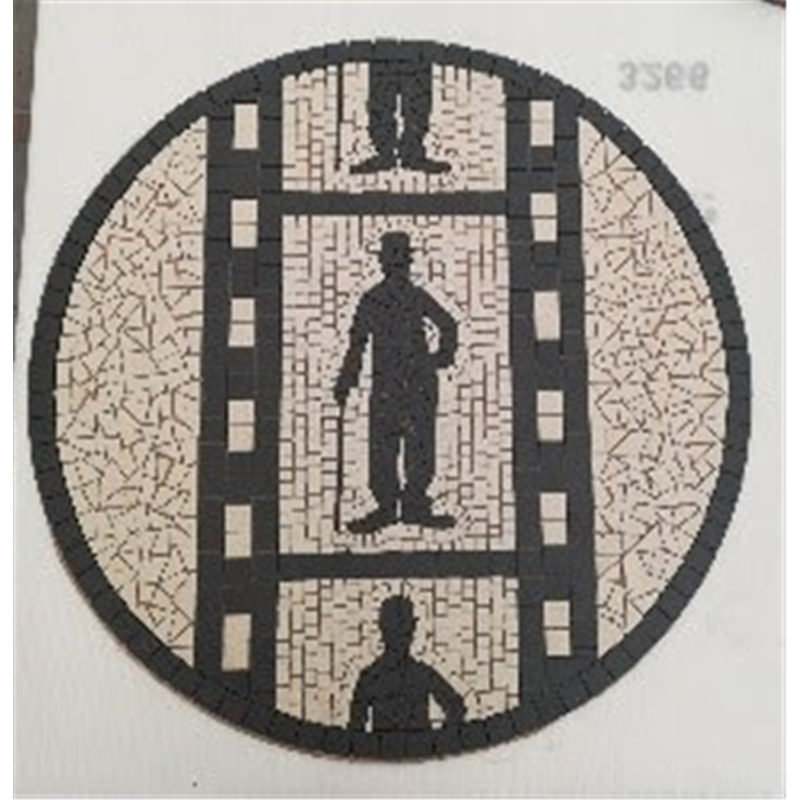 |
Hello Everyone We are now into our sixth week of lockdown and whilst The Arts Society Wokingham might have seemed quiet on the activity front, your committee has been meeting (on Zoom of course) to try and manage our future in these exceptional times. Here are some outcomes:
- July Lecture and Study Day Postponed: Although both Newbold Church and the Wokingham Theatre are big enough to allow our normal audience to be seated with respect to social distancing, both venues are currently closed to outsiders. It is also our view that July would most probably be too soon for members to get together even if restrictions on gatherings were lifted by then.
Therefore, we have reluctantly taken the decision to postpone both the study day on The Bauhaus and the lecture on Stanley Spencer until, hopefully, some time in the next season. - At this time, we are not altering our arrangements to our planned programme of lectures from September onwards. However, we have already started to think what we might be able to do for our members if the social distancing continues after summer and hopefully I’ll be able to report back on that in the next bulletin.
- In addition, you will already have seen that The Arts Society national organisation under the title of The Arts Connected has been putting out on-line arts talks and articles and we are hoping that in the next few weeks we can announce an expansion of that. You can find more details at https://www.connected.theartssociety.org/
Already they have published several features and blogs including an excellent short talk by Sarah Dunant, who came and talked to us a year ago. - The lists of free online arts material that we put out at the beginning of April have been well received and so you’ll find a brief update at the end of this bulletin.
And finally, many of you will have seen the Charlie Chaplin mosaic outside the Everyman Cinema that our society sponsored last year as part of the Mosaic Trail through town. We were all set to officially launch that with a publicity event including a free showing of a Chaplin film in the cinema, when the crisis hit. Nevertheless, you can see the associated, explanatory film about the original cinema in town, together with all the other mosaic films, by going onto YouTube and typing in “Wokingham Mosaics”. If you listen carefully you will notice that the commentary on this (and all the films) is by our own Vice-Chair, Paddy Haycocks. Enjoy.
Robin
Robin Cops, Chair, The Arts Society Wokingham
Arts for Free - where can I find it?
May update
As before we make no claim to this being definitive nor do we necessarily recommend the items- this is just to help you find some interesting Arts programmes on-line, broadcast or social media.
Theatre:
National Theatre at Home: currently showing Frankenstein, next week will be Anthony & Cleopatra. Plays are on for a week so be careful not to miss them!
Details at: https://www.nationaltheatre.org.uk/nt-at-home
Chichester Festival Theatre: Flowers for Mrs Harris, the hit musical from 9th April – 8th May.
Details at: https://www.cft.org.uk/flowers-for-mrs-harris-broadcast
Donmar Warehouse
Midnight Your Time. Starring Diana Quick. Donmar YouTube channel from 7 p.m. on 13 May 2020. It will then be available for a week.
The Globe Theatre. Currently showing Romeo and Juliet. This will be followed by The Two Noble Kinsmen, Macbeth, A Winter's Tale and The merry Wives of Windsor.
Details at: https://shakespearesglobe.com/watch/
Everything Shakespeare. Lots of talks, articles and plays.
Details at: https://www.youtube.com/user/TheShakespeareNinja
Dance:
Bolshoi Ballet: A daily ballet can be found here: https://www.youtube.com/user/bolshoi
Opera:
Metropolitan Opera House New York. Every night they are streaming a different opera in full. This week includes Cavalleria Rusticana and Pagliacci.
Details at: https://metopera.org
Royal Opera House:
Details at: https://www.roh.org.uk/news/the-royal-opera-house-launches-a-programme-of-free-online-content-for-the-culturally-curious-at-home
BBC iPlayer.
Just a reminder that if you go to 'Arts' in Categories, there is a huge selection of programmes, both current and archived.
Culture in Quarantine: an extensive selection of plays, exhibitions, talks and art festivals including the Royal Shakespeare Company (6 productions) and Northern Ballet.
Details at: https://www.bbc.co.uk/mediacentre/latestnews/2020/culture-in-quarantine
Museums, Galleries, Films
The Ashmolean: If the lockdown stopped you seeing the Young Rembrandt exhibition, go to a superb ½ hour guided tour by Simon Sharma in the Museums in Quarantine series on BBC iPlayer (worth watching all four in the series)
See more on this exhibition plus a virtual tour of the museum.
Details at: https://www.ashmolean.org/
The Courtauld Gallery: has a virtual tour as well as a new “Open Courtauld Hour” every Thursday evening from 30 April to 21 May.
Details at: https://courtauld.ac.uk/
The National Gallery:
Lots of stuff on YouTube . Why not start with a quick virtual tour https://www.youtube.com/watch?v=P4q7F4fU3kA and then explore London Original Print Fair: A free exhibition
Details at: https://londonoriginalprintfair.com/
Ken Loach has released his films free on YouTube
Detail at:https://www.youtube.com/user/KenLoachFilms and other YouTube searches
Pottery
This is a short film of an exhibition by potter Karen Marks at our local arts centre where we support some work with young people under our Young Arts programme.
Details at:
https://www.youtube.com/watch?v=5q0NNXUkkug&utm_source=South+Hill+Park+Ecomms&utm_campaign=db70092e43-September+Newsletter+2018_COPY_01&utm_medium=email&utm_term=0_31c1a977ba-db70092e43-89137781
…and finally some fun with art
People have been enjoying their shutdown by re-creating masterpieces. Try these:
https://www.channel4.com/news/how-isolation-art-is-reimagining-old-masterpieces-in-often-hilarious-ways
https://www.sadanduseless.com/recreated-art/
|
|
| Wednesday, 08 April 2020 |
| Arts for Free April 8th 2020 |
 |
Hello members
The previous list seemed to go down well so here is an update for you. Some of this is at very short notice and only stays on for 24 hours so do use your creativity to find your way round YouTube, Facebook etc. As I said previously, we take no responsibility for the accuracy or content of the list but it, at least, points you in the right direction.
Do let me know if you find something others might be interested in and I can add it to the list The list will stay on our website as well, under News.
Take care everyone
Robin
chairtheartssocietywham@gmail.com
Links:
Live Lectures:
You will by now have heard of The Arts Society announcement for its series of free on-line lectures. It made the main news on BBC Radio 4 as well as newspapers.
https://www.theguardian.com/education/2020/apr/07/arts-society-to-launch-online-lectures-for-over-70s
The first one on Las Maninas by Valesquez was announced in the new 'Connected' platform of TAS.
https://www.connected.theartssociety.org/talks-lectures
More lectures will follow every month.
Some filmed lectures on fine art can also be found at
https://www.gresham.ac.uk/schools/art
Theatre:
National Theatre at Home: From Thursday 9th April) a tremendous version of Jane Eyre - an amazing production from the Bristol Old Vic. Note that these productions stay available for 6 days after the Thursday, so currently One Man, Two Guvnors is still avalable if you missed it.
Details at: https://www.nationaltheatre.org.uk/nt-at-home
Hampstead Theatre: This week from Monday, Wonderland, a play set in the Miners Strike.
Details at: https://hampsteadtheatre.com/whats-on/hampstead-theatre-at-home/wonderland
Chichester Festival Theatre: Flowers for Mrs Harris, the hit musical from 9th April.
Details at: https://www.cft.org.uk/flowers-for-mrs-harris-broadcast
The Globe Theatre: Hamlet for 2 weeks followed by 5 other plays
Details at: https://shakespearesglobe.com/watch/
Dance:
Sadler's Wells: Available to watch on the Sadler's Wells Facebook page until 10th April. BalletLORENT's new dance-theatre fairy tale production Rumplestiltkin.
Details at: https://www.sadlerswells.com/whats-on/2020/digital-stage/
Bolshoi Ballet: A daily ballet but with only 24 hrs notice! Try the site on YouTube especially if your Russian is passable!
Details at:https://www.youtube.com/user/bolshoi
Opera:
Metropolitan Opera House New York. Every night they are streaming a different opera in full. This week includes Wagner's Parsifal and Mozart's Cosi Fan Tutte.
Details at: https://metopera.org
Royal Opera House: Each Friday a full opera at 7 p.m. on YouTube and Facebook. This week Acis and Galatea will be followed by Mozart's Cosi Fan Tutte. So if you are really keen you could compare it with The Met's!
Details at: https://www.roh.org.uk/news/the-royal-opera-house-launches-a-programme-of-free-online-content-for-the-culturally-curious-at-home
BBC:
BBC iPlayer. Just a reminder that if you go to 'Arts' in Categories, there is a huge selection of programmes, both current and archived.
Here are a few that I have picked out:
Titian Behind Closed Doors. BBC2 to accompany the now closed exhibition.
Behind the Scenes at the Museum. A fascinating series on the V&A.
Sex and Sensuality - History of Art Nouveau. An excellent series but finishing soon.
The Art of the Image. A slightly annoying commentary but full of wonderful images.
Augustus and Gwen John. A somewhat dated (1975) programme, but fascinating nevertheless, about the now out-of-fashion painter and his sister. (n.b. if you would like to get a fuller picture of 'Gus', Augustus John, the New Biography by Michael Holroyd is available on Kindle for about £5 - a good read).
Culture in Quarantine: an extensive selection of plays, exhibitions, talks and art festivals including the Royal Shakespeare Company and Northern Ballet.
Details at: https://www.bbc.co.uk/mediacentre/latestnews/2020/culture-in-quarantine
Museums and Galleries
Missing your visits to the museums? Here is a great article with links to virtual tours of some of the top museums and galleries in the world.
Details at: https://www.theguardian.com/travel/2020/mar/23/10-of-the-worlds-best-virtual-museum-and-art-gallery-tours |
|
| Thursday, 02 April 2020 |
| Arts for Free April 2nd 2020 |
 |
Hello members In this unprecedented period where access to our arts activities has been severely curtailed, a lot of theatres, concert halls and academic institutions have started to put out free access material on the internet to keep people occupied and entertained. Some have received wide publicity but even so it’s not always easy to find them. So, your committee thought it might be useful to list a few of these for you to have a look at. We make no claim to this being definitive nor do we necessarily recommend them but you should find something to your liking. Most material can be accessed through the organisations’ websites where there will be instructions on how to view it. Today I will just highlight some events but I hope to produce these occasionally and if you have found an event that you like, let me know. I’ll try and include it in future lists (no promises though) I hope you enjoy looking at some of these events and can keep positive and healthy during these difficult times. Take care everyone Robin chairtheartssocietywham@gmail.com Links: Theatre:
National Theatre: from today (2nd April) and each Thursday at 7 p.m. the NT will show a NT Live production of their top plays, starting with 'One Man Two Guvnors', on the YouTube platform.
Details at http://www.youtube.com/channel/UCUDq1XzCY0NIOYVJvEMQjqw
Hampstead Theatre: From this Monday a production each week for three weeks. This week 'Wild' by Mike Bartlett.
Details at: https://www.hampsteadtheatre.com/
Dance:
Sadler's Wells: until Friday 3rd at 7.30 p.m. BalletBoyz's new piece 'Deluxe' on Facebook.
Details: https://sadlerswells.com/whats-on/2020/digital-stage/
Opera:
Royal Opera House: Each Friday at 7 p.m. a full opera on YouTube and Facebook. This week 'Acis and Galatea'.
Details: https://www.roh.org.uk/
Metropolitan Opera House New York: Every night they are streaming a different opera in full. This week includes Verdi's 'Macbeth' and Rossini's 'The Barber of Seville'.
Details: http://metopera.org
BBC:
Culture in Quarantine: an extensive selection of plays, exhibitions, talks and art festivals including the Royal Shakespeare Company and Northern Ballet.
Details: https://www.bbc.co.uk/mediacentre/latestnews/2020/culture-in-quarantine
Museums:
Smithsonian Washington. They have an open access section during the crisis.
Details: https://www.si.edu/openaccess
Live Lectures:
Some filmed lectures on fine art can be found at https://www.gresham.ac.uk/schools/art |
|
| Thursday, 19 March 2020 |
| Coronavirus update 19th March 2020 |
 |
Dear Members
With the Coronavirus epidemic now spreading rapidly and Government recommendations coming daily, your committee have been looking at our programme for this year. As you know we have already cancelled Monday’s lecture but rather than do this piecemeal each month, we have now, regretfully, taken the following decisions.
All planned activity by our society will be suspended for the months of April, May and June. Towards the end of that period we will again assess whether we can resume our activities for July or maintain that suspension until the start of the new season in September. · The Visits and Study Days will be postponed and fitted into next season where possible. · Since most of next season’s lectures are already contracted, we will not be able to consider re-booking the affected lectures until the 2021/22 season which we will do our outmost to achieve. But for the time being you should consider these cancelled. · Currently committee members are negotiating with lecturers to amicably minimise the costs of the cancellations. Our venues (Newbold Church and Wokingham Theatre) are now both closed to outside events so there are no cancellation costs incurred there. In addition WBC will not charge us for the cancellation of our monthly committee meeting room. · After June, if matters ease, we will be able to have a final study day and lecture before the summer break. So could you keep the Bauhaus Study Day (3rd July) and the Stanley Spencer lecture (27th July) in your diary for the time being. Of course we’ll be back to you to clarify the situation before the end of June. Obviously you have paid your membership for a full programme which will not now happen and we feel we would like to compensate you for the loss where possible. However, we are a relatively small society run by our own volunteer members. So in order to minimise administration we would ask you to co-operate on the following basis. · Membership costs next year will rise to £50 – the first increase in 5 years and still extremely good value. However, for existing members who are renewing this summer, we will charge £25 for the whole year. This effective credit of 50% will enable us to avoid the complication of returning monies to individuals. If you can’t join next year perhaps you might consider not asking for any refund and donating that credit to your society to help it continue into the future. · For the one visit (Strawberry Hill) and the one study day (Andy McConnell) in the future that have been sold so far, we are currently negotiating to reschedule these events into next season’s programme. Those who have paid will be offered first places. So we won’t return monies currently but will sort out returns for members unable to attend the re-scheduled events nearer the time. We are still going ahead with the production of next year’s brochure detailing the planned programme – it does look good and should be available in June. We will also see if we can separately send you some links to virtual lectures and programmes to keep up your arts appreciation and enthusiasm. But at the moment your committee is busy sorting out the above matters. I suspect that soon we will have much more time to fine tune this support from your Society………….
It is such a pity that we have to cancel our planned enjoyment of the arts in the short term but these are difficult times for us all. So the committee and I hope that you will get through this period and look forward to things getting back to normal for next season. If you want to discuss any of the points above please contact me at chairtheartssocietywham@gmail.com
Keep well
Robin Chair The Arts Society Wokingham |
|
| Friday, 28 February 2020 |
| Review of 'Figures in the City' lecture on 24th February 2020 |
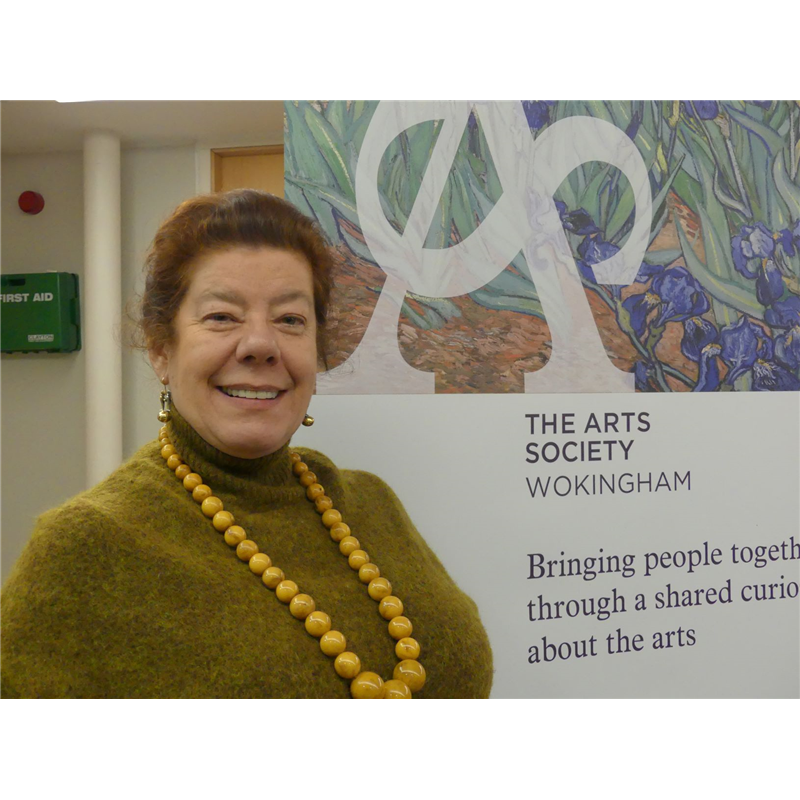 |
Figures in the City: Picturing People in Post-War London London, battered and bruised immediately after the war, produced a climate of creativity in art and Jo Walton took us there vividly and enthusiastically in her Arts Society, Wokingham lecture, sponsored by Clifton Ingram. It was a time of wealth and poverty, glamour and squalor which inspired artists and photographers like John Deakin. To illustrate the importance of their work, Jo described the sale in 2013 of Francis Bacon’s triptych, ‘Three studies of Lucien Freud’, for $142 million, breaking all records at that time. This was when the art market became extraordinary; auctions were entertainment and prices were pushed up. Going back to the forties, young artists like John Minton, John Craxton and Lucien Freud knew passionately the type of art they wanted to produce. Minton, troubled with depression, felt the city was becoming part of him and painted himself alongside the shells of bombed, roofless buildings. Craxton felt hemmed in by the landscape, eventually living in Greece, while Freud developed a more surrealist element in his early work. A zebra head, a lover’s gift, appears in several paintings. Later, he had a studio in badly damaged Paddington where he lived outside normal society. His painting, ‘Charlie’, a young lad smoking, evokes this time. Freud was comfortable with these folk who respected him. A level of darkness came into many art works including photography. He married Kitty Epstein and she became the subject of many meticulous portraits showing his intense examination of his subject, something that continued throughout his life. When Freud learned from Graham Sutherland that the best painter of their time was Francis Bacon, he decided he must get to know him. The two artists became friends. Bacon led a chaotic, unconventional life. Although he mixed with society, he also associated with low life. Many people were shocked by his art while others found it exciting. His paintings often showed individuals as if in a glass box, alienated. This was a skilled, disciplined style, influenced by great art of the past. With the desolation of London, people craved colour. Fashion became more exuberant; Cecil Beaton photographed women in dazzling ball-gowns. Freud knew the right people and started to paint them but he still lived life on the edge, gambling heavily. The mid-fifties saw the introduction of pop art, using images of everyday life and collage, leading on to the work of David Hockney in the sixties and seventies. This was not Freud’s style and he continued with his detailed portraits, working himself to exhaustion to achieve his results. Art became popular in society, epitomised by the glamorous Snowden photograph of Princess Margaret. The ‘Black Tie Auction’ had arrived. And Jo brought us back to where she started, a celebration of a fascinating period producing some amazing artists. We all learned so much; the general reaction was ‘Wow!’ Our next lecture, The Art of Partying will be held on March 23rd at The Newbold Church, St Marks Road, Binfield, RG42 4AN, commencing at 7.45pm. Do join us. Visitor Fee: £8. To find out more about the Arts Society, check out our website: www.theartssocietywokingham.org.uk. Linda Fawke |
|
| Friday, 31 January 2020 |
| Review of 'Rembrandt and Vermeer: Titans of the Golden Age of Dutch Art' lecture on 27th January 2020 |
 |
Rembrandt v Vermeer - Duel of the Dutch Titans Even the most entrenched philistine would have found it difficult not to enjoy Lucrezia Walker’s excellent lecture on Rembrandt and Vermeer, delivered to The Arts Society Wokingham at Newbold Church, Binfield. Her engaging style and presentation held the attention of her audience as she explored the contrast between the introspection of Rembrandt and the close observation of daily life represented in the works of Vermeer. Though he never left Holland, Rembrandt was influenced by the Italian and Flemish masters. His early years were conducted as a prolific and successful portrait painter in affluent Amsterdam where when his connections through marriage introduced him to a host of wealthy clients prepared to commission portraits. His later biblical, mythological and narrative themes demonstrated his empathy for the human condition. Most striking, however, were his self-portraits, painted throughout his lifetime with no attempt to disguise the ravages of time. Vermeer, in contrast, was only moderately successful during his lifetime, producing just 34 known paintings and relying on his other occupations as a publican and art dealer. He only came to international prominence in the 19th Century when his talent for close observation of ordinary life in 17th Century Holland was recognised. Lucrezia led us through a variety of household scenes where we were invited to be “accidental eavesdroppers” in the tradition of much 17th Dutch art. His use of paintings within paintings, probably part of his own collection as an art dealer, and of mirrors to reflect the warm light, are features of his work. Unlike Rembrandt, there is no collection of self-portraits which would have surely reflected the tragedy of his later years when Holland was at war. It would have been some consolation to him perhaps if he had known that his “Girl with a Pearl Earring” would eventually achieve worldwide attention. At the beginning of her lecture, Lucrezia invited her audience to choose either Rembrandt or Vermeer as the greatest artist of this Dutch Golden Age. Though the charm of the Girl with a Pearl Earring is patent, I am haunted by the final self portrait of Rembrandt Harmernszoon van Rijn, warts and all. Our next lecture, Figures in the City, will be held on Monday, 24th February at Salisbury Hall, Newbold College, St. Mark’s Road, Binfield, RG42 4AN commencing at 7.45pm. Do come and join us. Visitor fee £8. To find out more about the Arts Society, visit www.theartssocietywokingham.org.uk Dudley Cooper |
|
| Tuesday, 03 December 2019 |
| Review of Christmas Backstage at the Opera 29th November 2019 |
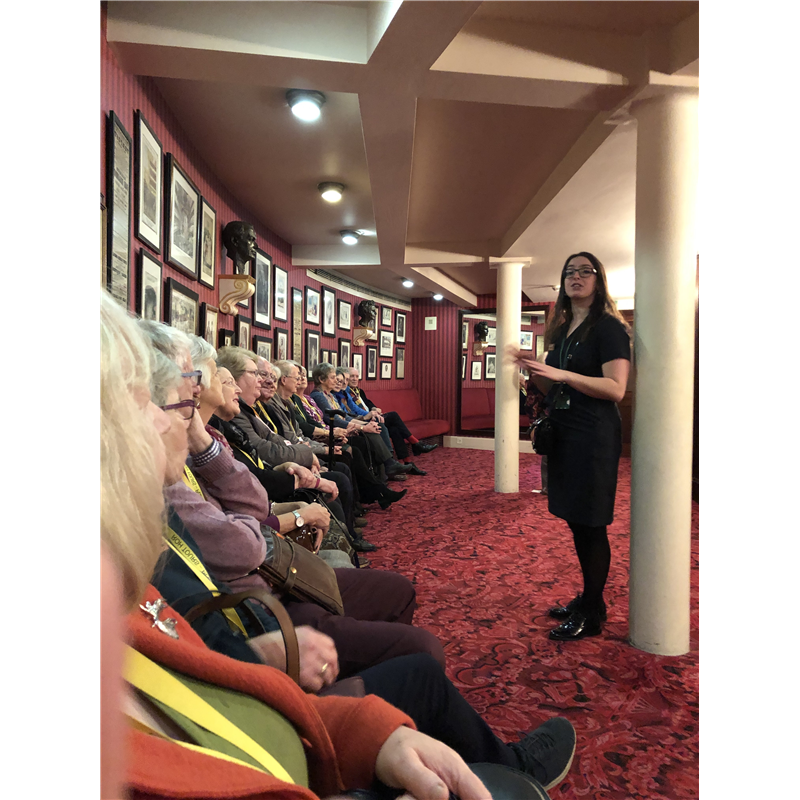 |
Christmas Backstage at the Opera 'Sarah gave an outstanding lecture about Christmas at the Royal Opera House. She was entertaining and informative; her lecture was a ‘tour de force’ including ballet and opera video footage and interviews with many members of the company, all of which provided us with a vivid insight into the busy but ‘special’ Christmas season in Covent Garden. A very enjoyable evening, thank you.’ Sarah Lenton has spent her working life in and around the theatre, working at the Royal Opera House, the English National Opera and Glynbourne; she continues to work in this exotic world writing and directing opera, presenting live broadcasts and podcasts for the BBC. It is a world she knows and which she shared with us. For all the company at the Royal Opera House and for us, its audience, Christmas is special! But how do they cope? From the start it was obvious that it is working together as a company which is vital. There will be 24 performances of Tchaikovsky’s The Nutcracker, in which 13 different dancers will play the Prince, and there will be 15 Sugar Plum fairies! The area backstage is huge, a working area in which the scenery is stored, moved into position and off stage, stuff ‘flies’ and all the singers, dancers and crew create the magic of the performance. The set for The Nutcracker is 30 years old, it is fragile and is treated with great care. The centre of the set is the Christmas Tree which moves up and down on its own lift – all part of the illusion! The stage manager has to bring all the pieces and people together, seamlessly. She has a traffic light system to bring in the traps, the lights, scene changes, flies and people. The dancers are usually ready in plenty of time, they are ready to perform. This is not always true of the singers they often wait in their dressing rooms and often need cues to get them into position! Sarah also took us behind the scenes to the rehearsal room to see the history and the development of the performance. We saw a video of dancers working on a performance of The Sleeping Beauty, working with performers who had previously danced the roles – Monica Mason (Princess Aurora) and Darcie Bussell (Lilac Fairy). The physical gestures and movements in a classical ballet often go back in time, in the case of The Sleeping Beauty to 1888, building on the performances of the past greats in the roles. Opera too has a developmental phase where, as a new performance comes together, techniques are passed on and acting skills enhanced as roles are interpreted. But to concentrate only on the dancers and singers would be to under value this company. It is world class due to the coming together of all its people, working together with a shared purpose. Sarah finished with a video showing a set change from a morning rehearsal of an opera, ready for an evening performance of a ballet – an everyday occurrence. We were in awe! Encore! And for some of us the lecture was an introduction which was followed by The Arts Society Wokingham’s visit to The Royal Opera House. Our next lecture, Rembrandt and Vermeer: Titans of the Golden Age of Dutch Art by Lucrezia Walker will be held on Monday January 27th Newbold Church, St Marks Road, Binfield, RG42 4AN, commencing at 7.45pm. Do come and join us. Visitor Fee: £8. To find out more about The Arts Society check out our website, www.theartssocietywokingham.org.uk. In the meantime - Seasons Greetings to All. |
|
| Monday, 18 November 2019 |
| Review of Welsh Architectural Eccentricities Study Day 15th November 2019 |
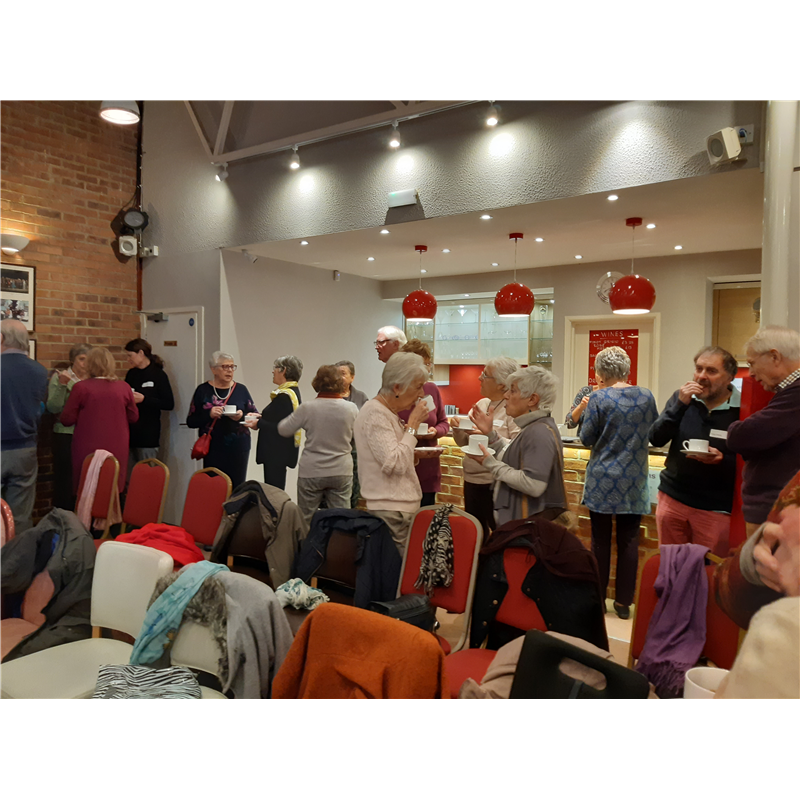 |
Travelling through some wonderfully eccentric Welsh architecture Matthew Williams took members of The Arts Society Wokingham on a journey through three of the most wonderfully eccentric buildings in Wales – Cardiff Castle, Castell Coch and Portmeirion. Matthew has a unique perspective having formerly been Keeper of Collections and then Curator at Cardiff Castle, having worked with Cadw (Wales) at Castell Coch and having grown up visiting Portmeirion where his uncle ran the hotel and village for Clough Williams-Ellis. The three eccentric, fantastic and also whimsical buildings owe everything to the imagination of three men – the third Marquess of Bute and his architect William Burges were responsible for the reinvigorating of both Cardiff Castle and Castell Coch; the architect, landscape designer and conservationist Sir Clough Williams-Ellis was the driving force behind the creation of the Italianate fantasy village of Portmeirion. Cardiff Castle started life as a Roman Fort; it was given to the Bute family as part of a wedding dowry in the 18th century, with 20 acres of Glamorgan rich with black coal. It was not the family home but a summer retreat. The third Marquess inherited the castle at six months old and it became his passion, with his architect William Burges, he created a great Victorian Gothic masterpiece with money no object. He was interested in modernity and Cardiff Castle was the first house in Wales to be lit be electricity and have central heating. The castle is now in the care of Cardiff council where we can all see the spectacular Gothic building and its fabulous rooms, full of amazing, and sometime fun, detail. Not content with working on one Castle, the Marquess of Bute and William Burges also brought the medieval Castell Coch back to life. Only five miles from Cardiff, it was rarely used by the family but Burges convinced the Marquess to create a fairy-tale castle from the ruin. It is one of the most visited castles in Wales, in the care of Cadw (Wales). When Clough Williams-Ellis was about to get married in 1915 his brother officers on the Western Front asked him what he would like as a wedding present. He had no hesitation; he said he wanted ‘a ruin’. This was the germ of an idea which became Portmeirion, which became an exclusive hotel, a secret haven, in the Second World War. Williams-Ellis extended the village with more and more fantastical buildings, often using salvage, to create the fantasy which was enjoyed by HG Wells, GB Shaw, Kenneth Clarke and Noel Coward, and now by so many visitors from around the world. Those of us lucky enough to have spent the day with Matthew delighting in the imagery and the story were, by the end of the day, busily planning trips to North and South Wales, determined to see some of these eccentric buildings for ourselves. If you would like to know more about The Arts Society, Wokingham, contact us via our website: www.TheArtsSocietyWokingham.org.uk or come along to our next lecture, Christmas Backstage at the Opera with Sarah Lenton on November 25th at The Church, St Marks Road, Binfield, RG42 4AN, commencing at 7.45 pm. Visitor Fee: £8. |
|
| Thursday, 31 October 2019 |
| Review of 'Last Supper in Pompeii' 28th October 2019 |
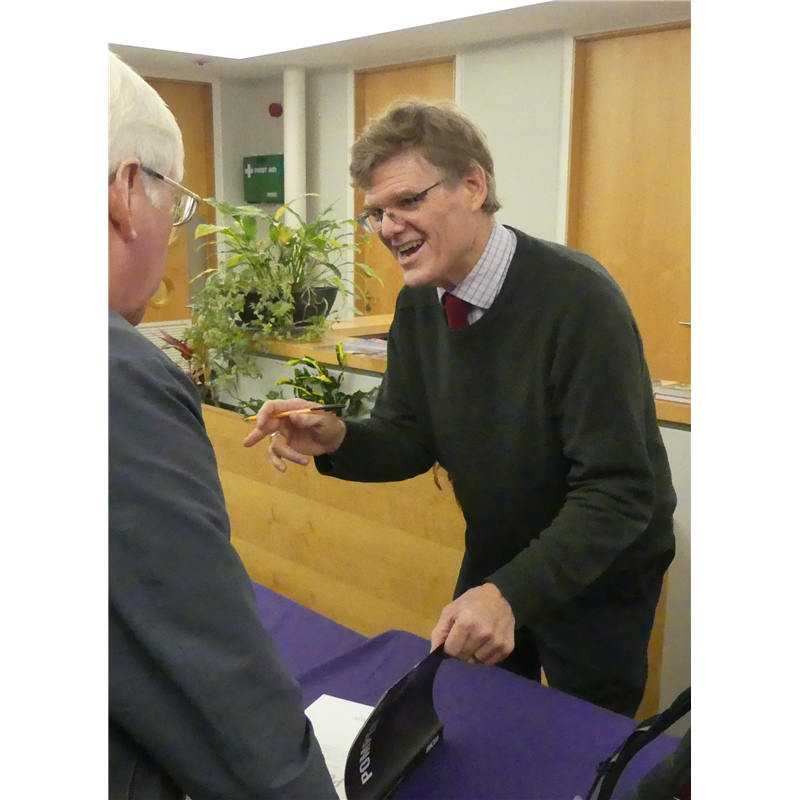 |
Last Supper in Pompeii Dr Paul Roberts whisked the audience straight back to Pompeii in AD 79 at this month’s lecture for the Arts Society, Wokingham. AD 79 was when Vesuvius erupted, a tragedy for the Romans but a gift for us. The rain of fine stones after the eruption covered and preserved everything – pottery, frescoes, mosaics and food – giving us a picture of how these people lived and what mattered to them. Paul is fascinated by ordinary people and he showed us how their lives depended totally on the gods whose images were everywhere, and the importance of food and drink. This was a picture of the ‘Last Supper’ for the Romans who did not know what was about to happen to their world. Pompeii was a busy, noisy, smelly city. Goods would be transported there by boat or carried by slaves. Bars lined the streets where ‘fast food’ was served, a vast amount of wine was produced in vineyards nearby and banqueting was how richer folk showed off their importance. Romans were wine snobs and the biggest accolade was being talked about for the opulence of their homes and their entertaining. Dining was more than nutrition. Guests would recline on couches beside tables laid with silver, able to admire exquisite, detailed mosaics, paintings and prized pieces of art. The quantity of food was huge with starters of eggs, cheese, lighter meats such as poultry and dormice (specially fattened, edible ones, bigger than the field dormice we know) and vegetables, similar to those we eat today. The main courses would consist of pigs, sheep and goats. They even ate something resembling haggis, a special fish sauce being used in almost all cooking. Puddings were mainly fruit and carbonised figs, pomegranates and walnuts have been found. The Romans were unaware of the finer side of hygiene, and food preparation took place in a kitchen which also housed the latrine. Why not? Food waste could be disposed of alongside human waste. Convenient – and as the master or mistress of the house would never go near the kitchen, they saw nothing of this. The Romans lived closer to death then we do and saw no reason why the pleasures of life should not continue. Their love affair with food continued after death. They depicted the after-life as a feast. Funeral stones often showed reclining guests enjoying a banquet and tombs contained utensils and pots for eating and drinking. Pottery food – grapes, figs, ricotta cheese, almonds – have been found at Pompeii. Paul finished his lecture by bringing us back to Britannia. Within a decade of the arrival of the Romans, we had adopted their ways, their foods, their beer industry and their gods. The Roman south of Italy had spread as far as Hadrian’s Wall. Paul Roberts is the Sackler Keeper of Antiquities at the Ashmolean Museum of Art and Archaeology, Oxford University, where he has curated an exhibition, Last Supper in Pompeii, on which this lecture was based. It is on until 12 January, 2020. After experiencing the enthusiasm and knowledge of Paul, I think many of us will be paying it a visit! Our next lecture, Christmas Backstage at the Opera, will be held on November 25th at The Newbold Church, St Marks Road, Binfield, RG42 4AN, commencing at 7.45pm. Do come and join us. Visitor Fee: £8. To find out more about the Arts Society, check out our website, www.theartssocietywokingham.org.uk. |
|
| Sunday, 06 October 2019 |
| Review of visit to Watts Gallery on 1st October 2019 |
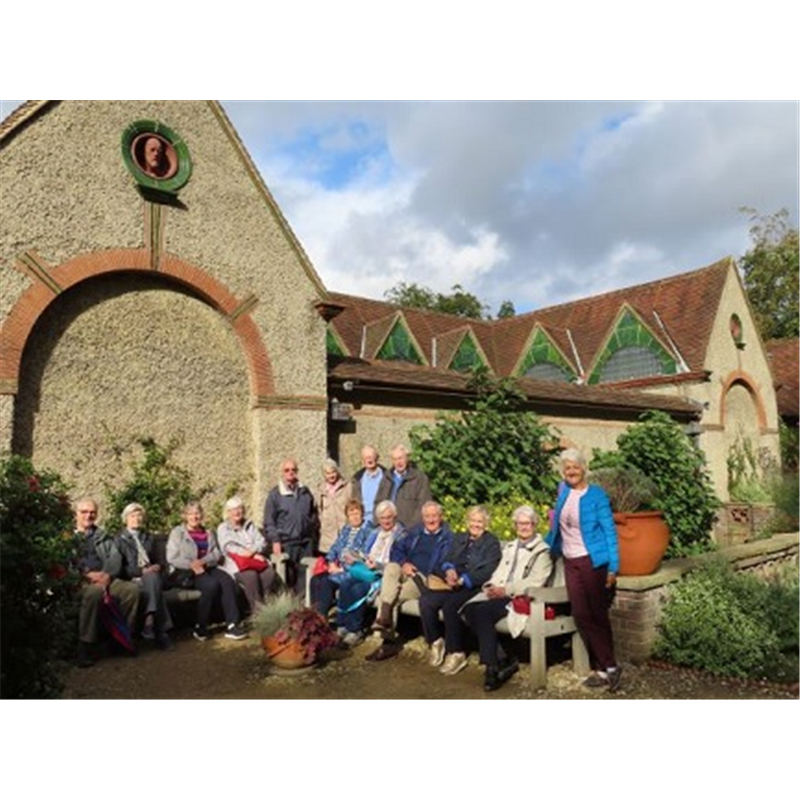 |
Watts Gallery Visit On a rather wet October morning, we set off by coach to the Watts Gallery and Artists’ Village for our autumn visit. There was a short introduction over coffee and biscuits and we were pleased to see the rain had stopped as we walked up the road to Limnerslease House, the Arts & Crafts home of George and Mary Watts. Our guide Hellen gave us a real insight into their life here, of their work, their friends and their devotion to each other. We saw George’s studio, complete with an ingenious device for lowering his huge canvases through the floor so he could reach to paint the top and also a gallery of Mary’s work which showed how the gesso panels were made for the ceilings in the house and the decoration in the chapel. After lunch Hellen showed us round the Watts Gallery, another Arts & Crafts inspired building, which was opened to the public in 1904 and cleverly designed to allow the works of G F Watts to be displayed under natural light. The collection ranged from early paintings highlighting social concerns, to the high society portraits which made his fortune and then on to a selection of his major symbolic works and sculpture. Despite the fame he achieved, his work later went out of favour but we still found our tour engaging. It became obvious that although George was the renowned artist of the day, Mary’s contribution to their time at Compton was just as important as she combined her philanthropy and decorative skills to set up community evening classes in terracotta pottery. These led to the creation of the Watts Chapel, designed by Mary and made with the local people of Compton. The exterior is decorated with terracotta reliefs with a fusion of art nouveau, Celtic and Romanesque motifs, as well as pelicans, peacocks and owls and lots of Celtic knots! The interior is a complete contrast with rich green, red and gold decorations in gesso of angels and the trinity linked with the tree of life. Mary detailed the symbolism of the design in a book and our guide Susan shared some of the details with us which were fascinating. As we walked back to the coach, several people mentioned how much they had enjoyed the day, how good the guides were and how much there was to see and we thanked the staff for making our visit so enjoyable. |
|
| Friday, 27 September 2019 |
| In Memory of Chris Gulliver, our Vice Chairman |
 |
Chris Gulliver - Vice Chair, The Arts Society Wokingham At the recent AGM of The Arts Society Wokingham, Chairman Robin Cops paid tribute to Chris Gulliver, its Vice Chair for the last three years. Chris had died suddenly and unexpectedly a couple of weeks prior to the meeting which of course was a huge shock to his family and all who knew him. Chris grew up in Essex and qualified as a chartered accountant setting up and running management consultancies built on a broad industrial background that included senior financial, general management and chief executive positions in a wide range of business sectors. As a very experienced non-executive director, he authored articles in business journals and presented seminars relating to business management and growth. He was a past Regional Chairman of the Institute of Directors and had been a course tutor for the IoD Director Development programme, coaching and mentoring chief executives and their top teams, individually or in peer groups. He brought all those skills to the many voluntary organisations with which he was involved as well as Round Table and 41 Club. Robin explained that he had first met Chris on the Corporation of Bracknell & Wokingham College where they were Chair and Vice Chair. So it was an easy transition when they found themselves working together again at The Arts Society Wokingham. As a young branch of the national arts appreciation organisation, he helped underpin it with leadership and guidance on organisation and operation. His key interest there was to get off the ground Young Arts, which channels funding from the Society to young people to encourage their involvement in and appreciation of the arts. He was a true team player, advising and encouraging the Society committee members with a light humour and a gentle style – a delight to have on the committee. He will be very much missed. The Society sends its sympathy and love to his wife Leigh and their family. |
|
| Friday, 27 September 2019 |
| Review of 'Les Parisiennes' lecture on 23rd September 2019 |
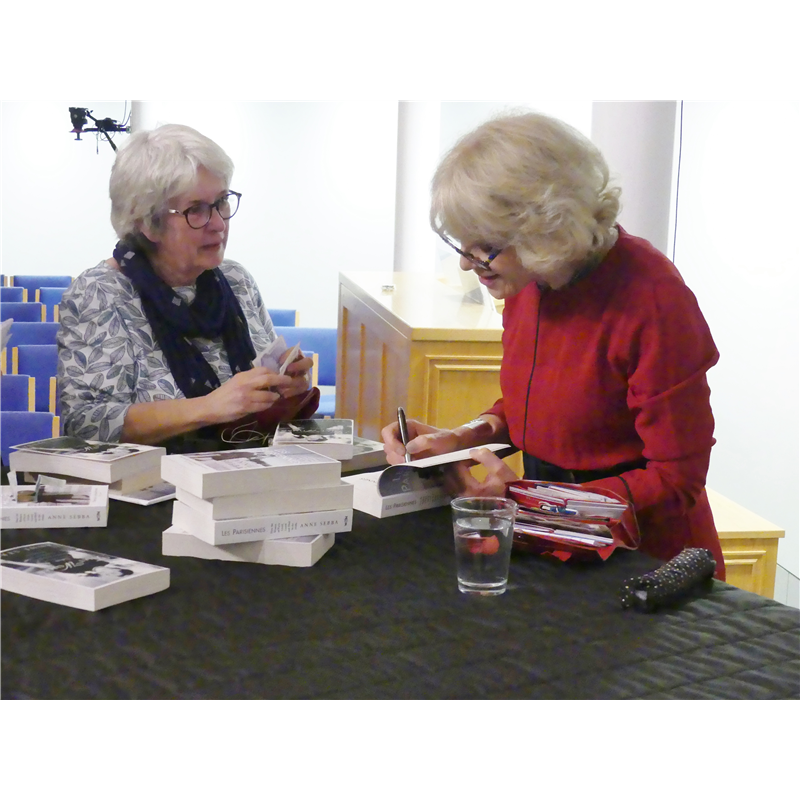 |
Les Parisiennes Journalist and former Reuters correspondent Anne Sebba began her lecture by inviting her audience to study the image used to illustrate her recent publication which also coveres the events leading to the fall of Paris, its occupation by the Nazis, and the postwar years. On it we can see the back of a Nazi, who we presume is young, standing confidently in the Paris landscape accompanied by a stylish young woman who looks nervous and tense. Does this give us an insight into the relationships in Paris after then Nazi invasion? Seba’s extensive research of the cultural history of Paris from 1939 to 1949 has created an unashamed account of the women’s version of those years – the war and how it affected women, how they coped with the occupation, particularly ‘ordinary women’. In setting the scene she provided some intriguing cultural context to France before the war – women could not get a job without the permission of their father or husband, they could not have their own bank account, they could not vote and, in a law on the statue books since Napoleonic times, they could not wear trousers in the street! On the eve of war there were many marriages, and many divorces, choices about leaving or staying to look after family. The French army had approximately 2 million med sent to Prisonor of war camps as a result of the fall of the Maginot line. The French government had to ‘pay’ the occupiers to be in Paris and yet send much of its agricultural produce east. Therefore in Paris there were few men, little food, and no cars. During her research Anne read memoirs, diaries, books and letters, watch films, but most importantly interviewed women who had lived through the events, or their children. This enabled her to get closer to the physical dangers, difficulties of everyday life, such as getting food, but also the emotional difficulties of having to make difficult choices as they lived day by day with their occupiers, and with fear. There were stories of women who resisted, suffered, and died, as well as those who collaborated and flourished. Many female resisters were arrested and ended their lives in concentration camps. One such was Genevieve de Gaulle, niece of Charles de Gaulle. She refused to accept any form of collaboration, was arrested and sent to Ravensbruck concentration camp, from where she was lucky to return alive. For many who made the ‘less-than-honorable’ compromises they were publicly shamed and attacked in post-war Paris. Though this did not apply to all! Coco Chanel suffered no ill effects from her collaboration. The lecture included some gossipy bits, in some ways an ‘amuse bouches’ of lots of little intriguing morsels; but also lots of impressive research and a range of alternative ‘war histories’ which provide an overview of the often forgotten different reactions of women to this impossible situation. It has provided lots of promising little avenues to follow up. Our next lecture, Last Supper in Pompeii by Paul Roberts, the curator of the exhibition of the same name at the Asmolean in Oxford will be held on Monday October 28th The Church, St Marks Road, Binfield, RG42 4AN, commencing at 7.45pm. Do come and join us. Visitor Fee: £8. To find out more about The Arts Society check out our website, www.theartssocietywokingham.org.uk. |
|
|
| Friday, 02 August 2019 |
| Review of 'Art of Grayson Perry' lecture on 25th July 2019 |
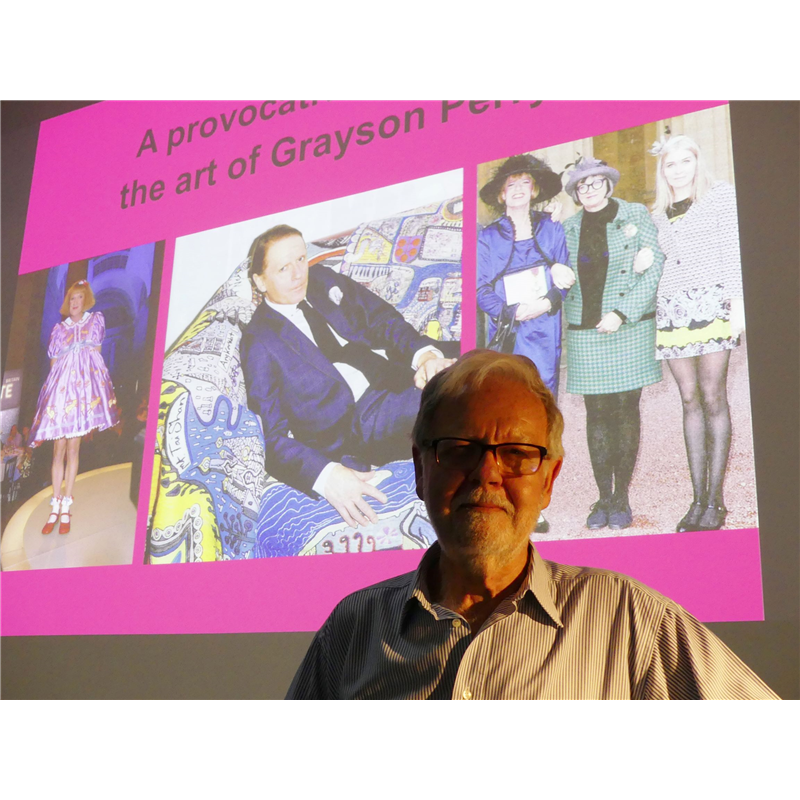 |
Provocative Beauty and the artist Sixty visitors joined the Arts Society, Wokingham members at their recent ‘Free’ lecture – A Provocative Beauty: Art of Grayson Perry. This initiative which began two years ago aims to invite friends of members and anyone in the community with an interest in art appreciation to join us for our July lecture, the last of our year. We hope this will enable visitors to learn more about the activities we pursue through the year, including what we do in the wider community. The number of ‘friends’ attending has been growing steadily and we hope some of our visitors may join us when we begin our new year in September. Our excellent lecture, by Frank Woodgate, was an introduction to the Turner Prize winning artist Grayson Perry and his works. Perry was born in Chelmsford in 1960, studied at Braintree College of Further Education before going on to Portsmouth Polytechnic from where he graduated in 1982. He went on to evening classes in pottery, which would become an important medium for his art. He has often described himself as a ‘performance artist who is also a craftsman’. He was the first ceramicist to win the Turner Prize in 2003. The prize is awarded for a body of work rather than individual, or necessarily recent, pieces of work. Perry’s ceramic pot The Names of Flowers, 1994, which reflects upon the ‘places of dispute’ in his lifetime – Syria, Palestine and others was purchased by the Stedelijk museum in Amsterdam. The museum asked for more works and offered an exhibition – Grayson Perry – Guerrilla Tactics, 2002 was the result. The Stedelijk showed a selection of about 45 pots that exhibited a cross-section of Perry’s oeuvre and themes; in addition there were drawings photographs, embroidery and quilts. The exhibition was shown at the Barbican Art Gallery later that year. This exhibition was instrumental in showing the range of work to a larger audience and his subsequent selection for the Turner Prize short list. In awarding the prize to Grayson Perry, the judging panel admired his use of the traditions of ceramics and drawing in his uncompromising engagement with person and social concerns. We were treated to many examples of Perry’s ceramic vases, tapestries and other art forms as Frank helped us to decode the messages contained therein. In particular we explored his observations of the contemporary art scene and his insight in dissecting the prejudices, fashions and foibles in our modern culture – encouraging the viewer to develop their social conscience. The strong autobiographical narrative in his work, which often features his alter ego, Claire, and his long-term friend Alan Measles became very evident in both serious and humorous works. As an artist he continues to evolve and explore new themes and new media, and is an important observer in our changing times. This exploration of his work has given many of us a desire to seek out and look again at his work, to reflect and to ponder on the themes therein as well as to admire his artistry.
For anyone who wants to see more of Grayson Perry’s work and is lucky enough to be in Edinburgh, until November, they can visit the exhibition, including the tapestries created for A House in Essex at The Dovecote Studios – Julie Cope’s Grand Tour – the Story of a Life by Grayson Perry.
https://www.artfund.org/whats-on/exhibitions/2019/07/25/julie-copes-grand-tour-the-story-of-a-life-by-grayson-perry-exhibition Our next lecture, Les Parisiennes by Anna Sebba, will be held on September 23rd (NOTE: Change to Monday) at The Church, St Marks Road, Binfield, RG42 4AN, commencing at 7.45pm. Do come and join us. Visitor Fee: £8. To find out more about The Arts Society check out our website, www.theartssocietywokingham.org.uk. |
|
| Wednesday, 24 July 2019 |
| Church Recording of St James’ Finchampstead |
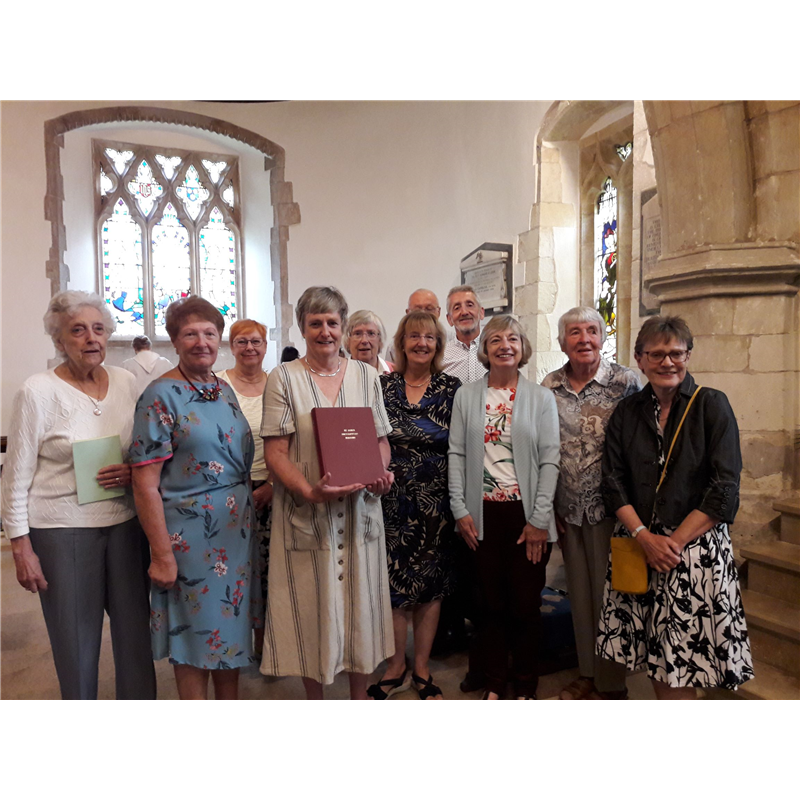 |
Church Recording of St James’ Finchampstead The bound copy of the first Church Recording undertaken by The Arts Society, Wokingham was presented to the Rector, Julie Ramsbottom, and congregation of St James’ Finchampstead on Sunday 21st July at their Patronal service. Church Recording is one of the community strands undertaken by The Arts Society. It began back in the 1970’s when the V&A became aware of the vulnerability of the contents of many churches to damage and loss and sought the assistance of NADFAS, as was, to produce detailed inventories of that heritage before it was too late. To date almost 2,000 churches have been examined, researched and recorded by The Arts Society throughout the country. These records are not only of great use to antiquarians, genealogists and historians but are greatly valued by church communities. A group of 20 volunteers from The Arts Society, Wokingham began their journey at St James in 2016. These volunteers have done an amazing job, methodically and meticulously researching and recording all aspects of the church, with small groups focusing on particular aspects such as woodwork, memorials and windows. The team was lead by Branwen Mellors, with Robin Simmons acting as an expert compiler and Philip Hayman as photographer. They were assisted throughout by the congregation at St James, with particular help and advice being provided by Olive Butchart, Church Archivist, Ed Sampson, Church Warden and Nicola Maddocks. As well as presenting a bound copy to St James, electronic copies will be sent to the V&A National Arts Library, Church Care, Historic England and the local Berkshire record office. There will be two copies on display at The Arts Society lecture on Thursday 25th at their monthly lecture. Note received from Olive Butchart, after Sunday’s presentation at St James: I was very delighted to accept your generous gift at the St James Festival Service yesterday it was a very proud moment for me. Having spent a lot of time with you I realise only too well how much time and effort you all have put into this project over the past 3years. Therefore it gives me great pleasure in thanking you once again. Olive If you would like to know more about The Arts Society, Wokingham, or attend one of our lectures contact us via our website: www.TheArtsSocietyWokingham.org.uk. |
|
| Friday, 05 July 2019 |
| Review of Mexican Study Day July 2019 |
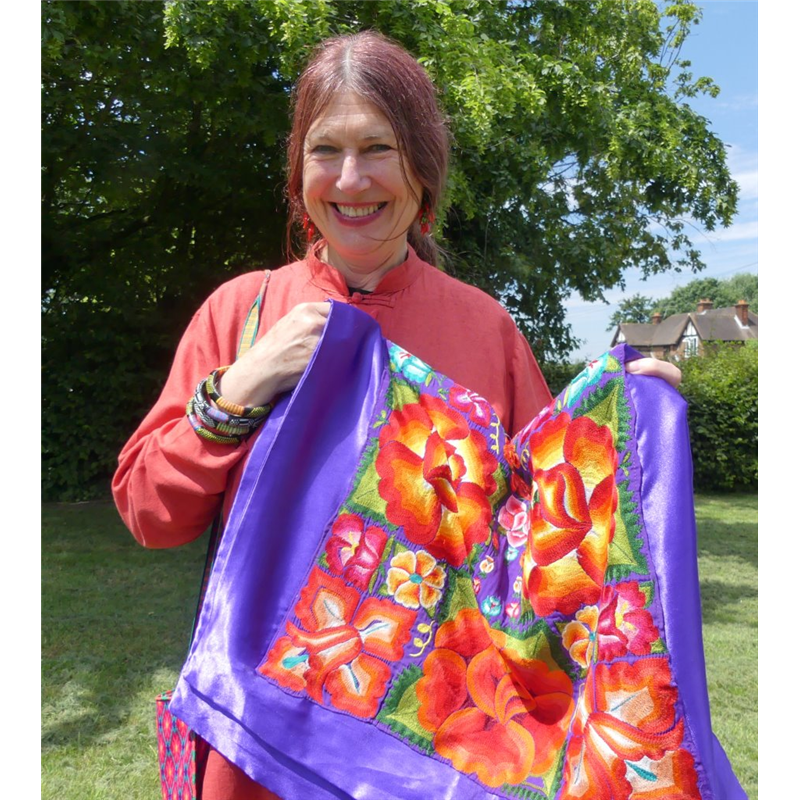 |
Mexican Art and Culture – Past and Present Over lunch at The Arts’ Society Wokingham study day in the Wokingham Theatre, the buzz was all around how enthralling and inspiring the lectures about Mexican arts and culture were. More than one couple were thinking of visiting the local travel agents afterwards to see if they could arrange a trip across Mexico to see some of the sights and cultural items shown in the slides. Chloë Sayer, our guide for the day, is a curator, writer and historian and has spent many years working in Mexico on various projects – a world class expert. The journey she took us on, from the pre-conquest civilisations through to today’s Mexican cultural background, was fascinating. Chloë started with the Olmec, Maya and Aztec empires peopled by muralists, sculptors in stone, ceramic artists, jewellers, weavers and feather & gold workers, visiting some of the wonderful city states on the way like Palenque and Uxmal. Then an excellent talk on the art and relationships of the great muralist Diego Rivera and Freda Kahlo, his wife. Rivera produced some of the greatest public art of the last century. “He never turned down an offer of a wall”. By contrast, Kahlo’s small-scale and highly personal paintings reflected her experiences, dreams, hopes and fears. Kahlo having been viewed historically only in regard to Rivera, is now considered a major artist in her own right. Finally Chloë, showing examples of textiles and clothes from her personal collection, explored the arts and crafts of contemporary Mexico, setting the whole thing within its strong cultural and religious background. A superb day being immersed in Mexico’s culture and history. The next study day for members of The Arts Society Wokingham is on the 15th November also at The Wokingham Theatre when the subject will be Welsh Architectural Eccentricities. But if you can’t wait, then don’t forget our next lecture, A Provocative Beauty; The Art of Grayson Perry by Frank Woodgate, which will be held on July 25th at The Newbold Church, St Marks Road, Binfield, RG42 4AN, commencing at 7.45pm. Visitors free for this lecture by pre-registering at MemsecTheArtSocietyWham@gmail.com Do come and join us. ROBIN COPS |
|
| Monday, 01 July 2019 |
| Review of 'The History of Wallpaper' lecture on 27th June 2019 |
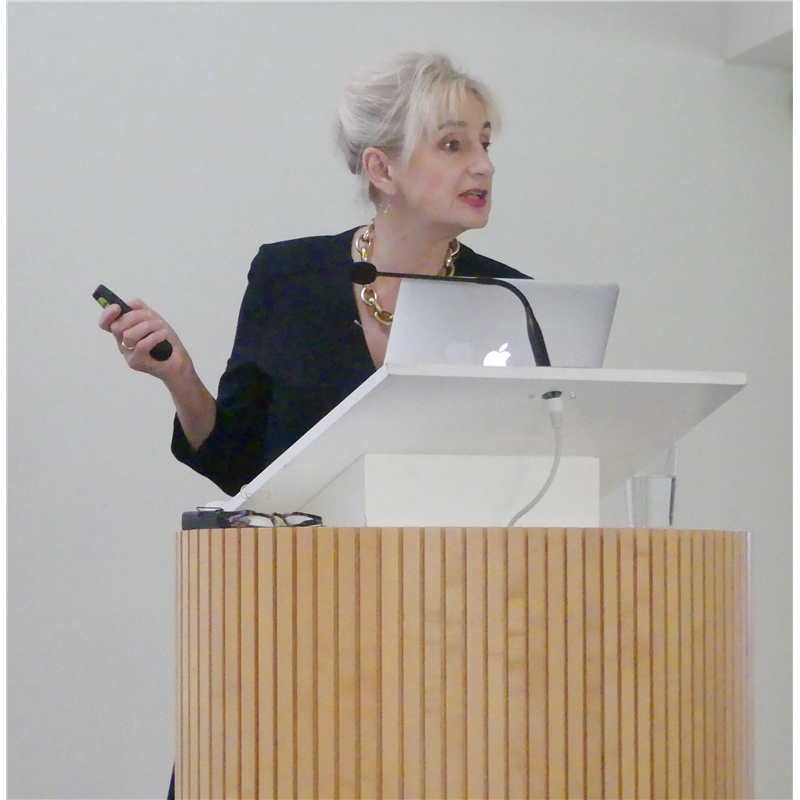 |
Cinderella of the Decorative Arts "This wallpaper is terrible - one of us will have to go!" – were these the final words of Oscar Wilde? No one knows for sure, but it was a high point for ‘wallpaper’, in the literary cannon. At The Arts Society (Wokingham) lecture on Thursday last Jo Banham took us through the history of this Cinderella of the arts; ephemeral it may be, but art definitely. We roamed from the early ‘papers’ in the 16th century, through changes in production, taste, retail and a range of beautiful patterns to the sophistication in modern designs in 21st century homes. Wallpaper actually began in ancient China, because the Chinese invented paper, and they probably glued rice paper onto their walls before anyone else. The earliest known fragment of European wallpaper that still exists was found in Christ’s College, Cambridge, and dates from 1509 and is attributed to Hugo Goes, a printer in York. Many of these early ‘papers’ were small pieces and black on white, due to paper size and production restrictions. They seem to have been inspired by textiles, and examples have been found in cupboards, chests etc in small country houses in spa towns such as Epsom. Country Houses and fashion conscious Londoners lead the way in wallpaper fashion, with pattern books being in demand. An example of exotic flocked wallpaper was found, in Worcester, from the end of the 17th century but the 18th century is when many more designs and fashions emerge. These London fashionistas hung Chinese Papers, which were hand painted not printed, are found from the early part of the century. They display either scenes from Chinese life or birds and flowers. There were many floral designs and architectural designs which resembled marble and stucco often referred to as ‘pillar and arch’ paper; boarders became a popular addition. There was also a fashion for ‘print rooms’ created by wallpaper, Doddington Hall is an example. This period saw significant changes in manufacturing methods, enabling a move away from the expensive hand painted papers. The use of stencils and ‘overprinting’ had improved the colour and meant that the wallpapers were more lively, but the colours often ‘bled’. The roll of wallpaper was introduced, inspired by the textile industry, initially made up of 20 ‘pieces’ of paper at a combined size of 12 yards by 21 inches wide – a size which continues to this day. This allowed printing on the roll with the use of printing ‘blocks’ which improved the density of the colour and the ‘match’ of colours. The 19th century sees the invention of printing machines, again inspired by the textile industry, which allows four colour printing directly onto the paper using a cylinder system. This improves quality, speeds up production and makes the product cheaper for the expanding number of consumers. There was a proliferation of patterns. Artists such as Pugin become involved in the design of wallpaper and the William Morris company produced over 50 designs. Children’s artists including Walter Crane and Kate Greenway design nursery wallpapers which have the added benefit of being arsenic free! Wallpaper pasting machines first appeared around the turn of the 20th century and the number of ordinary homes using the paper as a wall covering increased. The interwar years saw the number of rolls of wallpaper sold by Arthur Sanderson & Sons from 50 million to 100 million. Designers and artist continued to design in this medium through the 20th century, right up to Vivienne Westwood today. Though there was a decline in the use of wallpaper, the digital printing industry has enabled smaller runs and therefore a continuation of this Cinderella of the decorative arts. Our next lecture, A Provocative Beauty: Art of Greyson Perry by Frank Woodgate, will be held on July 25th at The Church, St Marks Road, Binfield, RG42 4AN, commencing at 7.45pm. This is our annual free lecture so do come and join us. To reserve a place send an email to: MemsecTheArtsSocietyWham@gmail.com. |
|
| Monday, 01 July 2019 |
| Review of visit to Greenwich June 2019 |
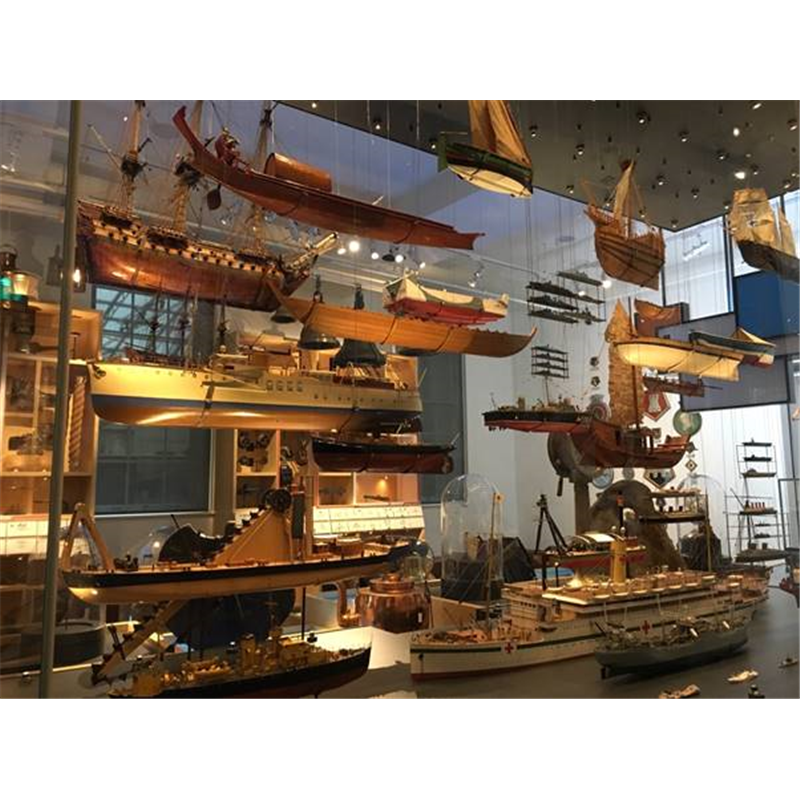 |
The National Maritime Museum, Greenwich The latest of The Arts Society, Wokingham’s visits for members was to the National Maritime Museum at Greenwich. Although the weather was not at its best we met in one of the new cafes for coffee and pastries, a delicious welcome prior to our guided tour of the four new galleries in the museum. The Museum invites the visitor to ‘Discover epic stories of exploration and endeavour that have shaped our world today’, not an idle boast we felt after our tour – and we only saw a fraction of the more than two million items held in Greenwich. The four new galleries have the sobriquet ‘Exploring the world, discovering ourselves’. These galleries examine how Britons explored the world in a quest for knowledge, riches and adventure from the late fifteenth century onward. The new exhibitions help the visitor to realise how the peoples and cultures which were encountered by explorers were changed by the contact, and also how Britain was, and continues to be, transformed in the process. The Tudor and Stuart Seafarers gallery tells the story of Britain’s emergence as a maritime nation, through key events, naval warfare with the Spanish Amada and the Dutch and a large variety of personalities – from Christopher Columbus and Francis Drake to ordinary seamen. There is an unrivalled collection of objects from the era, including astrolabes, compasses and telescopes. The Pacific Encounters gallery gives the visitor a strong sense of the vibrant and thriving communities found through the region both at the time of European exploration through to the modern era. So in addition to stories from the expeditions of Captain Cook to the region and European art by William Hodges and George Stubbs there are stories from Pacific islanders, such as Tupaia, whose knowledge of his surroundings greatly helped Cook and the success of his expeditions. There is a beautiful map used by the people of the Pacific to navigate across this vast ocean, yet it is made with local twine and shells; and the magnificent Adi Yehi, a Pacific double canoe, was memorising. The Polar Worlds gallery takes the visitor to the collaborative scientific investigation and cultural and wildlife encounters in the Arctic and the Antarctic. There is an exploration of the extremes of human endurance through explorers including Scott and Shackleton, with extracts from diaries and examples of expedition clothing, food supplies etc. The ongoing importance, both cultural and environmental, of these regions to the whole world is also a focus in the gallery. The final gallery, Sea Things, was an opportunity to view over 600 objects, with lots of opportunities to partake in hands-on activities. There were personal stories of maritime history and adventure, including a carved whale’s tooth, a pocket watch worn by a victim of the Titanic disaster, and an Ancient Egyptian votive ship model – one of the oldest artefacts in the Museum’s collection. At the end of our tour, Sir David Attenborough’s introduction seemed more apt – ‘You’re in for a treat. The new galleries are absolutely fabulous’. Some of us also took the opportunity to a walk to the Observatory, to stand on the historic Prime Meridian and to see one of the best views of the capital. Others visited the Queen’s House, built by Anne of Denmark, it currently has the iconic ‘Armada’ portrait of Elizabeth I in addition to its treasures. If you would like to know more about The Arts Society, Wokingham, contact us via our website: www.TheArtsSocietyWokingham.org.uk. Julia Stanton Publicity Officer |
|
| Saturday, 01 June 2019 |
| Review of 'Photography as Fine Art' lecture on 23rd May 2019 |
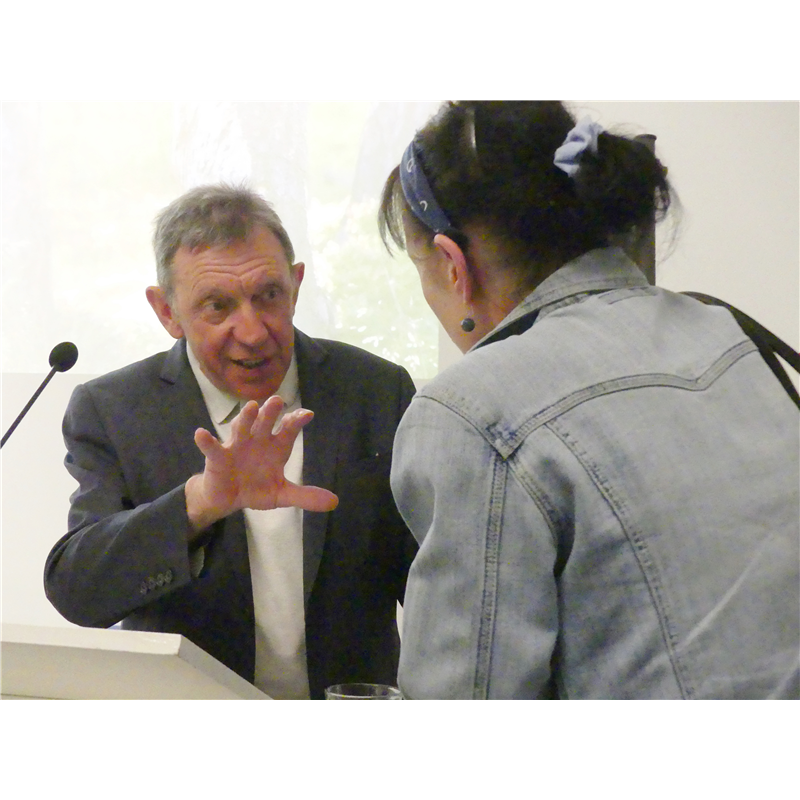 |
But is it Art…..? “Another outstanding lecture – I’ll look at photographs so differently from now on” said one of the large audience as they left Thursday’s lecture at The Arts Society Wokingham. Brian Stater (photo) set out to show in his talk “Photography as Fine Art” that the very best photographs can equal and indeed exceed other media. Using some of the best photos in the world, beautifully illustrated on the cinema quality projection at Newbold Church, he took up the challenge to show why a recent newspaper series on art was wrong not to have included a single photographic image and to counter the accusation that “successful painting is successful technique – photographers just press a button”. An obvious genre to start was Portraits and using examples from Arnold Newman to Robert Doisneau he illustrated how great photographs can show not just what someone looks like but who they are; succeeding sometimes where a conventional painted portrait can’t. In Landscapes the detailed and perfect work of Ansel Adams was compared to the simplified and relaxed views of Bill Brandt who would wait months to get the right image. “A good photo starts in the heart and mind of a photographer. Then he persuades the camera to show it” After Still Life, Brian moved on to The Human Condition including the English photographer Martin Parr whose works, rich in understanding and passion, were perfectly illustrated by a an image of a man in his Sunday best, repairing a window, perched on a ladder. It begged the question, “what happens next….” At this point Brian took some time out to look at the superb black and white images from Henri Cartier-Bresson, the man who championed 35mm photography. Trained as a painter, fascinated by geometry, his genius was to use his skills to give an in-depth interpretation to his photos. And finally to Narrative photos. From the wartime image of St. Pauls in the blitz to a distressing Vietnam picture from Life photographer Larry Burrows, Brian had definitely made his argument that great pictures are also great art. A superb lecture. Our next lecture, A Decorative Art: The History of Wallpaper by Jo Banham, will be held on June 27th at The Newbold Church, St Marks Road, Binfield, RG42 4AN, commencing at 7.45pm. Do come and join us. Visitor Fee: £6 |
|
| Thursday, 23 May 2019 |
| Review of Hidden Reading walk May 2019 |
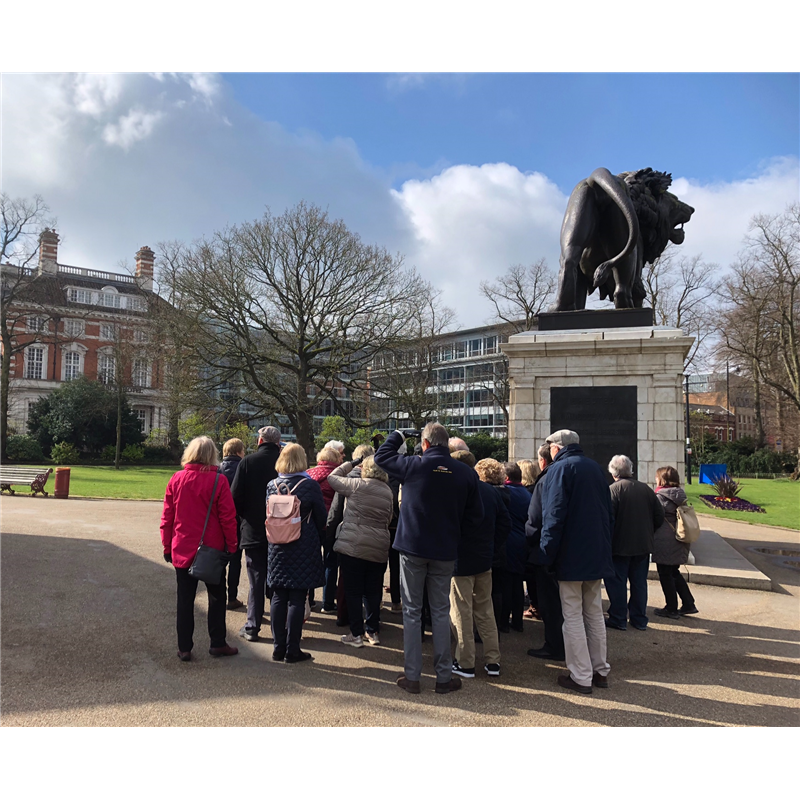 |
Walking through Reading, a Victorian masterpiece The Arts Society, Wokingham, organise three or four visits each year for its members – the most recent one was a walking tour of Reading, looking in particular at the Victorian architecture, which abounds in the town. Our guide, Richard Havelock, was excellent, he introduced us to new buildings and building details throughout the town, enriched our knowledge of old favourites and took us into two gems – the concert hall, in the town hall, and the chapel and ‘big school’ at Reading School. Reading, with its Abbey roots, was extensively developed and redesigned in the 19th century as the town became more affluent, thanks in part to the arrival of the railway. The buildings took on a ‘new town’ mantle which saw a strong influence of town planning. There was a determination to use local firms where possible, and there are many facades in Station Road, King Street, Broad Street, Duke Street and Market Place which showcase the work of local firms of architects, builders and artisans. The late Victorian Town Hall, designed by Alfred Waterhouse in has favourite 13th Century Gothic style is delightful, as are the later extensions to include the concert hall and the School of Art. Many of our group commented on the beauty of the concert hall and resolved to visit it more often! St James’s Church designed by Augustus Pugin with glass in the apse by William Warrington, a pioneer in the rediscovery and study of medieval techniques of stained-glass manufacture is a small Victorian marvel. The nearby Abbey Gateway (inner gatehouse) was restored by George Gilbert Scott, after a partial collapse and reminds us of the towns Abbey roots. There were statues of Queen Vitoria and Edward VII, George Palmer and Rufus Isaacs, Marquess of Reading by renown sculptors including Charles Sargeant Jagger,the latter in the extremely beautiful but often overlooked Eldon Square. There was also a monument to Edward Simeon by Sir John Soane, but the ‘Maiwand Lion’ in Forbury Gardens, by George Simonds, which took the prize. Cast in iron in nine sections and 31 feet long, it is maybe the largest in the world. Is it walking correctly, go and see? On our route to Reading School Richard improved our architectural knowledge and regaled us with stories, such as the Charles Dickens visits to the city and the attempt by Thomas Talfourd to get him to stand for the Reading Parliamentary seat. And how Dr Anthony Addington, a pioneer of progressive mental health, was called in to advise on treatment for George III and who donated the land on which the original part of the Royal Berkshire Hospital was built. But without a doubt Reading School was the biggest hit with the group, with its original buildings by Alfred Waterhouse, an adaptation of 13th Century Gothic using red brick and terracotta. We were privileged to visit the chapel, and the original ‘big school’ building where we were able to see first-hand the standard of craftsmanship and materials, and the beauty of the design, even if at the time it was falling from fashion and was derided by critics and Punch. The walk was a fun experience but also has given many of as a determination to know Reading better. Since the walk, Richard Havelock, our guide, has provided us with some of details of the architecture that we saw on his guided walk, but there are also some details of places you could not visit. Apart from providing dates and facts that you may have found it difficult to remember, it may encourage you to explore more of Reading in future! Click here to read Richard’s notes. |
|
| Tuesday, 30 April 2019 |
| Review of 'Florentine Disegno versus Venetian Colorito' lecture on 25th April 2019 |
 |
Let the art speak for itself! At The Arts Society (Wokingham) lecture on Thursday last we were taken back to the beginnings of ‘Art History’ and one of its first debates, over aesthetics – fuelled by Giorgio Vesari: Which is more important in art – the disegno (of Florence) or the colorito (of Venice)? This serious dispute has continued down the ages, even to the modern day – maybe we all have a bias for one or the other? Our excellent lecturer, Caroline Brooke, said she was torn between the two but that her soul leant towards Venice! Giorgio Vasari, (often called the first art historian) wrote ‘The Lives of the Artists’ in 1550, in it he described disegno as the ‘foundation’ of all the visual arts - the act of drawing was not only using line to define a subject, it was the underpinning for all the arts: painting, sculpture, architecture etc. However it must be remembered that Vasari was a Florentine artist and author employed by Cosimo 1 of Florence and thus praised the Florentine approach! For Florentine painters drawing or disegno was the starting point for their work. They looked back to the classical Greek art, and their patrons preferred a ‘classical’ style of art. They looked to real life, they sketched and drew what they saw, they observed scenes and details, taking drawing to a new level. Leonardo di Vinci raised the status of drawing and took it into new areas, such as anatomy. They drew cartoons of compositions, and parts of compositions and sometimes used their drawings to trace or transmit the ‘design’ onto the canvas or fresco – there is evidence of this on Michelangelo’s Sistine Chapel ceiling. Meanwhile Venetian painters employed colorito, the direct application of colour (paint) on to the canvas or panel. According to Lodovico Dolce ‘Venetian artists often worked out compositions directly on the canvas, layering patches of colour and gradually softening their colouring until it equated to nature’. What influenced Venetian painters, such as the great Titian to work differently? Their art traditions were Byzantine, not Roman. Venice was an independent trading city with strong links to the Byzantine Empire, never conquered by Rome. There was a strong ‘narrative’ tradition in its art, not being driven by the ‘classical’ tradition in Florence. There was little heritage of fresco painting, due to the damp, so they worked on canvas; they also had access to the vibrant pigments coming from the east and used oil paint rather than tempura, which can be applied directly and adjusted and changed as they worked. The patrons and artists in the city had long collected Netherlandish art of the 14th & 15 centuries. We left with a greater understanding of this debate which has raged from the Renaissance to present day, but at the end of the day Caroline encouraged us to ‘Let the art speak for itself’. So diaries out, when can we fit in a trip to Florence & Venice? As one of our members remarked - Simply a brilliant lecturer, completely a master of her subject. Indeed she left you wanting far more. And also desperately wising to revisit Florence & Venice, preferably with her as guide! Our next lecture, Photography as Fine Art by Brian Stater, will be held on May 23rd at The Church, St Marks Road, Binfield, RG42 4AN, commencing at 7.45pm. Do come and join us. Visitor Fee: £6. |
|
| Thursday, 04 April 2019 |
| Review of 'Captain Cook – Art and Exploration Extraordinaire' lecture on 28th March 2019 |
 |
Captain Cook – Art and Exploration Extraordinaire by James Taylor 'Wonderful whizz-bang overview of 18th century society and the finances & politics of such voyages - before we even got onto the men involved and specifically the artists. I emerged with head whirring - it has inspired me to research further, which must be a big accolade.' This response from one of The Arts Society Wokingham’s members to our Clifton Ingram sponsored lecture on Thursday night, by James Taylor. The lecture, Captain Cook and the Art of Exploration, had a great cast of characters all brought to life through their own word and their works. James Taylor was master of the changing cast, from voyage to voyage and of those involved in the extraordinary ‘official publication’ which followed each voyage. The two main characters were Cook and Joseph Banks, renown in their own age as their numerous portraits attest. Cook the sea farer from Yorkshire whose amazing draftsmanship, learned when mapping the St Lawrence River for the admiralty, marked him out for advancement. His maps, so detailed they compare favourably with satellite images today and were in use for hundreds of years; the three voyages mapped more land than virtually any other explorer and going further south than anyone prior to the 20th century. Banks, a wealthy networker who was, literally, potty about botany. He funded the first voyage, contributing £10,000, organised and scientific work and found the artists. He was instrumental in organising the art into two main strands – natural history and botanic and landscape and artefacts, each headed by an artist. This organisation was a success and was used by later voyages of exploration, including that of Darwin’s Beagle. We were treated to examples of the art of Sydney Parkinson and Alexander Buchan from the first voyage, and some of the engravings which were created from the source material for the account of the voyage. We also viewed some wonderful work from the Forster’s, father and son, and William Hodges from the second voyage, and from John Webber on the third voyage. It was fascinating to see how the works referenced other European work of the time; to see the distinct influences in style and even technique from artists such as Claude and even some distinctly European flora in an antipodean setting! Amazingly the art we enjoy today from these great voyages was primarily intended as promotion – promotion of the voyages and promotion of those involved! But it was a fundamental brick in the development of the art of natural history, and map making, due to these extraordinary voyages. Our next lecture, Florentine Disegno Versus Venetian Colorito: Fact and Fiction in Early Art Theory by Caroline Brooke, will be held on April 25th at The Church, St Marks Road, Binfield, RG42 4AN, commencing at 7.45pm. Do come and join us. Visitor Fee: £6. |
|
| Friday, 22 March 2019 |
| Review of 'The Image of the Annunciation' Study Day 13th March 2019 |
 |
The Image of the Annunciation by Cathy Oakes - 13th March 2019 Many of you will recognise the Image of the Annunciation from visits to churches and art galleries but to explore this topic in detail was such a treat, enjoyed by all at our recent study day.
Cathy Oakes guided us expertly from the 5th to 15th century and from one end of Europe to the other, with images in every possible media such as sculpture and reliefs in ivory, alabaster, stone, wood and metal and stunning paintings from altarpieces and manuscripts.
Her delivery engaged us from the start as she explained about the iconography of the subject and it was interesting to see how changing historical, social and theological context affected the composition and style of the images.
On leaving, one member mentioned how varied Gabriel’s wings were - we had seen everything from gold and shiny to soft and feathery with lots of colours and shapes. A study day is a great opportunity to take the time to notice the details and thanks to Cathy, we know so much more about the Annunciation. Our study days are normally held at Wokingham Theatre. They start at 10am with a welcoming cup of tea or coffee. There are then two hour-long lectures (with a tea/coffee break in-between) followed by a delicious sandwich lunch in the theatre foyer. During the lunch break there is time to socialise with fellow society members and then at 2pm we return to the theatre for our final lecture. The day finishes at 3pm. Our next Study Day is on Friday 5th July and is entitled ‘Mexican Art and Culture - Past and Present’. Chloë Sayer will be our lecturer for the day. Booking will open for members before the lecture on 23rd May. |
|
| Thursday, 07 March 2019 |
| Review of 'Passion and Rivalry – Mantegna and Bellini' lecture on 28th February 2019 |
 |
Passion and Rivalry – Mantegna and Bellini, Renaissance Titans At The Arts Society Wokingham’s lecture at Newbold on Thursday last Paula Nuttall skilfully introduced us to these two most celebrated of painters from Renaissance Italy and some of their greatest works; brothers-in-law with a passion for their craft, were they also rivals? For those who visited the recent National Gallery exhibition it was a reintroduction, for those who had not it was a revelation to compare the works of these two titans for the first time. Coming from different backgrounds, Mantegna a self-made made from Padua, and Bellini the progeny of a successful artistic Venetian family, we saw evidence of a close artistic relationship, a mutual exchange of ideas and themes. From his early works Mantegna gives the viewer a virtuosity of perspective with foreshortening and recessed architecture, sculptural detail heralds a life-long commitment to classical antiquity and brilliant compositional innovation, with increasingly sophisticated special effects. He is in the vanguard of the changes taking place in Italian art. Bellini seems to look to Mantegna in his early years, but without some of the ‘outline’ present in Mantegna’s work he starts to exhibit a ‘lightness’ in his own work which is atmospheric and almost ‘visionary’ exemplified by his Resurrection of Christ. One of the great differences between the men was in the chosen media – Mantegna stayed with egg tempura throughout his career while Bellini moved on to oil paints predominantly. To view some of the ground-breaking pieces from Mantegna’s Triumph of Caesar, with its glorious detail and precision and Bellini’s masterful Madonna del Prato dazzling in its colour and light was a treat, there was no room for comparison. There were many examples of the glorious light and colour evoked in Bellini’s work and of the precision and crispness to be found in Mantegna’s, but how to choose? At the end of the day it must be a personal choice, but what works of art to use as visual tools. Our next lecture, Captain Cook and the Art of Exploration by James Taylor, will be held on March 28th at Newbold College, St Marks Road, Binfield, RG42 4AN, commencing at 7.45pm. Do come and join us. Visitor Fee: £6. |
|
| Thursday, 31 January 2019 |
| Review of 'Still Searching for the Queen of Sheba' lecture on January 24th 2019 |
 |
Still Searching for the Queen of Sheba January 24th 2019 Those members and visitors who attended The Arts Society Wokingham’s lecture at Newbold on Thursday last were treated to a fascinating insight into the history, art and modern archaeology which lie behind the quest for the Queen of Sheba. First mentioned in the Book of Kings, but part of other great religious works including the Muslim Qur'an and the Hebrew Bible, this queen whatever her name (Queen Bilquis being one) has beguiled and puzzled in equal measure. Louise Schofield archaeologist and former British Museum curator has spent many years in the quest to ‘tie up the legend and myth’ of Sheba with evidence. She explored how the Queen of Sheba has captured the imagination through the ages. Her epic journey to the court of King Solomon has been captured in the work of great artists and contemporary films. We were introduced to the possible land of the Sabaeans, in the Yemen and northern Ethiopia – their language, their temples and rock-hewn churches, the ruins of which are being explored to this day. Intriguing stories followed, how the Ark of the Covenant, thought to have been brought back by The Queen’s son, Menelik I has been locked up with a priest. The discovery of a 20ft stone stele (slab) carved with a sun and crescent moon presaged other exciting finds, including a gold mine which might once have provided gold for the Queen of Sheba. The quest for answers goes on, and Louise continues to work with the local people to uncover more of the story. If you missed this interesting lecture, do come and join us for our next lecture – Mantegna and Bellini by Paula Nuttall on February 28th at Newbold College, St Marks Lane, Binfield, RG42 4AN, commencing at 7.45pm. All welcome. Visitor Fee: £6. |
|
| Thursday, 31 January 2019 |
| Lectures to take place on Monday evenings from Sept. 2019 |
 |
Important Change for 2019 As you will be aware, our lectures for January, February and March will transfer back to our old venue at Newbold College in Salisbury Hall. We will then return to the Church for the remaining lectures until the end of the summer. The reason for this is, that during the winter months the Church at Newbold houses and feeds the homeless on a Thursday night. After much discussion your committee has decided that from this September onward our lecture night will move to Monday evening to avoid this problem in the future. This is in line with our policy from September 2017 to make the Church at Newbold our long term venue for lectures.
We do recognise that, for a few of you, this might present some difficulty because of a clash of activities for which we apologise. However we have deliberately chosen Monday as this tends to be the quietest night of the week for other clubs and societies. For the same reason we are hoping that potential members who couldn’t make Thursdays will now be able to take advantage of this new night for our lectures.
I do hope that you will be able to make that change in September and I can still welcome you to our excellent programme of lectures which we are already booking. Do drop me an E-Mail if you want to discuss any points about this decision.
Many thanks
Robin Cops - Chair email: chairtheartssocietywham@gmail.com
|
|
| Saturday, 13 October 2018 |
| Winning entry of the Service the Others category - Love Wokingham Photographic Competition |
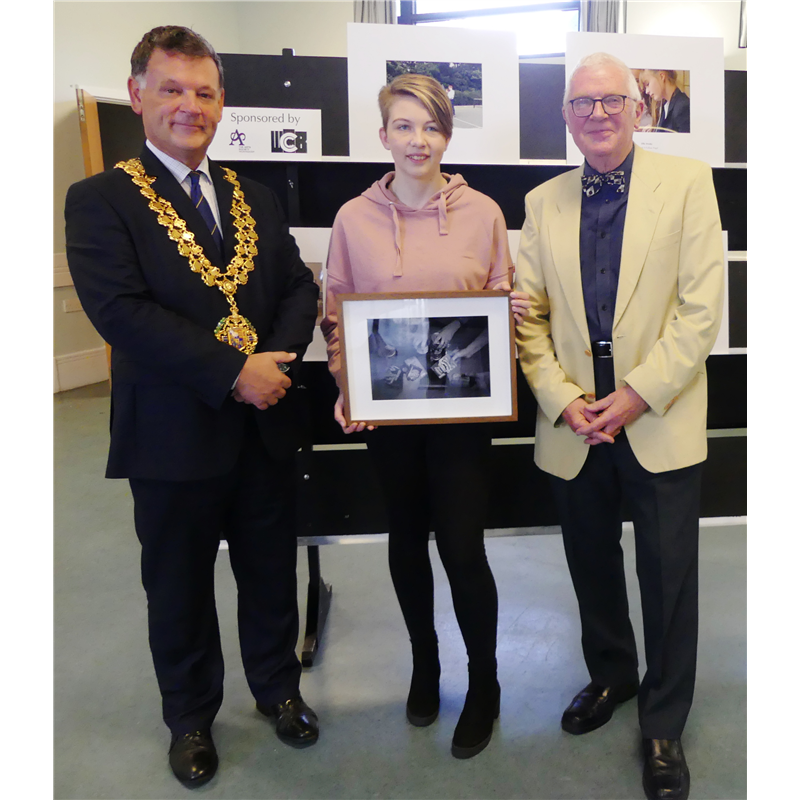 |
As part of its Young Arts programme, The Arts Society Wokingham has funded a prize for the winner of an additional category in the ‘Love Wokingham Photographic Competition’ - the under 18s prize for the best photograph depicting 'Service to Others in Wokingham' On Saturday, Robin Cops, Chair of the society, presented the trophy and a cheque for £100 to Emily Payler, whose winning entry(opposiite) depicts the 'Helping Hands' of volunteers filling a box with groceries at the Wokingham Food Bank. Emily is currently a pupil at St Crispin’s school studying photography among other GCSE subjects. She is looking forward to a career in Media Studies. |
|
|
| Thursday, 31 May 2018 |
| May 2018 Bulletin - Newbold Church |
 |
Newbold Church is confirmed as our new venue Many thanks to all those members who attended the May lecture in Newbold Church and gave us such prompt and positive feedback on the proposed new venue.
Based on your comments on the much improved quality of the images projected on to one large central screen, the spacious and airy building, café area and the comfortable chairs, we have booked the Church for the June and July lectures.
Next season, we are able to hold the September, October and November lectures in the Church but have to move back to Salisbury Hall for January, February and March 2019 as the Church is not available.
We will be back in the Church in April, May, June and July 2019. The church is on the same campus as Salisbury Hall and has the same parking - click here to see the map. Results of the Member Survey Many thanks also to all those of you (more than 100) who took the time to complete last month's survey. The general opinion of members is that the Society is well-organised and is doing a very good job in providing members with activities and events that are interesting and enjoyable. Typical comments from members include. “Always something of interest”, “The Society is excellent in every respect”.
It is good to know that the efforts of your Committee to provide a high quality programme are appreciated. “Brilliant organisation”, “Thank you to the team”.
Aspects that need attention:- The poor quality screens at Salisbury Hall - as you will have read above, we are moving most of our lectures to Newbold Church.
Lack of socialising - the move to the Church will provide more space for circulating at lectures, including a café area with tables and chairs
Other Potential Activities to be considered:-
Theatre trips - more than half said that they would be interested.
A specific annual social event for members. Getting Involved
The range of activities offered by our Society to its members depends significantly on the active involvement of volunteers. Most volunteers stay involved for a limited period, which, although this can be up to four years, means that a regular flow of new volunteers is needed.
The Survey indicated that there are as many as 38 members who might be interested in supporting Church Recording, and Young Arts including joining the Committee. This is very encouraging. However, the Survey did not reveal identities.
Getting involved is a great way to get to know other members of the Society, so if you are interested, please see the contact details below:- To read the full report click here |
|
| Monday, 30 April 2018 |
| April 2018 Bulletin |
 |
Results of the Member Survey Many thanks to all 105 members who took the time to complete our member survey. The committee are reviewing all your answers and comments and we will be letting you know shortly what changes and improvements we are planning as a result. Church Recording - calling all volunteers 16 members said that they would like to be involved in a future project - if you were one of them please could you email Branwen churchrectheartssocietywham@gmail.com Young Arts- calling all volunteers Similarly 16 members said that they would be interested in getting involved in this activity - if you were one of them please could you email Jo jom1001@yahoo.co.uk Young Arts Annual Photography Competition under 18s category 'Service to Others in Wokingham' As part of this year's Young Arts programme we are funding an under 18s prize and trophy in the 'Love Wokingham' Annual Photography Competition for the best photograph depicting 'Service to Others in Wokingham'. The closing date is 8th June. For details email Chris Gulliver chris@chrisgulliver.plus.com Local Events 'America’s Cool Modernism - Keeffe to Hopper' Ashmolean, Oxford 23rd March – 22nd July Those of you who enjoyed the February lecture on Edward Hopper may be interested in the current exhibition at the Ashmolean in Oxford, entitled ‘America’s Cool Modernism - Keeffe to Hopper’. It is on until 22 July. For more details go to https://www.ashmolean.org/exhibitions 'Patron Saints - Collecting Stanley Spencer' Stanley Spencer Gallery, Cookham Just opened - until 4th November Some of you may have read about the new Stanley Spencer Exhibition which has just opened in Cookham. It covers 21 works lent by their (local) owners when Spencer was reliant on local sponsors. For more details go to http://www.stanleyspencer.org.uk/ |
|
| Thursday, 20 October 2016 |
| Clifton Ingram Partnership Press Release October 2016 |
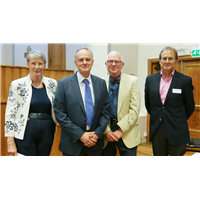 |
Wokingham DFAS AGM Sept 2016 Judy Tomlin, Jonathan Davis (Chairman Clifton Ingram Solicitors), Robin Cops, Tim Burton Clifton Ingram LLP Press Release October 2016 Clifton Ingram Solicitors Help Support the Finer Things Clifton Ingram Solicitors are proud to be appointed the first ever corporate partner of the Wokingham Decorative and Fine Art Society. Wokingham DFAS is an affiliate member of the National Association of Decorative and Fine Arts Societies (NADFAS), a leading UK Arts charity that works to advance decorative and fine arts education and appreciation. The Wokingham Branch currently has around 300 members. The Clifton Ingram sponsorship will help support some of the many events that the WDFAS holds, as well as its volunteer work in the community. Tim Read, managing partner at Clifton Ingram said “We are delighted to be associated with Wokingham DFAS and help support them in both their practical arts conservation work and artistic education.” For an annual subscription, Wokingham DFAS members attend lectures from visiting art experts. They have the opportunity to attend study days and participate in visits to art collections and guided walks. New members are always welcome. For more information about Wokingham DFAS please visit www.wokinghamdfas.org.uk For further information contact: Melissa Baxter, Clifton Ingram LLP, 22/24 Broad Street, Wokingham t. 0118 9780099 melissabaxter@cliftoningram.co.uk |
|
| Tuesday, 02 June 2015 |
| Venue Change for 2015-2016 Lecture Programme.
|
 |
|
31 May 2015
Dear Member,
As you are probably aware, Bearwood College was taken over by Reddam House at the beginning of the school year in September 2014
Our Treasurer, Tim Burton, and I had a meeting in October with one of the Directors of Reddam House. We were assured that the aims and objectives of NADFAS fell within the overarching umbrella of the new ethos for the School and that our contract with the school was secure.
Earlier this year in January, with your committee’s approval, I signed the new Contract with Reddam House for 2015/16 in order that we could go ahead and book the lecture programme for the forthcoming year.
However, at the end of April, Tim and I were called to another meeting with the new Head, Dr. Stephen Spurr. We were notified that he wished to utilize the theatre complex for the sole use of the school and that there would be no possibility of hiring the theatre for our lectures with effect from the end of July, i.e. in two months’ time. Unfortunately, there was a clause in the contract, which allowed the school to back out at any time – we always knew that could happen but thought we might be given a year’s grace, at the very least, so that we might honour our bookings already made with lecturers. We were told this was not possible.
Needless to say, we were extremely upset as the lecture programme for next year has been arranged and all the lecturers booked.
Now, as you are probably aware, Wokingham and the surrounding area, is very short of venues sufficiently large to host a membership of 350 individuals. Schools always need to use their halls at exam time and, understandably, are unwilling to remove the exam layout of tables and chairs for a lecture and neither the local hotel conference facilities nor the local theatre are able to cater for our membership numbers.
We considered every option and you will be pleased to hear that, after frantic searching, we finally found a venue. A choice of one.
From September 24th, our AGM, we will have our lectures at Salisbury Hall, Newbold College, Binfield.
We are delighted with the new venue:-
it has the same quality of projection as Bearwood
the seats are rather more comfortable
the seating is on one level but as the projection screens are raised there will be no problem with viewing the presentations from all parts of the auditorium
we will have some refreshments available
the venue has a much more welcoming feel than the dark foyer at Bearwood
there is plenty of parking within the College grounds
and the added bonus is that the distance between the centre of Wokingham and Newbold College is shorter by about a mile to that between Wokingham and Bearwood.
So, although we have had no option but to make this change and with a choice of one venue, it turns out that it might be a blessing in disguise. Also, there is no short notice cancellation clause in the contract with Newbold!
Further details and a map will be forwarded to you by email in August and also the information will be on the website.
We do hope you will all stay with us when we transfer to the Binfield venue in September but meanwhile, we look forward to seeing you at the next lecture which has “Faber and Faber” as it’s subject with Tony Faber delivering the lecture.
Best wishes,
Judy
Judy Tomlin
Chair
|
|
| Tuesday, 05 May 2015 |
| Michael Shirley elected to NADFAS Trustee Board |
 |
| Many congratulations to Michael Shirley on his election to the Trustee Board of NADFAS.
In his role as New Societies Advisor for South and West Mercia NADFAS Areas
Michael was hugely helpful and supportive in the setting-up of Wokingham DFAS.
We are delighted that he will be able to continue as a committee member of Wokingham DFAS and continue to share with us his skills and experience. |
|
| Tuesday, 29 July 2014 |
| Introductory Lecture |
 |
| The Wokingham DFAS Introductory Lecture, "British Art 1850-1950" delivered by Linda Smith at Bearwood College Theatre was a most successful event.
The talk was attended by more than 200 people who enjoyed an entertaining, witty, and insightful lecture and a fine visual presentation on British Painting and Art from the Pre-Raphaelites to Paolozzi.
Membership numbers are increasing quickly but there is still time to join this new Decorative and Fine Arts Society before our next lecture, "Treasures of the Royal Collection," on Sept. 25th
Information about how to join the society and details of the forthcoming lecture series can be found elsewhere on this website. |
|